Paraguay Banking Crisis Topples Santiago Peña, Sparks Political Turmoil

November 11, 2026

Prosecutors allege that Peña continued to intervene in decisions concerning the placement, renewal and maintenance of public and pension funds at Ueno Bank while serving as president.
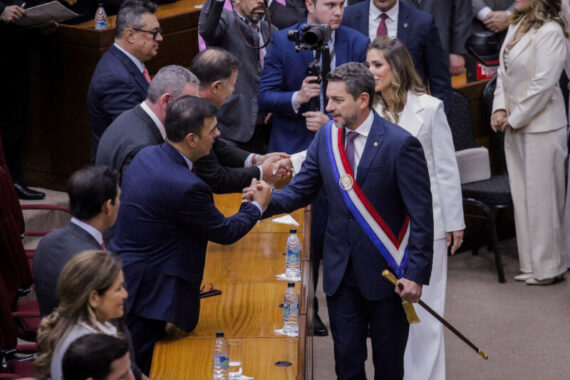
Following the acceptance of the impeachment of former President Santiago Peña by the Paraguay National Congress, Pedro Alliana was sworn in as Paraguay's new president in a ceremony held in Asunción. Photo by Anadolu Images.

A

banking collapse that left millions of customers unable to access their money has brought down Paraguayan President Santiago Peña, triggering one of the country’s most serious political crises in years and raising questions about the government’s links to the failed lender.

Peña, a conservative economist and close ally of US President Donald Trump, was removed from office after the collapse of Ueno Bank, a major digital lender whose financial difficulties exposed alleged conflicts of interest involving the former president and senior financial officials.

The Central Bank of Paraguay intervened in Ueno Bank after determining that its solvency ratio had fallen below the legally required minimum. The decision froze the accounts of nearly 2.9 million customers in a country with a population of approximately 6.1 million.

The crisis quickly escalated from a banking emergency into a political confrontation. After days of protests and growing public pressure, Peña announced that he would resign, saying his departure could help restore stability and reassure the population.

However, lawmakers rejected the resignation route and instead moved to impeach him. The lower house voted unanimously to remove him, followed by a Senate decision that formally ended his presidency. Vice President Pedro Alliana was subsequently sworn in as his successor.

Peña is now facing criminal charges related to his alleged financial connections to the bank and decisions involving public funds. He denies wrongdoing and has been placed in pretrial detention while prosecutors investigate the case.

Alleged conflicts of interest at the center of the crisis

The investigation focuses on Peña’s previous business relationship with Grupo Vázquez, the main shareholder of Ueno Bank. The former president held shares in the business group before selling his stake in 2025.

Prosecutors allege that Peña continued to intervene in decisions concerning the placement, renewal and maintenance of public and pension funds at Ueno Bank while serving as president, despite his alleged economic and corporate connections to the institution’s controlling group.

He has been charged with breach of trust and administration for personal gain. Prosecutor Nancy Salomón said the charges could carry prison sentences of up to 10 years each. Under the relevant provisions of Paraguay’s penal code, a second conviction would carry a reduced sentence, potentially exposing Peña to a combined prison term of up to 15 years.

Investigators have also alleged that Ueno Bank granted Peña two simultaneous loans totaling $580,000 in May 2024 to finance the construction of a luxury summer residence in San Bernardino, approximately 50 kilometers from the capital, Asunción.

Authorities searched the property on November 10, recovering computers, electronic devices and documents that could be relevant to the investigation. Prosecutors also identified a sophisticated security vault at the residence.

The inquiry has extended beyond Peña. Former central bank chief Carlos Carvallo has also been charged in connection with the case, while investigators are examining the role of bank executives and the management of public funds deposited at the lender.

The collapse has raised concerns about the exposure of pension and government resources to the bank. Public schoolteachers went on strike on November 9, demanding protection for approximately $60 million in pension funds held at Ueno Bank. The crisis has also affected government accounts and prompted concerns among workers and retirees about the security of their savings.

Trump ally’s removal raises questions about Paraguay’s political future

Peña’s removal has also attracted attention in Washington because of his close relationship with the Trump administration.

A member of Paraguay’s conservative Colorado Party, Peña had aligned himself with several of Trump’s priorities, particularly on immigration and regional security. Earlier in 2026, he attended a White House summit in Miami alongside other Latin American leaders who maintain close relations with the US president.

His government also developed cooperation with Washington on defense and regional coordination, including a safe third-country agreement allowing asylum seekers from the United States to be transferred to Paraguay.

Following Peña’s announcement that he would resign, a US State Department spokesperson said Washington remained committed to its relationship with Paraguay and intended to continue cooperation on shared priorities.

The Trump administration has also indicated that Peña’s removal would not damage bilateral relations. US Secretary of State Marco Rubio said the political developments would not undermine ties between the two countries.

Alliana, who will serve the remainder of the presidential term, has promised to restore public confidence and address the financial consequences of the collapse. A former congressman, speaker of the Chamber of Deputies and governor of Ñeembucú, he has called for greater discipline in government spending and pledged zero tolerance for corruption.

He has also begun reshuffling senior officials. Among the changes, economist Jorge Schreiner was appointed to lead the central bank, replacing Carvallo. Schreiner has acknowledged that the crisis has seriously damaged Paraguay’s financial credibility but said the country’s reputation could be restored.

The government has begun compensating affected depositors through the country’s Deposit Guarantee Fund. Alliana said on November 10 that approximately 1.74 million depositors had received payments totaling $330 million, representing nearly 95 percent of those eligible for compensation under the scheme. The government said the remaining payments were expected to follow shortly.

However, the repayments do not resolve every financial concern. Questions remain over public and pension funds deposited at Ueno Bank and whether customers with balances exceeding the guaranteed limits will recover their full savings.

The political response has also failed to satisfy everyone. Although many Paraguayans welcomed Peña’s removal, some protesters have objected to Alliana’s succession because he was part of the same administration. Demonstrators in parts of Asunción have called for the departure of the entire political leadership.

The crisis has therefore become more than the collapse of a financial institution. It has exposed concerns about the management of public money, the relationship between political power and private banking, and the effectiveness of financial oversight in Paraguay.

For Alliana’s government, restoring access to deposits and recovering public funds will be immediate priorities. But rebuilding confidence in the country’s banking system and political institutions may prove a longer challenge.

(Source: CNN)

Politics Today is dedicated to publishing insightful analyses in order to understand the changing nature of contemporary politics. It aims to contribute to the sound and constructive discussion of international affairs.