Spain Abandons F-35 Fighter Deal
The shelving of the F-35 deal leaves Spain’s Navy in a critical position.
August 6, 2025
S
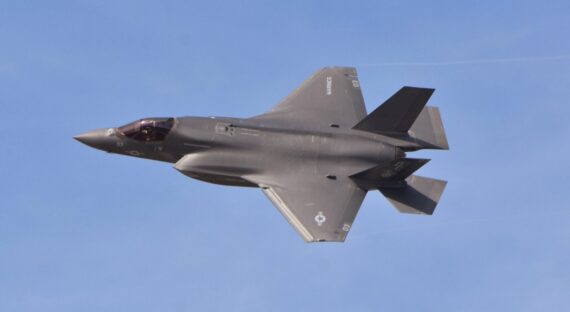
pain has officially shelved plans to purchase the U.S.-made F-35 Lightning II fighter jets, dealing a blow to transatlantic defense cooperation and signaling a clear pivot toward European strategic autonomy. According to government sources cited by El País, all preliminary contacts regarding the acquisition of Lockheed Martin’s fifth-generation stealth fighters have been indefinitely suspended.
Despite having earmarked €10.47 billion for defense modernization earlier this year and reaffirming its commitment to reaching 2% of GDP in defense spending, Madrid’s decision to invest 85% of those funds in European defense initiatives has made acquiring the American F-35 “incompatible with national priorities,” the report said.
The shelving of the F-35 deal leaves Spain’s Navy in a critical position. The AV-8B Harrier jump jets—its only fixed-wing combat aircraft—are due for retirement by 2030 after nearly five decades in service. Extending their operational life is not viable, as both the U.S. Marine Corps and Italy’s Navy are phasing out the model, eliminating supply chain support and spare parts access. The F-35B, the only available short takeoff and vertical landing (STOVL) aircraft capable of replacing the Harrier, had been the preferred solution.
Without the F-35B, Spain’s flagship vessel, the Juan Carlos I, will only be able to operate helicopters, stripping the Navy of its fixed-wing aviation capability for the foreseeable future.
In an effort to maintain future naval aviation capabilities, the Spanish Navy has commissioned Navantia, the state-owned shipbuilder, to study the feasibility of a new aircraft carrier with a longer flight deck capable of launching and recovering conventional carrier-based aircraft. While this could allow for alternative fighter options such as the French Rafale M, any such vessel would not be operational in time to cover the Harrier’s retirement, creating a capability gap of several years.
The Spanish Air and Space Force had also been evaluating the F-35A variant as a temporary solution until the Future Combat Air System (FCAS)—a joint sixth-generation fighter project with France and Germany—is expected to enter service by 2040. With the oldest U.S.-made F-18s being replaced by Eurofighters, the Air Force had ruled out expanding its Eurofighter fleet further, fearing overreliance on a single platform.
Lieutenant General Francisco Braco, head of the Air Force, has stated that Spain would seek alternatives to the F-35, including future versions of the French Rafale, but acknowledged that such aircraft fall short in key areas such as stealth and sensor fusion. As Admiral General Teodoro López Calderón, Chief of the Defense Staff, warned in July: “We will have to survive with the fourth generation we have and wait for the FCAS someday. The problem is that we have to wait many years.”
Spain’s refusal to purchase U.S. military hardware has drawn sharp criticism from U.S. President Donald Trump, who clashed publicly with Spanish Prime Minister Pedro Sánchez during the June NATO summit in The Hague. Trump lambasted Sánchez for rejecting a proposed 5% of GDP defense spending goal, accusing him of freeloading on NATO and threatening punitive tariffs on Spanish exports.
“He’s the only one who refuses to pay. We’re going to make them pay double,” Trump said during the summit. The U.S. has since applied a 15% tariff on most EU products, partially mitigated by a new agreement with the European Commission for the bloc to buy $750 billion in American liquefied natural gas over three years.
Republican senators, led by John Kennedy, also introduced a resolution urging all NATO members to meet the 5% target, criticizing Spain’s deviation from allied consensus.
Recommended

Sánchez has argued that such dramatic spending increases would force EU countries to depend heavily on U.S. equipment, undermining Europe’s strategic autonomy. Ironically, however, more than a dozen European countries—including the UK, Germany, Italy, the Netherlands, and Denmark—have already adopted the F-35, making it the likely standard for NATO air forces into the next decade.
Despite its high unit cost (approximately €68.4 million for the F-35A and €87.5 million for the F-35B), the aircraft is seen as technologically unmatched, particularly in stealth, integrated sensor systems, and electronic warfare capabilities, as demonstrated in recent U.S. and Israeli airstrikes on Iranian nuclear sites.
While the current government has definitively shelved the F-35 acquisition, some defense officials suggest a future administration could revive the U.S. option—particularly if the FCAS timeline slips or if growing geopolitical tensions require a faster reinforcement of Spain’s aerial capabilities.
For now, however, Spain appears poised to wait, manage its capability gaps, and bet on European defense sovereignty—even at the cost of losing temporary access to fifth-generation airpower.
(Source: El Pais Newspaper).

Politics Today is dedicated to publishing insightful analyses in order to understand the changing nature of contemporary politics. It aims to contribute to the sound and constructive discussion of international affairs.
You can see how this popup was set up in our step-by-step guide: https://wppopupmaker.com/guides/auto-opening-announcement-popups/

Stay informed by subscribing to
our weekly newsletter.
You can see how this popup was set up in our step-by-step guide: https://wppopupmaker.com/guides/auto-opening-announcement-popups/
You can see how this popup was set up in our step-by-step guide: https://wppopupmaker.com/guides/auto-opening-announcement-popups/
You can see how this popup was set up in our step-by-step guide: https://wppopupmaker.com/guides/auto-opening-announcement-popups/
You can see how this popup was set up in our step-by-step guide: https://wppopupmaker.com/guides/auto-opening-announcement-popups/