L
ibya’s eastern-based parliament has unanimously approved a controversial maritime agreement with Türkiye, reversing its previous rejection of the deal and marking a significant breakthrough in Ankara’s efforts to strengthen relations with military commander Khalifa Haftar.
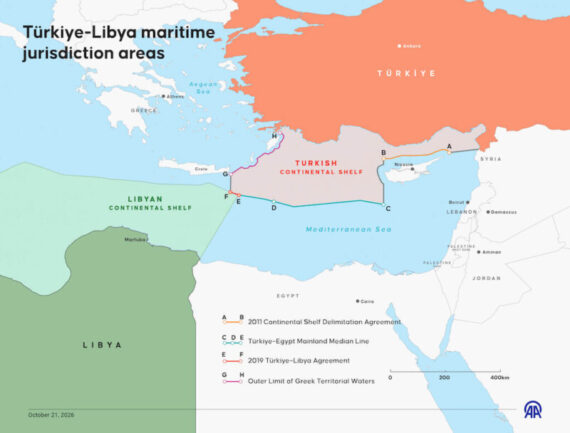
The House of Representatives, based in the eastern city of Tobruk and aligned with Haftar, voted Tuesday to ratify the 2019 maritime memorandum signed between Türkiye and Libya’s former UN-recognized Government of National Accord (GNA).
The agreement establishes maritime boundaries between the two countries in the Mediterranean Sea and has long been a source of tension between Türkiye and neighboring Greece and Cyprus.
The decision represents a dramatic reversal for the eastern parliament, which unanimously rejected the agreement in 2020 and severed political ties with Ankara over its military support for the rival Tripoli-based administration.
Lawmaker Aisha al-Tabalqi told Reuters that specialized parliamentary committees had presented a comprehensive explanation of the agreement’s provisions before lawmakers voted to approve it.
Another lawmaker, Tarek al-Jeroushi, defended the decision, acknowledging that it could provoke objections from other countries but insisting Libya’s national interests must take priority.
He said the agreement would strengthen Libya’s standing as a political, military and economic partner to major regional and international powers.
Türkiye and Haftar move from confrontation to cooperation
The parliamentary approval underscores a broader transformation in relations between Ankara and eastern Libya, following years in which the two sides supported opposing factions in the country’s civil war.
Türkiye intervened militarily in Libya in late 2019 after signing security and maritime agreements with the Tripoli-based GNA, then led by Prime Minister Fayez al-Sarraj.
At the time, Haftar’s self-styled Libyan National Army (LNA) had nearly surrounded Tripoli and appeared poised to defeat the internationally recognized administration.
Ankara’s deployment of military advisers and armed drones helped halt the LNA offensive, fundamentally changing the course of the conflict and establishing Türkiye as a major military and political player in western Libya.
Haftar’s forces, which have historically received support from Egypt and other regional powers, subsequently maintained an adversarial relationship with Ankara.
However, relations have improved considerably over the past year, with both sides pursuing closer military and diplomatic cooperation.
In July, Türkiye and Haftar’s forces reached an agreement to develop military facilities and advanced surveillance systems, signaling Ankara’s expanding engagement with eastern Libya.
Discussions have also emerged over the possibility of establishing a Turkish military presence in territories controlled by the LNA.
The latest parliamentary decision further consolidates that rapprochement, potentially allowing Türkiye to safeguard its strategic interests across Libya regardless of how negotiations over the country’s political future unfold.
The move comes as Libya continues to struggle with institutional divisions more than a decade after the civil war that followed the overthrow of longtime leader Muammar Gaddafi in 2011.
Recommended
Greece condemns agreement as Mediterranean tensions resurface
The eastern parliament’s approval has already triggered a strong response from Greece, which has consistently opposed the 2019 maritime agreement.
In a statement Tuesday, the Greek Foreign Ministry argued that the memorandum “violated international maritime law and infringed upon the sovereign rights of other countries in the region.”
Athens urged Libya to “avoid actions that could undermine stability in the Mediterranean” and said it had informed its international partners and allies of its concerns.
Greece also pledged to take all appropriate measures to “defend its sovereign rights.”
The original agreement sparked protests from Athens and Nicosia because of competing interpretations of maritime boundaries and exclusive economic zones in the eastern Mediterranean, a region containing strategically important energy resources.
For Türkiye, securing approval from eastern Libya’s parliament represents an important diplomatic achievement, particularly because the institution previously opposed both the agreement and Ankara’s military involvement in the country.
The decision could strengthen Türkiye’s position in future negotiations over Mediterranean maritime jurisdiction while expanding its economic and security partnerships with Libya’s competing political authorities.
It also reflects Ankara’s evolving strategy of maintaining relationships with both western and eastern Libyan factions rather than relying exclusively on its traditional allies in Tripoli.
With political reunification efforts continuing under international mediation, Türkiye appears increasingly determined to preserve its influence regardless of which faction ultimately emerges from Libya’s prolonged political transition.
However, Greece’s immediate rejection demonstrates that the maritime agreement remains a contentious regional issue, with its latest approval potentially opening another chapter in the longstanding geopolitical dispute over the eastern Mediterranean.
(Source: Aljazeera English)