Anti-Israel Catherine Connolly Wins Irish Presidency
Irish president-elect Connolly has long been a critic of western foreign policy and has accused the U.S. and U.K. of enabling genocide in Gaza.
October 27, 2025
L
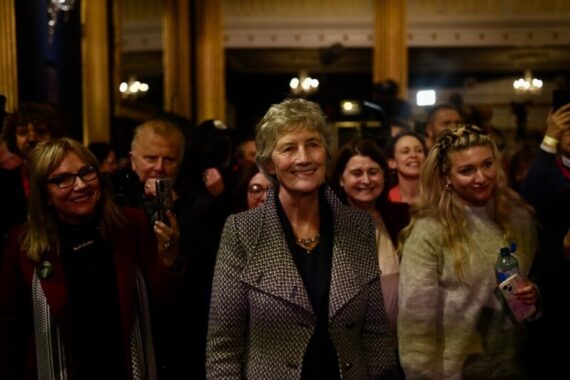
eftwing independent Catherine Connolly has won Ireland’s presidential election by a decisive landslide, securing 63% of first-preference votes in a result that stunned the political establishment and delivered a major symbolic blow to the ruling coalition.
The 68-year-old Galway TD and long-time social justice campaigner will become the Republic’s 10th head of state, succeeding Michael D Higgins after his 14-year tenure.
Speaking at Dublin Castle on Saturday night after being officially declared president-elect, Connolly pledged to be “a president for all”, vowing to defend Irish neutrality, champion climate justice and give a platform to the marginalized.
“I will be a voice for peace, a voice that builds on our policy of neutrality, a voice that articulates the existential threat posed by climate change,” she said, switching between Irish and English. “Together, we can shape a new republic that values everybody and champions diversity.”
Connolly secured 914,143 of 1,442,698 valid votes, far ahead of Fine Gael’s Heather Humphreys, who received 424,987 (29%). Fianna Fáil’s candidate, Jim Gavin – who had withdrawn following a financial scandal but remained on the ballot – won 103,568 votes (7%).
Despite the commanding win, turnout fell to 46%, unusually low for a presidential election, and more than 213,000 ballots were spoiled or invalid, reflecting frustration with the lack of choice and the perception of a two-horse race.
Though the presidency is largely ceremonial, Connolly’s victory is widely interpreted as a rebuke to the two big centrist parties that have dominated Irish politics for a century.
Her candidacy surged on the back of anger over Ireland’s housing and cost-of-living crises, missteps by government strategists, unity among leftwing parties, a viral, youth-driven online campaign.
Sinn Féin, Labour, the Social Democrats and People Before Profit all backed Connolly once her momentum became clear, giving her a rare pan-left coalition of support.
Recommended
Connolly has long been a critic of western foreign policy and has accused the U.S. and U.K. of enabling genocide in Gaza. Her victory raises questions about how far she will test the traditionally soft-spoken boundaries of the presidency.
Political analysts say friction with the government is likely if she uses the Áras as a platform for moral advocacy in the tradition of Mary Robinson and Michael D Higgins—but with a more radical tone.
For her supporters, Connolly embodies a generational shift and a rejection of politics-as-usual.
She gained traction with younger voters through podcasts, cultural endorsements and viral videos—including a lighthearted football keepy-uppy clip that became a campaign trademark. She was publicly supported by musicians and artists such as Kneecap and The Mary Wallopers.
Outgoing president Higgins congratulated her in a statement, saying the office would offer “full support” as she prepares for her inauguration next month.
Connolly will take office amid high expectations from Ireland’s left — and deep unease within government ranks — setting the stage for a presidency unlike any other in recent decades.
(Source: The Guardian)

Politics Today is dedicated to publishing insightful analyses in order to understand the changing nature of contemporary politics. It aims to contribute to the sound and constructive discussion of international affairs.
You can see how this popup was set up in our step-by-step guide: https://wppopupmaker.com/guides/auto-opening-announcement-popups/

Stay informed by subscribing to
our weekly newsletter.
You can see how this popup was set up in our step-by-step guide: https://wppopupmaker.com/guides/auto-opening-announcement-popups/
You can see how this popup was set up in our step-by-step guide: https://wppopupmaker.com/guides/auto-opening-announcement-popups/
You can see how this popup was set up in our step-by-step guide: https://wppopupmaker.com/guides/auto-opening-announcement-popups/
You can see how this popup was set up in our step-by-step guide: https://wppopupmaker.com/guides/auto-opening-announcement-popups/