France Hit by Largest School Protests in Decades as Students, Teachers Demand Better Conditions
Marches were held in Paris, Strasbourg, Rennes, Toulouse, Lyon, Marseille and Nantes, among other cities.
October 7, 2026
D
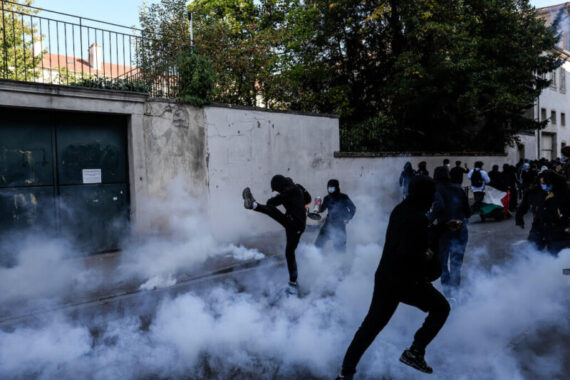
emonstrations swept across France on Tuesday as students, teachers and parents protested against overcrowded classrooms, staff shortages and deteriorating school buildings, with clashes between protesters and police leaving hundreds injured and prompting the government to promise a response.
The nationwide protests marked the biggest day of demonstrations in a movement that began in September in deprived suburbs of Paris before spreading across the country. Prime Minister Sebastien Lecornu described the violence as the most serious student unrest in decades.
More than 250,000 people took part in demonstrations in dozens of cities, according to the Interior Ministry, while organisers put the figure at about 450,000. Marches were held in Paris, Strasbourg, Rennes, Toulouse, Lyon, Marseille and Nantes, among other cities.
Police used tear gas and water cannons to disperse groups involved in clashes on the edges of demonstrations. The Interior Ministry said 488 people were arrested on Tuesday and 48 security personnel were injured.
Lecornu told lawmakers that at least 215 teenagers and 85 school employees had been injured in clashes, describing the casualties as the “heaviest toll in decades” for France’s school system. His office said more than 700 police officers had also been injured during the protests.
President Emmanuel Macron convened Lecornu and senior ministers for an emergency meeting as the government faced mounting pressure to contain the unrest.
Despite the scale of the demonstrations, the demands of the protesters have focused primarily on conditions inside France’s schools rather than immigration or religion.
Students and teachers have complained about understaffing, overcrowded classrooms, insufficient funding and poorly maintained buildings. Some schools have faced basic problems including water leaks and rat infestations.
The High School Students Union said more than half of France’s high schools had either been blockaded or closed for the day. In some areas, education authorities attempted to move classes online.
Protesters carried handmade signs criticising years of what they described as government neglect. In Marseille and Nantes, demonstrators held signs reading “The state has killed national education,” while parents in Toulouse joined students and teachers at the front of a march.
Hugo Vetzel, a recent high-school graduate in Strasbourg, said protesters felt increasingly disconnected from political decision-makers.
“There is such a gap between the elites and us,” he said.
Rights groups, student organisations and parents have accused authorities of using disproportionate force against young protesters. The government, meanwhile, has argued that the movement has been hijacked by outsiders and that some demonstrations have descended into urban violence.
In Paris, police said around 300 people, many of them masked or hooded, confronted security forces. Several storefronts were damaged, although authorities said the broader demonstration in the capital was largely peaceful.
More than 1,800 people were being prosecuted for unspecified offences connected to the unrest, including 1,483 minors, according to the Justice Ministry.
Teachers and protesters have disputed the government’s distinction between peaceful demonstrators and violent groups. Omar Slaouti, a high-school teacher in the Paris suburb of Argenteuil, said authorities were trying to divide young people into “good” and “bad” protesters.
Recommended
Lecornu has ordered ministers to respond to the main demands raised by students and school staff. The government plans to examine measures to ensure absent teachers are replaced, review the length of the school day and consider extending lunch breaks.
Ministers will also examine repairs required at ageing school buildings. Lecornu has instructed them to present their initial proposals by the end of October.
But parents and protesters have expressed scepticism about whether government promises will translate into meaningful improvements.
Emilie Lhomme, a parent protesting outside the Helene Boucher school in Paris, said official statements would not be enough to change students’ daily lives.
The government faces a difficult financial environment as it considers additional education spending. France is under pressure to reduce a widening budget deficit while economic growth remains weak and concerns over public debt have pushed borrowing costs higher.
The yield on France’s 10-year bonds briefly exceeded 5% last week, reaching its highest level in 24 years. Rising borrowing costs have also raised concerns across the wider euro area.
Finance Minister Roland Lescure said Tuesday there was no need for the European Central Bank to intervene.
The protests come as France approaches a presidential election next spring, with support for populist parties on both the far right and far left increasing. Far-right National Rally leader Marine Le Pen has used the country’s fiscal difficulties to promote plans for reducing public spending.
At the same time, France’s education system faces longer-term challenges. Education spending has lagged inflation, while French students have fallen behind their OECD peers in overall performance, according to data cited from the PISA 2025 assessment.
The government must now balance demands for greater investment in schools with pressure to control public finances. For students, teachers and parents, however, the protests have brought immediate concerns about classrooms, staffing and school buildings to the center of the national debate.
(Source: Reuters)

Politics Today is dedicated to publishing insightful analyses in order to understand the changing nature of contemporary politics. It aims to contribute to the sound and constructive discussion of international affairs.
You can see how this popup was set up in our step-by-step guide: https://wppopupmaker.com/guides/auto-opening-announcement-popups/

Stay informed by subscribing to
our weekly newsletter.
You can see how this popup was set up in our step-by-step guide: https://wppopupmaker.com/guides/auto-opening-announcement-popups/
You can see how this popup was set up in our step-by-step guide: https://wppopupmaker.com/guides/auto-opening-announcement-popups/
You can see how this popup was set up in our step-by-step guide: https://wppopupmaker.com/guides/auto-opening-announcement-popups/
You can see how this popup was set up in our step-by-step guide: https://wppopupmaker.com/guides/auto-opening-announcement-popups/