Japan to Supply $6.5B in Stealth Frigates to Australia
For Japan, the deal to sell Stealth Frigates to Australia marks its largest-ever arms export since it began loosening post–World War II restrictions on lethal weapons sales
August 14, 2025
A
ustralia has announced a landmark $6.5 billion deal to buy 11 state-of-the-art warships from Japan, a move analysts say could elevate Canberra into a top-tier Pacific maritime power while propelling Tokyo into the ranks of major global weapons exporters.
The vessels — upgraded Mogami-class stealth frigates built by Mitsubishi Heavy Industries — are described as among the most advanced surface combatants afloat, rivaling or surpassing anything fielded by China or even the United States.
Australia’s Defense Minister for Industry Pat Conroy framed the purchase as a strategic counterweight to growing Chinese naval activity, including a task force that circumnavigated Australia earlier this year and staged live-fire drills off its coast. “This is another step towards delivering a much larger and more lethal navy, with stealth frigates that will reassure our allies and deter our adversaries,” Conroy said.
The Australian version of the Mogami will be larger than those in service with Japan’s Maritime Self-Defense Force, featuring an extended range of about 11,500 miles — roughly half the Earth’s circumference without refueling — and a lean crew of 90. That is nearly half the complement required for Australia’s current ANZAC-class frigates, a crucial advantage for countries facing military recruitment shortfalls.
Weaponry will center on 32 US-made Mk 41 vertical launch cells, allowing each ship to fire up to 128 air-defense missiles — quadrupling Australia’s current surface fleet capacity. The cells can also accommodate Tomahawk cruise missiles with 1,000-mile strike ranges, as well as long-range anti-submarine rockets, potentially giving Australia an edge in detecting and neutralizing nuclear-powered submarines.
“It’s stealth, it’s reduced manning, it’s modularity — all at a relatively affordable price,” said Alessio Patalano, professor of war and strategy in East Asia at King’s College London. Carl Schuster, a former US Navy captain, called the ship “slightly superior” to China’s Type 054B frigate, with particular strengths in air defense.
Beyond hardware, experts stress the Mogami’s software and sensor systems may be its most decisive features. “Superior sonar software could be the difference between tracking a hostile contact or missing it entirely,” noted Sidharth Kaushal of the Royal United Services Institute in London.
Both Schuster and Patalano highlighted Japan’s track record for delivering complex naval platforms on time and on budget — a point of contrast with US shipbuilding delays. The US Navy has not had frigates since 2015, and its Constellation-class program, launched in 2020, is already at least three years behind schedule.
“In my opinion, [the Mogami] is superior to the Constellation class,” Schuster said. Patalano added that the US has “a lot to learn” from allies like Japan, South Korea, and the UK in innovation and efficiency.
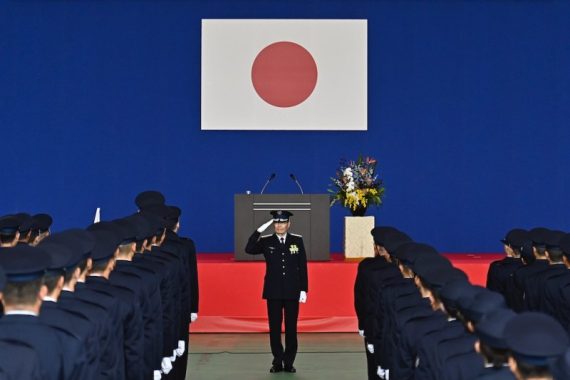
For Japan, the deal marks its largest-ever arms export since it began loosening post–World War II restrictions on lethal weapons sales. Previously, Tokyo had sold surveillance radars to the Philippines and Patriot missile interceptors to the US, but the frigate contract — with the first three ships to be built in Japan and the remaining eight in Australian shipyards — represents a leap into high-end defense manufacturing for export.
Exporting not only the warships but also the production technology “would catapult Japan into the space of major defense industry exporters,” Patalano said.
The arrangement is also expected to create 10,000 jobs in Australia and strengthen interoperability between two members of the US-led Quad security grouping, which also includes India. Canberra anticipates the first ship will be operational by 2029.
Recommended
The deal also spotlights Mitsubishi Heavy Industries’ storied naval legacy. The firm built the Yamato and Musashi, the largest battleships ever constructed, for the Imperial Japanese Navy during World War II. Those behemoths, armed with 18-inch guns, were rendered obsolete by aircraft carriers before seeing decisive action; both were sunk by US air power in 1944–45.
Eighty years later, Mitsubishi is again producing cutting-edge warships — this time as part of a democratic alliance network seeking to maintain stability in the Indo-Pacific.
Analysts say the Australia–Japan frigate deal fits into a broader pattern of allied maritime rearmament, aimed at deterring China’s naval expansion and securing vital sea lanes. It also underscores how technological partnerships among US allies can sometimes advance more quickly than US-led programs, potentially shaping the future balance of naval power in the region.
As Patalano put it: “This is not just a ship sale. It’s a signal — that in the Pacific, America’s closest allies are investing in each other to ensure they can stand together against shared challenges.”
(Source: CNN)

Politics Today is dedicated to publishing insightful analyses in order to understand the changing nature of contemporary politics. It aims to contribute to the sound and constructive discussion of international affairs.
You can see how this popup was set up in our step-by-step guide: https://wppopupmaker.com/guides/auto-opening-announcement-popups/

Stay informed by subscribing to
our weekly newsletter.
You can see how this popup was set up in our step-by-step guide: https://wppopupmaker.com/guides/auto-opening-announcement-popups/
You can see how this popup was set up in our step-by-step guide: https://wppopupmaker.com/guides/auto-opening-announcement-popups/
You can see how this popup was set up in our step-by-step guide: https://wppopupmaker.com/guides/auto-opening-announcement-popups/
You can see how this popup was set up in our step-by-step guide: https://wppopupmaker.com/guides/auto-opening-announcement-popups/