Macron urges Xi to Boost Cooperation, Trade Balance During Beijing Visit
China exports roughly $45 billion in goods to France annually, much of it low-value consumer items sold through online marketplaces such as Shein.
December 5, 2025
F
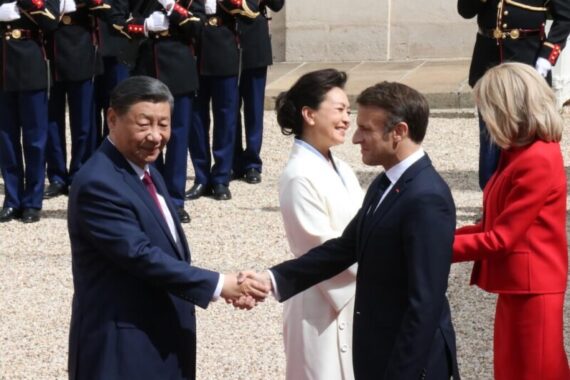
rench President Emmanuel Macron on Thursday urged Chinese President Xi Jinping to step up cooperation on global stability, the Ukraine conflict, and rebalancing economic ties, as the French leader began a three-day state visit to China accompanied by a high-level business delegation.
Speaking at the Great Hall of the People in Beijing, Macron said the current global environment made dialogue between France and China “more vital than ever,” as Europe looks to China for support in ending the war in Ukraine while Beijing seeks diplomatic leverage amid mounting trade friction with Western economies.
“I propose a positive three-fold agenda for our relations – one of geopolitical stability, economic rebalancing, and environmental sustainability,” Macron said, stressing that cooperation between Paris and Beijing was “decisive” for global peace efforts.
The French president, on his fourth state visit to China, is accompanied by senior executives from major French companies including Airbus, BNP Paribas, Schneider Electric and Alstom. Paris hopes the visit will help secure commercial agreements and strengthen France’s economic position in the world’s second-largest economy.
Beijing, meanwhile, is aiming to ease tensions with the European Union, which has recently confronted China over heavily subsidized electric vehicles and broader concerns about economic dependence.
China views France as a key European partner at a time when Beijing is navigating economic slowdowns and heightened trade pressure from the United States following multiple rounds of tariffs imposed by Washington.
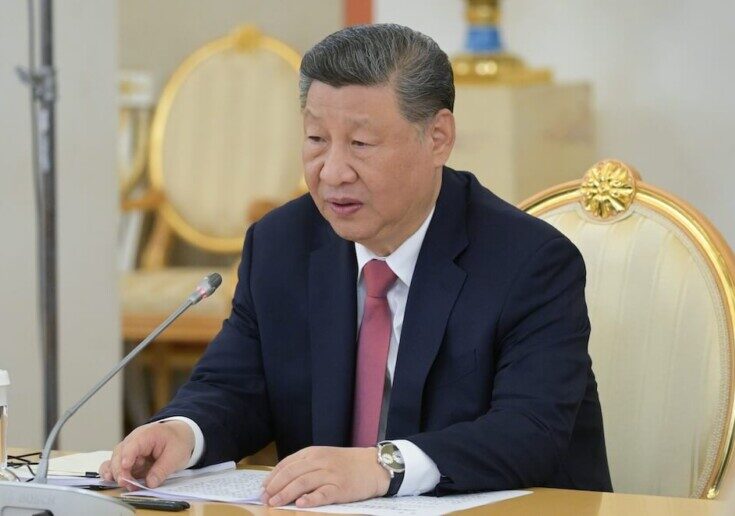
During the talks, Xi said France and China should demonstrate “the independence and strategic vision of major powers,” reaffirming Beijing’s position that Paris should maintain its autonomy in its foreign and trade policies.
He also emphasized China’s continued support for peace efforts in both Ukraine and Gaza, though analysts say major shifts in China’s stance on Ukraine remain unlikely following recent assurances of continued cooperation with Russia.
While Macron arrived with strong expectations for economic breakthroughs, political realities are likely to limit major outcomes.
Beijing is expected to delay approval of a long-anticipated 500-aircraft Airbus order, reportedly as part of its strategy to retain leverage in parallel trade discussions with the U.S. China is also unlikely to lift minimum pricing restrictions on French cognac imports—restrictions introduced after the EU moved to impose tariffs on Chinese EVs in 2024.
Prospects for easing Chinese duties on EU pork imports also remain limited, with Beijing using the issue to pressure Brussels into agreeing to minimum pricing for Chinese EVs entering Europe.
Following the talks, the two sides signed 12 cooperation agreements covering investment, nuclear energy cooperation, ageing populations, and panda conservation.
Recommended
France faces mounting pressure to rebalance its trade with China, which has widened steadily in recent years. China exports roughly $45 billion in goods to France annually, much of it low-value consumer items sold through online marketplaces such as Shein. In contrast, French exports to China are valued at about $35 billion, with cosmetics, aircraft parts and alcohol among the top categories.
Macron said both countries had a role to play in developing fairer global economic rules, adding that supply-chain stability and predictability were essential.
“Our two countries have a role to play in laying out, with other partners, the foundations for rebalanced economic governance,” he said.
In an unusual diplomatic gesture, Xi is scheduled to accompany Macron to Sichuan province on Friday, an honor rarely extended to visiting foreign leaders once they leave Beijing. The move is seen by observers as a signal that China places high value on its relationship with France, despite ongoing tensions with the broader European Union.
The visit comes as the EU prepares to unveil new policies aimed at reducing reliance on Chinese manufacturing and protecting key technologies—measures likely to shape the future of EU-China relations.
As France looks to bolster its global diplomatic influence and China seeks to stabilize its international partnerships, both sides emphasized the importance of maintaining channels of communication amid a turbulent geopolitical landscape.
(Source: Reuters)

Politics Today is dedicated to publishing insightful analyses in order to understand the changing nature of contemporary politics. It aims to contribute to the sound and constructive discussion of international affairs.
You can see how this popup was set up in our step-by-step guide: https://wppopupmaker.com/guides/auto-opening-announcement-popups/

Stay informed by subscribing to
our weekly newsletter.
You can see how this popup was set up in our step-by-step guide: https://wppopupmaker.com/guides/auto-opening-announcement-popups/
You can see how this popup was set up in our step-by-step guide: https://wppopupmaker.com/guides/auto-opening-announcement-popups/
You can see how this popup was set up in our step-by-step guide: https://wppopupmaker.com/guides/auto-opening-announcement-popups/
You can see how this popup was set up in our step-by-step guide: https://wppopupmaker.com/guides/auto-opening-announcement-popups/