Maduro Seeks Chinese Support as American Military Presence Nears
Maduro met with China’s ambassador to Venezuela, Lan Hu, to review progress in economic, technological, and artificial intelligence projects.
August 25, 2025
V
enezuela’s President Nicolás Maduro is appealing to China for closer cooperation as tensions with the United States intensify. Speaking during the closing of the “First Pedagogical Congress of Bolivarian Teachers,” Maduro highlighted recent communication with Chinese President Xi Jinping and presented a Huawei phone he said was gifted to him by Beijing’s leader.
Maduro demonstrated the device while jokingly greeting Xi in Mandarin: “Ni hao, xiexie,” he said, suggesting satellite communication between the two leaders. Though lighthearted, the gesture underscored Venezuela’s increasing focus on its strategic ties with China as U.S. military forces step up operations in the Caribbean.
Earlier this week, Maduro met with China’s ambassador to Venezuela, Lan Hu, to review progress in economic, technological, and artificial intelligence projects. He praised China as a “sister nation” and stressed its role in countering economic pressure. Since May 2023, Ambassador Hu has publicly criticized U.S. sanctions and celebrated what he described as “mutual cooperation” between Caracas and Beijing.
Last year, during the 50th anniversary of diplomatic relations between the two countries, Hu condemned “unilateral coercive measures” imposed by Washington. Beijing has maintained a surplus in trade with Venezuela, exporting an estimated US$3.45 billion worth of goods in 2023 while importing only US$739 million, according to the Observatory of Economic Complexity.
The backdrop to these renewed ties is an escalating standoff between Caracas and Washington. The U.S. has deployed military assets to the Caribbean, including a nuclear-powered submarine, reconnaissance jets, destroyers, and a guided-missile cruiser, as part of an operation framed as a crackdown on drug trafficking.
White House Press Secretary Karoline Leavitt said the U.S. intends to “use all the resources of its power” to curb the flow of narcotics and hold those responsible accountable. While a U.S. Defense Department official confirmed that no orders have been given to approach Venezuela’s territorial waters—approximately 4,000 kilometers of coastline—Maduro has mobilized 4.5-million-armed people, vowing that “no empire is going to touch the sacred ground of Venezuela.”
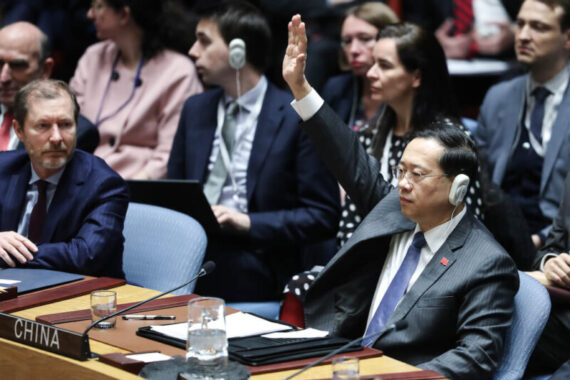
China has voiced opposition to any potential escalation. “We oppose the use or threat of force in international relations and the interference of external forces in Venezuela’s internal affairs under any pretext,” Chinese Foreign Ministry spokesperson Mao Ning said. Beijing called on the U.S. to “do more to promote peace and security in Latin America.”
Analysts, however, caution that Beijing’s response is largely symbolic. “China’s position is politically correct but not a commitment to intervene,” said Gabriel Pastor of the Uruguay-based think tank CERES. “It signals economic interest rather than direct military or diplomatic backing.”
Recommended
Venezuela’s vast oil reserves remain central to the geopolitical equation. A recent Reuters report revealed that a private Chinese company has started operations in two Venezuelan oil fields, investing over $1 billion in a project expected to yield 60,000 barrels per day by 2026 under a 20-year production-sharing deal.
“The oil in the disputed Essequibo region between Venezuela and Guyana plays a crucial role in this dynamic,” explained José Antonio Hernández Macías, a Latin American Studies researcher at UNAM. “China is looking to secure access to energy resources while managing its broader interests in the region.”
The U.S. continues to accuse Maduro of leading the Cartel of the Suns, a drug trafficking organization it recently designated as an international terrorist group. Washington has increased the reward for his capture to $50 million. Venezuela denies these allegations, insisting its 2024 presidential election—widely contested by the opposition—was legitimate.
For now, Maduro remains defiant, portraying his government as a David against Goliath. “Venezuela today more than ever has what it takes. We are living in peace and will continue in peace,” he said, referencing biblical imagery during a televised ceremony.
While China offers limited diplomatic cover, the deepening U.S. military presence raises questions about whether the standoff could escalate further, or whether Beijing will remain a cautious, economically driven observer.
(Source: CNN)

Politics Today is dedicated to publishing insightful analyses in order to understand the changing nature of contemporary politics. It aims to contribute to the sound and constructive discussion of international affairs.
You can see how this popup was set up in our step-by-step guide: https://wppopupmaker.com/guides/auto-opening-announcement-popups/

Stay informed by subscribing to
our weekly newsletter.
You can see how this popup was set up in our step-by-step guide: https://wppopupmaker.com/guides/auto-opening-announcement-popups/
You can see how this popup was set up in our step-by-step guide: https://wppopupmaker.com/guides/auto-opening-announcement-popups/
You can see how this popup was set up in our step-by-step guide: https://wppopupmaker.com/guides/auto-opening-announcement-popups/
You can see how this popup was set up in our step-by-step guide: https://wppopupmaker.com/guides/auto-opening-announcement-popups/