Post-Czech Republic Elections: The EU's Far-Right and Racist Movements Challenge

November 20, 2025

The presence of the Drivers' Party (Motoristé Sobě) and Freedom and Direct Democracy (SPD) within the Patriots for Europe group as potential coalition partners is causing concern in Brussels regarding the Czech Republic’s future direction.
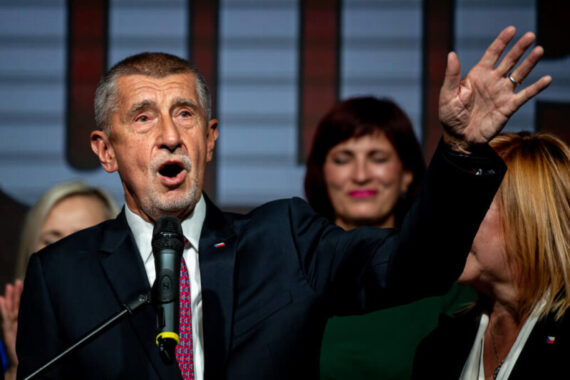
Leader of the ANO movement, Andrej Babis holds a press conference at ANO headquarters after the polling stations of Czech elections closed in Prague, Czech Republic on October 4, 2025. Photo by Anadolu Images.

I

n early October, the ANO party won the Czech Republic’s parliamentary elections with the support of more than a third of the electorate. The Spolu Union, the largest party in the ruling center-right coalition, lost power after dropping 4.4 percent in the vote count compared to the previous elections. More importantly, the far-right ANO party’s first-place finish has created a political situation in which no coalition is possible without it.

Following the October 3–4, 2025 elections, discussions intensified regarding the ANO party and its leader, Andrej Babiš. In the Czech Republic, a member of the European Union, there is increasing speculation about a possible political reversal in the event of an ANO-led government due to the party’s stance on the EU. ANO chairman Andrej Babiš has begun indirect preliminary talks with the far-right parties Motoristé Sobě (Drivers’ Party) and SPD (Freedom and Direct Democracy) regarding the formation of a coalition or a minority government supported by these parties. However, both parties being discussed as potential coalition partners for ANO have drawn attention due to their far-right and racist statements.

The SPD’s opposition to the EU and the Drivers’ Party’s anti-EU stance have already raised doubts about the potential new coalition or minority government, despite the latter’s claims to the contrary. The most striking aspect of these doubts is the ANO party’s position. Prior to the 2024 European Parliament elections, ANO was part of the liberal ALDE group. However, after the 2024 elections, ANO joined the newly formed far-right, racist Patriots for Europe group. After meeting with the Czech president on November 3, 2025, the ANO party leader will most likely be tasked with forming a government and will begin negotiations to form a coalition or minority government with the two aforementioned parties. Europe’s first far-right, racist coalition or partnership now appears likely to be formed in the heart of Europe.

Fragmented and divided politics

Looking back at the period before the most recent elections, the differences in Czech politics become more apparent. The ANO party, which won the elections, does not have a long political history. Established in 2011, it held six ministerial posts in the Bohuslav Sobotka-led coalition government from 2013 to 2017. Under Babiš’s leadership, ANO became the leading party in the 2017 Czech Republic elections, winning nearly 30 percent of the vote. However, this also led to a political stalemate. Although ANO had previously been part of a center-right coalition with the Social Democrats and Christian Democrats, no party was willing to form a coalition with it after the 2017 election.

Other political movements focused more on Babiš himself than on the ANO party. Despite these reactions, ANO formed a minority government with the external support of the far-right Freedom and Direct Democracy (SPD) party. While receiving support from the far right in government, ANO also cooperated with the far-right SPD and the Communist Party in parliament. In mid-2018, however, ANO formed a coalition with the Social Democrats (CSSD) and established a minority government with external support from the Communist Party, which lasted until 2021.

Although ANO has been classified as an anti-EU party since its inception, it was part of the ALDE group, composed of European Liberals, in the European Parliament from 2014 to 2024. Following the most recent European Parliament elections, however, its inclusion in the newly formed Patriots for Europe group appears to be the main reason why a clear political assessment of this party—set to govern the Czech Republic in the coming period—remains difficult.

Another noteworthy point is Steve Bannon’s earlier involvement with extreme political movements in the country. He was one of the first to mention the Patriots across Europe. In 2018, Bannon traveled extensively throughout Europe, attempting to organize far-right political movements with high voter potential and broad appeal to large constituencies in various countries. Bannon served as a chief advisor during Trump’s first presidential term and stated at a conference that the future of Europe would lie with an elite group of European patriots. Prior to the 2019 European Parliament elections, Bannon organized programs and conferences with leading far-right political movements in Europe. Prague was one of the European capitals Bannon visited during this process.

Steve Bannon was received by then-Czech president Miloš Zeman in September 2018. Bannon shared his experiences from the U.S. elections with Zeman for the 2019 European Parliament elections. Petr Bystron, a member of the German Federal Parliament and the Alternative for Germany (AfD), accompanied Bannon on this visit.

It is also noteworthy that former Czech president Miloš Zeman has increasingly shifted to the right and embraced anti-immigrant and anti-Islam political views since leaving the Social Democratic Party (CSSD), which he once led.


Brussels tense and cautious

As the leader of a political movement shifting from liberal to conservative values, Andrej Babiš ran his campaign under the slogan “Czech Republic First,” employing a tactic similar to Trump’s “America First” motto. Babiš won the election by prioritizing the interests of Czech citizens in his political discourse, including cutting off support to Ukraine during previous government terms. He frequently stated that he would prioritize the social interests of his citizens and that their needs came first. He emphasized his determination to end the supply of ammunition to Ukraine via the Czech Republic.

Experts say that Babiš clearly changed his political stance after the 2024 European Parliament elections, adopting a pro-Russian position within the EU and becoming one of Russia’s “Trojan horses.” The Czech Republic’s vocal objections to EU policies—alongside Slovakia and Hungary within the Visegrad Group—have drawn attention. Previously viewed as a reliable partner for Brussels under Prime Minister Fiala, the Czech Republic is now under Babiš’s leadership.

The presence of the Drivers’ Party (Motoristé Sobě) and Freedom and Direct Democracy (SPD) within the Patriots for Europe group as potential coalition partners is causing concern in Brussels regarding the Czech Republic’s future direction. Both parties are anti-EU and pro-Russia in their rhetoric and oppose aid to Ukraine. Brussels is also concerned that the Czech Republic’s new government may drift further from the European path. Together with countries such as Slovakia and Hungary, it could contribute to the expansion of an anti-EU movement.

The Czech Republic: Where the roads cross

The Czech Republic is located in the heart of Europe and is a member state of strategic importance to the EU in every respect. The Gazela pipeline, which transports natural gas from the Nord Stream pipelines to southern Germany and other Central European countries, gives the country strategic importance for European energy security. During the Fiala government, efforts were made to reduce dependence on Russian gas by highlighting alternative LNG supplies from Qatar and the United States via Poland. However, the lack of serious initiatives in this regard has led to increased energy costs due to supply shortages or transportation challenges in this economically struggling country.

Furthermore, the governance of the Czech Republic—an important NATO member—is significant in terms of Europe’s energy and military security, as well as the new groupings emerging in the EU political arena. Although ANO leader Babiš has made pro-EU and pro-NATO statements, EU leaders in Brussels remain unconvinced.

The future of the far right in the European political arena

The victory of a party that founded the Patriots for Europe group—which includes Europe’s far-right and racist parties and was established after the 2024 European Parliament elections—in an important EU country is also significant for the future of the far right or populist right. It is concerning that a party that can be categorically described as populist and right-wing, yet appears liberal in its rhetoric, is turning to the far right for power and embracing far-right and racist political discourse. However, focusing specifically on the Czech Republic, the loss of votes by far-right and racist parties such as the SPD suggests that relatively moderate right-wing parties could rise to power in other countries by adopting the rhetoric of the far right.

Moreover, these new political developments indicate an increase in political movements within EU member states that prioritize national interests over European interests. The EU bureaucracy itself is partly responsible for this situation. For a long time, EU bureaucrats and leaders have failed to foster a cohesive European identity, which has become increasingly diluted. Negotiations over issues not inherently European or not directly related to Europe, coupled with the vilification of national leaders and politicians defending their countries’ national interests against the EU in recent years, have paved the way for far-right or right-wing populist political movements in national elections. This has contributed to a shift from the center-right to the political fringe. This is precisely what is happening in the Czech Republic.

Following the October 3–4, 2025 elections, the Czech Republic is approaching a political turning point. The country continues to experience polarization and political fragmentation in an environment where the balance of power has shifted to the far right. Ultimately, Andrej Babiš is the leader of the party that was elected. Whether or not the EU favors Babiš, it must engage with him politically. It is within the EU’s power to leverage this relationship to its advantage. Time will tell whether Babiš—whom President Pavel will task with forming a government on November 3, 2025—will be truly pro-European or whether he will distance himself from his European partners. This new situation is of vital importance to the stability of Central Europe and the EU.

(Originally published in Turkish by Kriter)

Dr. Muhterem DİLBİRLİĞİ is a Turkish academic who serves as the Education Attaché, Turkish Consulate General in Cologne.