UK-Turkey Free Trade Update Aims to Set ‘Global Example,’ Says Envoy
A planned update to the free trade agreement between the United Kingdom and Turkey is set to serve as a “great example” of modern, forward-looking trade partnerships.
August 4, 2025
A
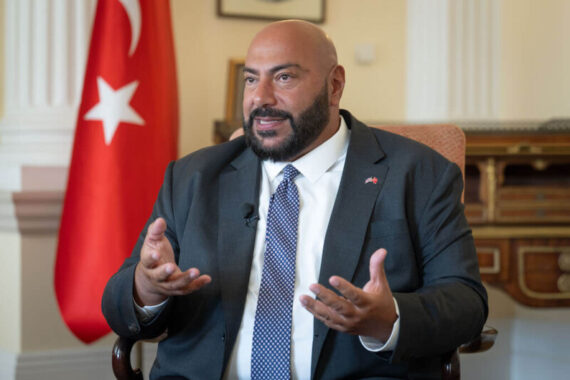
planned update to the free trade agreement between the United Kingdom and Turkey is set to serve as a “great example” of modern, forward-looking trade partnerships, according to the UK’s Consul General in Istanbul and Trade Commissioner for Eastern Europe and Central Asia, Kenan Poleo.
Speaking in an exclusive interview with Anadolu, Poleo said the first round of negotiations concluded on a positive note, covering key areas such as trade in goods and sustainability. Future discussions, he noted, are expected to broaden the scope to include services, innovation, and digital sectors, reflecting a mutual ambition to modernize bilateral ties.
“The most exciting thing about this new free trade agreement is the opportunity for the UK and Turkey to set a great example for the whole world around what a modern free trade agreement between two important partners looks like,” said Poleo.
Negotiators are preparing for the next round of talks later this year, with both sides aiming to build a roadmap for deeper cooperation in technology, climate-related industries, and other future-oriented sectors.
With bilateral trade already exceeding £27 billion (approximately $36 billion) annually, Turkey has become one of the UK’s top 20 trading partners. That number is expected to grow, driven by shared economic goals and geopolitical developments that are encouraging both countries to diversify supply chains and expand global trade ties.
“Given the depth of our relationship, really, the sky’s the limit,” said Poleo, highlighting the growing synergy between the two economies.
Poleo described trade ties as “huge,” pointing to recent gains across multiple sectors including clean energy, advanced manufacturing, and mobility. The UK, in its post-Brexit trade strategy, sees Turkey as a gateway to wider regional markets. For Turkey, the UK represents not just a major consumer market but also a valuable partner in innovation and regulatory reform.
“There isn’t a sector where we don’t see positive opportunities,” he said.
The two countries are also finding alignment in high-tech and defense cooperation. A standout development came during the International Defense Industry Fair (IDEF) in Istanbul last month, where the UK and Turkey signed a memorandum of understanding paving the way for Turkey to acquire Eurofighter Typhoon aircraft.
Describing the deal as emblematic of a “strategic and defense partnership,” Poleo emphasized the economic as well as security benefits.
“A third of those aircraft are going to be built within the UK,” he said. “It provides huge opportunities for both countries in terms of defense and security, but also economic growth.”
The Eurofighter Typhoon, a multirole aircraft equipped with advanced radar and cutting-edge combat capabilities, is co-produced by the UK, Germany, Italy, and Spain. Turkey’s inclusion as an operator reflects deepening trust and interoperability with NATO partners.
Beyond defense, clean energy and next-generation nuclear power represent some of the most promising areas of UK-Turkey collaboration, according to Poleo. He spotlighted the UK’s Offshore Renewable Energy Catapult, a research institution in northern England, as a hub attracting Turkish firms interested in wind energy technologies.
“We’ve developed innovation capability and capacity that have allowed Turkish companies, who are looking to explore those opportunities globally and also in Turkey, to come and become part of that ecosystem,” Poleo said.
With Turkey aiming to install 5 gigawatts of offshore wind capacity by 2035, the UK’s expertise could accelerate progress. The British envoy sees the potential for Turkey to “leapfrog” into a leading position through targeted partnerships.
On nuclear energy, cooperation could involve regulatory development and capacity building, especially as Turkey moves forward with its first nuclear power plant in Akkuyu and pursues small modular reactor (SMR) technologies by 2050.
“There’s an opportunity for us to collaborate and learn from each other on our experiences,” Poleo added, referring to the UK’s decades-long leadership in nuclear infrastructure.
Recommended
As Poleo prepares to conclude his assignment in early 2026, he reflects on a tenure marked by personal and professional milestones. Born in South London to a Turkish Cypriot family, he described his post in Turkey as a dream come true.
“This was always my dream job,” he said. “It is both a joy to have served here, but it’s also a tragedy for me that it has to come to an end.”
During his time in Istanbul, Poleo oversaw a steady expansion of bilateral trade, high-profile joint projects, and cultural diplomacy. Fluent in Turkish, he charmed local audiences with an emotional farewell speech, switching languages mid-sentence to remark with a smile:
He also spoke warmly of his daily view of Istanbul’s Golden Horn, calling it one of the “great joys” of diplomatic life.
Poleo first visited Istanbul as a student at the age of 21 and recalled standing outside the British Consulate building, dreaming of working there one day. Now, nearly three decades later, he is set to leave the city having fulfilled that vision.
(Source: Anadolu Agency)

Politics Today is dedicated to publishing insightful analyses in order to understand the changing nature of contemporary politics. It aims to contribute to the sound and constructive discussion of international affairs.
You can see how this popup was set up in our step-by-step guide: https://wppopupmaker.com/guides/auto-opening-announcement-popups/

Stay informed by subscribing to
our weekly newsletter.
You can see how this popup was set up in our step-by-step guide: https://wppopupmaker.com/guides/auto-opening-announcement-popups/
You can see how this popup was set up in our step-by-step guide: https://wppopupmaker.com/guides/auto-opening-announcement-popups/
You can see how this popup was set up in our step-by-step guide: https://wppopupmaker.com/guides/auto-opening-announcement-popups/
You can see how this popup was set up in our step-by-step guide: https://wppopupmaker.com/guides/auto-opening-announcement-popups/