Ukraine Expands Sea Drone Operations as Russia Pulls Back
Ukraine's current drone operations rely on a combination of human control and software assistance and the next stage will see more use of Artificial Intelligence.
December 9, 2025
U
kraine’s military intelligence service says it is preparing to carry out more complex maritime drone operations next year, after the country’s uncrewed surface fleet succeeded in forcing Russia’s Black Sea forces into a defensive posture and limiting their naval movements.
In comments to The Associated Press, the commander of the Defense Intelligence Directorate’s (GUR) Group 13 maritime drone unit said Ukraine’s sea-based attacks have reached a “plateau” in recent months, as Russia adapted its tactics following a series of high-profile strikes earlier in the war. The officer, identified publicly only by the call sign “13th” under Ukrainian security protocol, said the change in Russian behavior demonstrated both the impact and the challenges of Kyiv’s evolving drone program.
“We are effectively limiting the enemy’s movement, but those dramatic, high-profile strikes we saw earlier haven’t happened for some time,” he said. “That’s because the enemy has adapted.”
Ukrainian officials announced last month that maritime drones were used to hit vessels belonging to Russia’s so-called “shadow fleet,” a network of tankers used to evade sanctions. The commander declined to discuss those operations, citing restrictions imposed by the intelligence service.
According to Group 13, Russian naval vessels now stay close to their bases, typically traveling no more than 25–40 kilometers from port to fire cruise missiles before quickly returning. “They barely operate,” the commander said. “They constantly hide. And in a way, that is also a result of our work — because you can imagine the cost of maintaining a fleet that cannot operate at sea.”
The interview took place at an undisclosed location inside Ukraine. The officer wore full uniform, with his face covered and eyes obscured for security reasons. The intelligence agency requested that details of the site, equipment storage, and logistics not be revealed.
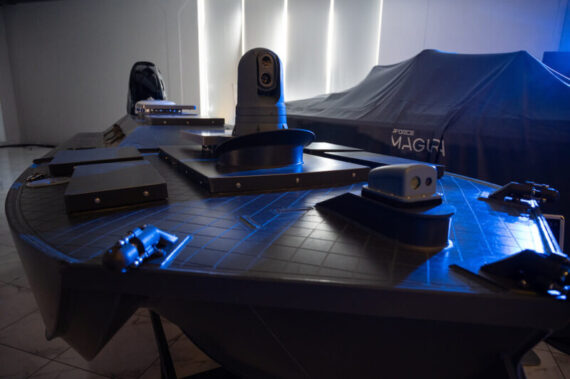
Maritime drones have become one of Ukraine’s most significant tools in countering Russian naval power. Kyiv operates two separate programs — one under its armed forces, the other under its intelligence service. Group 13 oversees the Magura family of sea drones, which have been credited with several major strikes on Russian warships, landing craft, and logistics vessels.
The unit currently uses two primary models: the Magura V5, a compact high-speed ramming drone used in explosive attacks, and the Magura V7, a larger multi-role platform capable of carrying various weapons. Both systems are controlled remotely through compact consoles equipped with joysticks, thermal and optical screens, and safety mechanisms.
During a recent demonstration for journalists, Ukrainian operators displayed a V7 equipped with modified U.S.-made AIM-9 Sidewinder air-to-air missiles. In May, GUR said one such drone downed a Russian fighter jet — a development the commander described as “a breakthrough” in modern naval warfare, marking what Kyiv claims is the first time a maritime surface drone has shot down an aircraft.
The commander said Ukraine’s next wave of innovation will center on expanded use of artificial intelligence. Current drone operations rely on a combination of human control and software assistance. Operators guide the systems over long distances, while AI assists with horizon scanning, obstacle recognition, and initial target identification.
“Right now, the search process is part operator, part AI,” he said. “In the future, you’ll launch the drone and it will independently search for a target, distinguish civilian ships from military ones, and make more of the decisions.”
Ukraine, he added, has accumulated “a huge amount of operational data” — including video from combat missions, sensor readings, navigation routes, and engagements — which will be used to further train AI algorithms.
Although he declined to provide specifics, the officer said experts in Ukraine and partner states were examining long-range strike options, submersible systems, and potential “mixed-fleet” operations involving coordinated attacks by aerial, surface and underwater drones.
Recommended
Ukraine is also working to expand co-production of maritime drones. During a visit by President Volodymyr Zelenskyy to Athens in November, Kyiv and Greece agreed to begin joint projects on maritime uncrewed vehicles, deepen intelligence-sharing on sea-based threats and increase training opportunities for Ukrainian operators.
Officials in Kyiv view cooperation with NATO member states as essential to sustaining Ukraine’s drone capabilities amid Russia’s ongoing attempts to jam, disrupt or intercept uncrewed systems.
Despite Russia’s adaptations, the commander insisted that Ukraine’s naval drone fleet continues to play a decisive role in restricting Moscow’s movements in the Black Sea. Analysts say Russia’s decision to relocate key vessels from Sevastopol to ports farther east — including Novorossiysk — was driven in large part by Ukraine’s repeated drone strikes over the past two years.
“We’re working on many fronts to change the situation and create a turning point,” the commander said. “We haven’t lost effectiveness. We’re holding the enemy in check — and preparing for what comes next.”
(Source: The Associated Press)

Politics Today is dedicated to publishing insightful analyses in order to understand the changing nature of contemporary politics. It aims to contribute to the sound and constructive discussion of international affairs.
You can see how this popup was set up in our step-by-step guide: https://wppopupmaker.com/guides/auto-opening-announcement-popups/

Stay informed by subscribing to
our weekly newsletter.
You can see how this popup was set up in our step-by-step guide: https://wppopupmaker.com/guides/auto-opening-announcement-popups/
You can see how this popup was set up in our step-by-step guide: https://wppopupmaker.com/guides/auto-opening-announcement-popups/
You can see how this popup was set up in our step-by-step guide: https://wppopupmaker.com/guides/auto-opening-announcement-popups/
You can see how this popup was set up in our step-by-step guide: https://wppopupmaker.com/guides/auto-opening-announcement-popups/