US Fed Raises Interest Rates by 25 Basis Points, Signals Another Hike This Year
Inflation in the US remained elevated, prompting the central bank to maintain a focus on bringing price pressures back toward its 2% target.
September 17, 2026
T
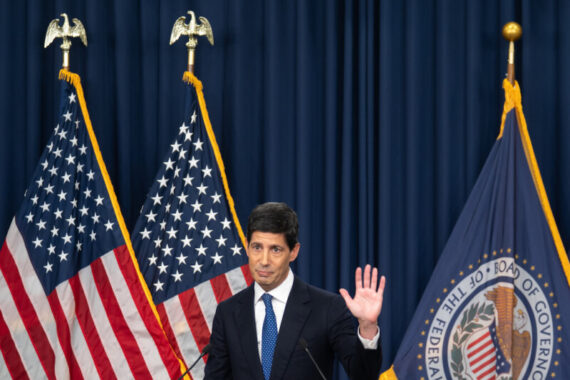
he U.S. Federal Reserve raised its benchmark interest rate by 25 basis points on Wednesday, marking its first rate increase since 2023 and lifting the federal funds target range to 3.75%-4%, as policymakers continued to grapple with inflation that remains above the central bank’s 2% target.
The decision by the Federal Open Market Committee (FOMC) was unanimous and was broadly in line with market expectations. The Fed said the move was intended to support its dual mandate of achieving maximum employment and stable prices.
In its policy statement, the central bank said economic activity had continued to expand at a solid pace, while domestic spending remained resilient. It added that uncertainty remained elevated, partly because of geopolitical developments.
The Fed also pointed to strong productivity growth and solid capital investment. Employment gains were described as broadly matching growth in the labor force, while the unemployment rate had changed little.
However, inflation remained elevated, prompting the central bank to maintain a focus on bringing price pressures back toward its 2% target.
“Today’s policy action will support a more timely return to the Committee’s 2 percent objective,” the Fed said, adding that it would work to ensure price stability.
The rate increase marks a significant shift from the Fed’s policy course over the previous year. The central bank had cut interest rates by a combined 75 basis points in September, October and December of the previous year before leaving rates unchanged during its first five meetings of 2026.
Recent economic data showing continued strength in the labor market alongside inflation above the Fed’s target had increased expectations for a rate hike at the September meeting. Financial markets had largely priced in a 25-basis-point increase ahead of the decision.
The Fed’s last rate increase came in July 2023, when it raised the federal funds target range by 25 basis points to 5.25%-5.50% as it sought to combat persistent inflation.
Alongside its policy decision, the Fed released updated economic projections that indicated another rate increase could take place before the end of 2026.
The central bank raised its median year-end federal funds rate projection to 4.1%, up from the 3.8% forecast issued in June. Its projection for the federal funds rate in 2027 was also raised to 4.1% from 3.6%, while the forecast for 2028 increased to 3.9% from 3.4%. The Fed projected a rate of 3.6% for 2029.
Its longer-run estimate for the federal funds rate was revised slightly upward to 3.2% from 3.1%.
The Fed’s so-called dot plot, which shows individual policymakers’ expectations for future interest rates, indicated that 16 of the 18 FOMC officials expected at least one additional rate increase this year.
The projections suggest that policymakers expect interest rates to remain relatively restrictive as they continue to address inflationary pressures.
The Fed also raised its inflation forecast for 2026. Its projection for headline inflation increased to 3.7% from 3.6%, while the forecast for 2027 remained at 2.3%. The central bank raised its 2028 inflation projection to 2.1% from 2%, and projected inflation at 2% in 2029.
Recommended
Core inflation, which excludes volatile food and energy prices, was also expected to remain higher than previously forecast. The Fed raised its 2026 core inflation projection to 3.4% from 3.3%, while maintaining its 2027 forecast at 2.5%. Its 2028 projection increased to 2.2% from 2.1%, with a 2% forecast for 2029.
Despite the continued inflation pressure, the central bank upgraded its expectations for economic growth.
The Fed raised its 2026 growth forecast to 2.3% from 2.2% and its 2027 projection to 2.4% from 2.3%. It left its 2028 forecast unchanged at 2.2% and projected growth of 2.1% in 2029.
The unemployment outlook also improved. The Fed lowered its unemployment rate forecast for 2026 and 2027 to 4.1% from 4.3%. Its projection for 2028 was reduced to 4.1% from 4.2%, while the forecast for 2029 was also set at 4.1%.
The combination of stronger growth and lower unemployment projections suggests that Fed officials expect the U.S. economy to remain resilient even as interest rates stay elevated.
The latest decision therefore leaves monetary policy at the center of the Fed’s effort to balance continued economic expansion, labor-market conditions and persistent inflation. The updated projections also indicate that policymakers expect the fight against inflation to continue beyond the September meeting, with most officials anticipating another rate increase before the end of the year.
(Source: Anadolu Agency)

Politics Today is dedicated to publishing insightful analyses in order to understand the changing nature of contemporary politics. It aims to contribute to the sound and constructive discussion of international affairs.
You can see how this popup was set up in our step-by-step guide: https://wppopupmaker.com/guides/auto-opening-announcement-popups/

Stay informed by subscribing to
our weekly newsletter.
You can see how this popup was set up in our step-by-step guide: https://wppopupmaker.com/guides/auto-opening-announcement-popups/
You can see how this popup was set up in our step-by-step guide: https://wppopupmaker.com/guides/auto-opening-announcement-popups/
You can see how this popup was set up in our step-by-step guide: https://wppopupmaker.com/guides/auto-opening-announcement-popups/
You can see how this popup was set up in our step-by-step guide: https://wppopupmaker.com/guides/auto-opening-announcement-popups/