
Scholars’ Association Declares Israel’s Gaza Actions Genocide
The world’s largest academic association devoted to the study of genocide has declared that Israel’s military campaign in Gaza meets the legal definition of genocide.
September 2, 2025
T
he world’s largest academic association devoted to the study of genocide has declared that Israel’s military campaign in Gaza meets the legal definition of genocide, according to a resolution overwhelmingly approved by its members.
The International Association of Genocide Scholars (IAGS), a 500-member body of academics and legal experts, announced on Monday that 86 percent of participating members voted in favor of the resolution, which states that Israel’s “policies and actions in Gaza” satisfy the criteria outlined in Article II of the 1948 United Nations Genocide Convention.
The resolution calls on Israel to “immediately cease all acts that constitute genocide, war crimes and crimes against humanity against Palestinians in Gaza,” listing deliberate attacks on civilians, starvation, deprivation of aid, sexual and reproductive violence, and forced displacement among the actions cited.
Israel’s Foreign Ministry strongly rejected the resolution, calling it “disgraceful” and claiming it was “entirely based on Hamas’ campaign of lies.”
“Israel will continue to defend its citizens while taking all feasible measures to minimize harm to civilians,” a ministry spokesperson said. The government is already defending itself against a genocide case filed at the International Court of Justice (ICJ) in The Hague.
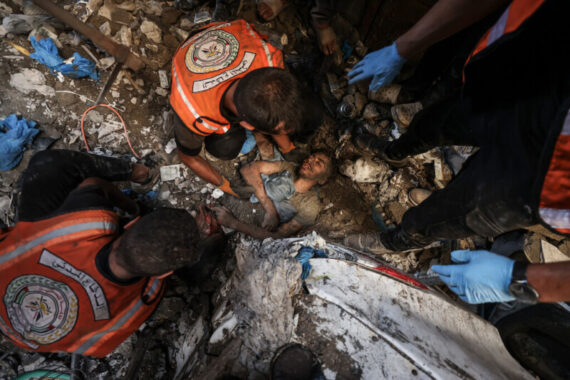
Since October 7, 2023, Israeli operations have killed over 63,000 Palestinians, and left 15,000 more under the rubble of their homes, according to health officials in Gaza, and caused widespread destruction of infrastructure, homes, and public services. Nearly the entire population has been displaced at least once, while a UN-linked hunger monitor has warned of a “man-made famine” in parts of the territory.
“This is a definitive statement from experts in the field of genocide studies that what is going on on the ground in Gaza is genocide,” said Melanie O’Brien, president of the IAGS and a professor of international law at the University of Western Australia. “There is no justification for the commission of war crimes, crimes against humanity, or genocide—not even self-defense,” she added.
Since its founding in 1994, the IAGS has passed nine resolutions recognizing historic or ongoing genocides. It publishes a peer-reviewed journal, organizes international conferences, and is widely regarded as the leading academic network in the field of genocide studies.
Ismail Al-Thawabta, head of the Gaza government media office, welcomed the resolution as a “prestigious scholarly stance” that “places a legal and moral obligation on the international community to take urgent action to stop the crime, protect civilians, and hold the leaders of the occupation accountable.”
Sergey Vasiliev, an international law professor at the Open University in the Netherlands, who is not affiliated with the association, said the resolution reflected a growing consensus. “This legal assessment has become mainstream within academia, particularly in the field of genocide studies,” he told Reuters.
Several international rights organizations, including Amnesty International and Human Rights Watch, have previously accused Israel of committing crimes that may amount to genocide. In recent weeks, hundreds of staff members at the UN Office of the High Commissioner for Human Rights urged UN High Commissioner Volker Türk to explicitly characterize the conflict as an unfolding genocide, according to a letter seen by Reuters.
The debate over Israel’s actions in Gaza has deepened international divisions. While some Western nations, including the United States, have defended Israel, others have increasingly expressed alarm over the scale of civilian casualties and destruction.
The 1948 U.N. Genocide Convention, drafted in response to the Holocaust, defines genocide as crimes committed “with intent to destroy, in whole or in part, a national, ethnical, racial or religious group, as such.” It obligates signatory states to prevent and punish acts of genocide, regardless of when or where they occur.
Legal experts note that establishing genocide requires proving both the act and the intent to destroy a group in whole or in part. Israel’s critics argue that its policies of blockade, bombardment, and population displacement in Gaza demonstrate such intent.
Recommended

If the ICJ rules against Israel, it would mark one of the most consequential cases in the court’s history and could intensify calls for international sanctions or legal actions. However, enforcement mechanisms remain limited, and Israel’s key allies, including the United States, have so far opposed measures that would significantly constrain its military operations.
For many in Gaza, the scholarly resolution offers moral recognition amid widespread devastation. “It won’t bring back the dead, but maybe it will make the world act faster,” said Fatima Hassan, a displaced resident in Rafah.
The IAGS resolution is non-binding, but its near-unanimous support reflects a notable shift in how the academic and legal community views the ongoing genocide—one increasingly framed not just as a war, but as a potential atrocity crime.
(Source: Reuters)

Politics Today is dedicated to publishing insightful analyses in order to understand the changing nature of contemporary politics. It aims to contribute to the sound and constructive discussion of international affairs.
You can see how this popup was set up in our step-by-step guide: https://wppopupmaker.com/guides/auto-opening-announcement-popups/

Stay informed by subscribing to
our weekly newsletter.
You can see how this popup was set up in our step-by-step guide: https://wppopupmaker.com/guides/auto-opening-announcement-popups/
You can see how this popup was set up in our step-by-step guide: https://wppopupmaker.com/guides/auto-opening-announcement-popups/
You can see how this popup was set up in our step-by-step guide: https://wppopupmaker.com/guides/auto-opening-announcement-popups/
You can see how this popup was set up in our step-by-step guide: https://wppopupmaker.com/guides/auto-opening-announcement-popups/