

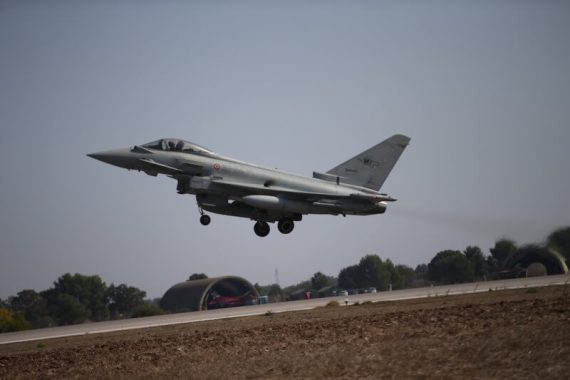
German and Swedish Jets Intercept Russian Military Plane over Baltic Sea
Sweden’s air force confirmed it monitored the Russian aircraft over Estonia, describing its movements as occurring in international airspace.
September 22, 2025
G
erman and Swedish fighter jets intercepted a Russian reconnaissance aircraft over the Baltic Sea on Sunday, the latest in a string of military incursions testing NATO’s air defenses.
According to Germany’s defense ministry, NATO ordered Berlin’s “quick reaction alert force” to investigate an unidentified aircraft flying without a flight plan or radio contact. German Eurofighter Typhoons identified the plane as a Russian IL-20M reconnaissance aircraft before handing the escort over to Swedish NATO partners. The German jets then returned to their base in Rostock-Laage.
Sweden’s air force confirmed it monitored the Russian aircraft, describing its movements as occurring in international airspace. Still, the interception adds to growing unease in the Baltic region, where NATO has faced multiple airspace violations in recent weeks.
On Friday, Estonia accused three Russian MiG-31 jets of entering its airspace for 12 minutes, prompting Tallinn to invoke NATO’s Article 4, which allows members to consult on security threats. Earlier this month, Poland triggered the same provision after more than a dozen Russian drones crossed into its territory, with Prime Minister Donald Tusk calling it “the closest we have been to open conflict since World War II.” Romania also reported Russian drone intrusions.
Russia’s Ministry of Defense has denied all allegations of airspace violations, calling some of them provocations. But NATO allies say the pattern points to deliberate pressure.
“This is exactly what Russia wants — to divert our attention away from helping Ukraine and to focus on our own backyard,” Estonia’s Defense Minister Hanno Pevkur said. “That is a key goal behind these kinds of provocations.”
U.S. President Donald Trump, asked about the incidents, struck a cautious tone: “Well, I don’t love it. I don’t love it when that happens. Could be big trouble.”
The repeated confrontations underscore escalating tensions between NATO and Russia, with the Baltic region now a flashpoint for potential miscalculation.
(Source: Reuters)
Recommended


Politics Today is dedicated to publishing insightful analyses in order to understand the changing nature of contemporary politics. It aims to contribute to the sound and constructive discussion of international affairs.
You can see how this popup was set up in our step-by-step guide: https://wppopupmaker.com/guides/auto-opening-announcement-popups/

Stay informed by subscribing to
our weekly newsletter.
You can see how this popup was set up in our step-by-step guide: https://wppopupmaker.com/guides/auto-opening-announcement-popups/
You can see how this popup was set up in our step-by-step guide: https://wppopupmaker.com/guides/auto-opening-announcement-popups/
You can see how this popup was set up in our step-by-step guide: https://wppopupmaker.com/guides/auto-opening-announcement-popups/
You can see how this popup was set up in our step-by-step guide: https://wppopupmaker.com/guides/auto-opening-announcement-popups/

