Syria and Russia Reach Deal to End Moscow’s Military Use of Key Mediterranean Bases
Despite the reduction of Russia’s military role, Syria’s new leadership has sought to maintain relations with Moscow.
August 12, 2026
S
yria and Russia have reached an agreement that will significantly reshape Moscow’s military presence along Syria’s Mediterranean coast, with Damascus set to take control of two strategically important facilities previously used as Russian military outposts.
Under the agreement announced by Syria’s Foreign Ministry, Syria will assume control of the Hmeimem air base near Latakia and the commercial berth at Tartus port as part of its civil administration. Military facilities at both locations will instead be transformed into joint training and qualification centers.
The ministry described the arrangement as a “reorganizing of the Russian presence” along Syria’s coast and said it represented the most significant development since negotiations began about a year and a half ago.
Russia had been the most important political and military ally of former President Bashar Assad throughout Syria’s civil war. The Hmeimem air base and Tartus naval facility became central pillars of Russia’s military presence in the eastern Mediterranean, allowing Moscow to project air and naval power into the region.
The agreement comes after Assad was overthrown following a lightning insurgency. Russia did not intervene to prevent his removal but subsequently granted asylum to Assad and his family. Russian forces remaining in Syria have gradually withdrawn since the change of government.
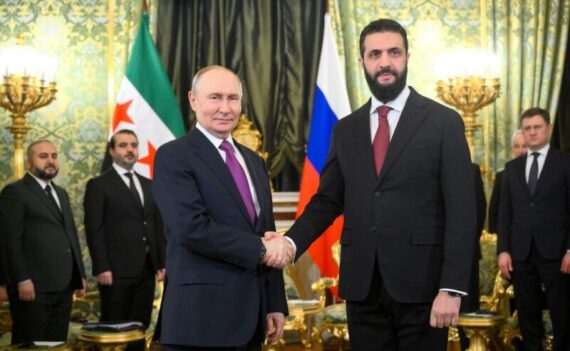
Despite the reduction of Russia’s military role, Syria’s new leadership has sought to maintain relations with Moscow. Interim President Ahmad al-Sharaa has visited Russian President Vladimir Putin in Moscow twice since taking power, with the future of the two Mediterranean facilities among the key issues discussed.
The latest agreement does not appear to end Russian-Syrian cooperation altogether. Instead, the conversion of the military facilities into joint training centers suggests that Damascus and Moscow intend to preserve some form of defense and institutional relationship while reducing Russia’s role as a military power stationed on Syrian territory.
Russia had not immediately issued a public comment on the agreement.
Recommended
The development also reflects a broader transformation in Syria’s foreign policy following Assad’s fall. While Damascus has maintained ties with Moscow, it has simultaneously strengthened relations with Western governments and neighboring Arab states that had distanced themselves from Syria during Assad’s crackdown on opposition protests.
The United States has lifted most of its sanctions on Syria, while European countries have also begun rebuilding diplomatic relations with Damascus.
French President Emmanuel Macron visited Syria in July, during which he announced that France and Syria would appoint ambassadors for the first time in 14 years.
The shift has placed Syria at the center of a wider geopolitical realignment. For years, Russia’s military presence in Syria provided Moscow with a strategic foothold in the Mediterranean and helped sustain Assad’s government. The new arrangement indicates that this role is now being substantially reduced under Syria’s new leadership.
For Damascus, taking control of Hmeimem and the commercial facilities at Tartus represents an important assertion of sovereignty over strategic infrastructure. For Moscow, maintaining joint training facilities could preserve elements of its longstanding relationship with Syria even as its former military footprint is scaled back.
The agreement is likely to become an important marker of Syria’s transition from the Assad era, as the country seeks to balance its longstanding relationship with Russia against growing engagement with Türkiye Europe, the United States and Arab countries.
(Source: CNN)

Politics Today is dedicated to publishing insightful analyses in order to understand the changing nature of contemporary politics. It aims to contribute to the sound and constructive discussion of international affairs.
You can see how this popup was set up in our step-by-step guide: https://wppopupmaker.com/guides/auto-opening-announcement-popups/

Stay informed by subscribing to
our weekly newsletter.
You can see how this popup was set up in our step-by-step guide: https://wppopupmaker.com/guides/auto-opening-announcement-popups/
You can see how this popup was set up in our step-by-step guide: https://wppopupmaker.com/guides/auto-opening-announcement-popups/
You can see how this popup was set up in our step-by-step guide: https://wppopupmaker.com/guides/auto-opening-announcement-popups/
You can see how this popup was set up in our step-by-step guide: https://wppopupmaker.com/guides/auto-opening-announcement-popups/