Outgoing French PM Lecornu Begins Talks to End Political Crisis
Macron’s approval ratings have fallen sharply amid perceptions that he has become increasingly isolated and erratic in his decision-making.
October 7, 2025
F
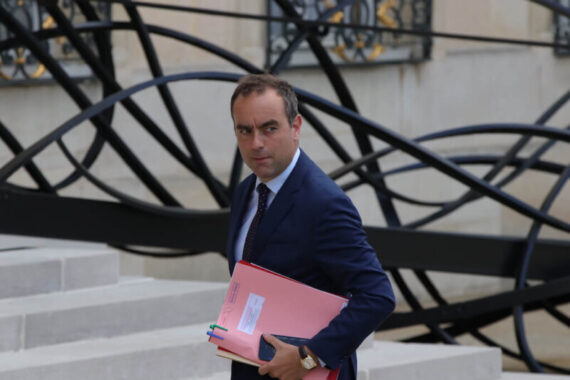
rance’s outgoing Prime Minister Sebastien Lecornu began two days of emergency consultations on Tuesday in a last-ditch attempt to resolve the country’s escalating political crisis, just a day after tendering his resignation following the collapse of his government — the shortest-lived administration in modern French history.
President Emmanuel Macron tasked Lecornu with leading the talks amid mounting confusion, frustration, and criticism from across the political spectrum. The 39-year-old former defence minister, long seen as one of Macron’s closest allies, will meet party leaders and parliamentary heads in a bid to find a viable path forward for the deeply divided National Assembly.
The president has set a Wednesday evening deadline for Lecornu to report back, but even Macron’s supporters have privately expressed doubts about whether the discussions will yield any breakthrough.
“Like many French people, I do not understand the president’s decisions anymore,” said centrist lawmaker and former prime minister Gabriel Attal, voicing a sentiment echoed by many across the political class.
Lecornu’s resignation on Monday morning capped an extraordinary 24 hours in French politics. His cabinet, announced only the night before, was swiftly rejected by both allies and opponents, leaving Macron’s government adrift and underlining the paralysis that has gripped France since last year’s snap parliamentary elections.
The move left Macron without an effective prime minister — the third to step down since June 2024 — and reinforced perceptions of a president struggling to govern amid an unprecedented political stalemate.
Lecornu, standing on the steps of Hotel Matignon after submitting his resignation, said he would “continue to serve France as the president requests,” but did not elaborate on the scope of his new mandate.
The latest political turmoil represents the gravest challenge yet to Macron’s authority since the creation of the Fifth Republic in 1958. France’s semi-presidential system was designed to ensure stability through a strong presidency backed by a clear parliamentary majority. That system has now been upended.
Macron’s decision to dissolve parliament last year — after the far-right National Rally (RN) scored historic gains in European elections — produced a fractured National Assembly with no single party commanding a majority. The result has left Macron’s centrist Renaissance party reliant on fragile alliances and procedural maneuvers to pass legislation.
Since then, efforts to forge a governing coalition have repeatedly failed, and Macron’s opponents — from both the left and right — have seized on the chaos to accuse him of eroding France’s democratic institutions.
The president’s latest attempt to install Lecornu as prime minister was meant to restore order, but the swift rejection of his government instead deepened the perception of drift.
What exactly Lecornu can achieve in two days of talks remains unclear. His schedule on Tuesday included meetings with Gerard Larcher, the conservative president of the Senate; Yael Braun-Pivet, head of the National Assembly; and representatives from Les Républicains (LR), the Socialists, the Greens, and the far-right National Rally.
But there is no clear consensus among parties about the way forward. The left-wing New Popular Front (NFP) coalition, which emerged as the largest bloc after the 2024 elections, has called on Macron to name a prime minister from its ranks — a demand the president has consistently resisted.
A leftist government would likely seek to roll back Macron’s flagship pension reform and alter tax and immigration policies, moves that would reverse much of his second-term agenda. Macron has so far refused to yield to that pressure, arguing that the NFP lacks the cohesion needed to govern effectively.
Opposition leaders have instead urged Macron to either dissolve parliament again or resign — both options the president has firmly ruled out. His term runs until 2027, and under the French Constitution, he cannot seek a third.
“France is stuck in a constitutional deadlock,” said political scientist Dominique Reynié of Sciences Po Paris. “The president refuses to compromise, the opposition refuses to cooperate, and the public has lost patience. The danger is paralysis — or populist revolt.”
The crisis has rattled not only the political establishment but also the country’s economic stakeholders. The head of France’s leading employers’ federation, Medef, warned that prolonged uncertainty could further weaken investor confidence and damage growth.
“We are witnessing a political spectacle that saddens us,” said Patrick Martin, president of Medef, in an interview with Franceinfo radio. “This crisis adds to the concern that already existed within our ranks. We call for responsibility from all political players.”
The French economy has shown resilience in recent quarters but remains vulnerable to slowing European demand, high public debt, and labour unrest. Analysts warn that continued gridlock in Paris could derail key reforms and complicate the 2026 budget process.
Macron’s approval ratings have fallen sharply amid perceptions that he has become increasingly isolated and erratic in his decision-making. The president, who once promised to rejuvenate French politics with centrist pragmatism, now faces accusations of arrogance and detachment.
Lecornu, though still loyal, has also become a symbol of Macron’s narrowing circle of trusted allies. A former defense minister and widely regarded as competent and loyal, Lecornu was expected to steady the government. Instead, his 24-hour administration has become a political embarrassment.
For now, Macron’s immediate goal is to prevent the crisis from spiraling further. Lecornu’s talks are seen as a temporary measure to “buy time” before a new prime minister is appointed — possibly even Lecornu again, though that would likely trigger further backlash.
“Macron is trapped between his refusal to empower the left and his inability to govern alone,” said Reynié. “Every move risks deepening the divide rather than resolving it.”
Recommended
As Lecornu met party leaders behind closed doors in Paris, public frustration simmered. Polls show that more than two-thirds of French citizens believe the country is in a state of political “crisis or decay.”
Outside the National Assembly, a small group of demonstrators held signs reading “Dissolve!” and “Return power to the people.”
With just over eighteen months until France hosts its next presidential election campaign, Macron’s room for maneuver is rapidly shrinking. His vision of a centrist, pragmatic France — resilient against both far-right nationalism and left-wing populism — now faces its toughest test yet.
“France is not ungovernable,” Lecornu said Monday evening, attempting to project calm. “But it must choose dialogue over division.”
For now, however, few in Paris seem confident that dialogue will be enough.
(Source: Reuters)

Politics Today is dedicated to publishing insightful analyses in order to understand the changing nature of contemporary politics. It aims to contribute to the sound and constructive discussion of international affairs.
You can see how this popup was set up in our step-by-step guide: https://wppopupmaker.com/guides/auto-opening-announcement-popups/

Stay informed by subscribing to
our weekly newsletter.
You can see how this popup was set up in our step-by-step guide: https://wppopupmaker.com/guides/auto-opening-announcement-popups/
You can see how this popup was set up in our step-by-step guide: https://wppopupmaker.com/guides/auto-opening-announcement-popups/
You can see how this popup was set up in our step-by-step guide: https://wppopupmaker.com/guides/auto-opening-announcement-popups/
You can see how this popup was set up in our step-by-step guide: https://wppopupmaker.com/guides/auto-opening-announcement-popups/