Madagascar’s President Ousted in Military Coup Following Protests
Home to about 30 million people, Madagascar is one of the poorest nations in the world, despite its rich natural resources and biodiversity.
October 15, 2025
M
adagascar’s President Andry Rajoelina was ousted on Tuesday in a military coup following weeks of massive, youth-led protests demanding his resignation over poverty, corruption, and chronic power outages that have crippled the country. The takeover marks another turbulent chapter in the island nation’s history of political instability, coming 16 years after Rajoelina himself seized power in a similar coup.
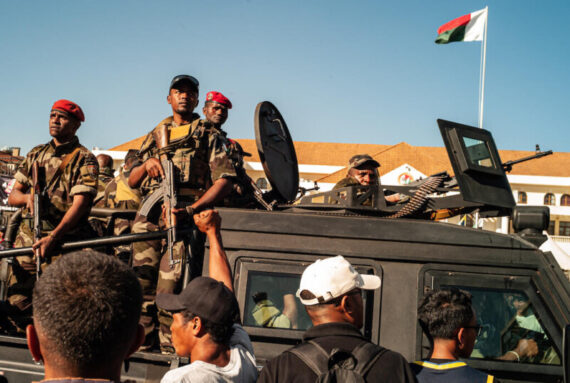
The move came hours after Madagascar’s parliament voted overwhelmingly to impeach the 51-year-old leader, who had already fled the country fearing for his life. In a dramatic announcement outside the ceremonial presidential palace in Antananarivo, Colonel Michael Randrianirina — commander of the elite CAPSAT military unit — declared that the armed forces had assumed control of the government and would form a transitional council composed of army and gendarmerie officers.
“We are taking power,” Randrianirina told reporters to the cheers of thousands of protesters gathered nearby. “The constitution is suspended. We will organize a referendum within two years to establish a new democratic order.”
The military’s declaration effectively ended Rajoelina’s presidency, which had already been under intense pressure from the streets. In a last-ditch attempt to cling to power, Rajoelina issued a decree from an undisclosed location on Tuesday seeking to dissolve parliament’s lower house — but lawmakers ignored him and proceeded with the impeachment vote.
The coup followed weeks of protests driven largely by Gen Z activists frustrated with what they described as years of government mismanagement and neglect. What began as small gatherings over rolling blackouts and water shortages quickly evolved into a nationwide movement demanding an end to corruption and inequality.
“I study in darkness every night because we have no electricity,” said 18-year-old university student Shaniah Rakotohania, who joined the protests in Antananarivo. “If the government cannot even give us light, how can we have a future?”
Protesters flooded the capital’s Independence Avenue and other major squares, waving the national flag and chanting “Rajoelina must go!” as security forces initially responded with tear gas and arrests. But momentum shifted dramatically over the weekend when the powerful CAPSAT unit, long considered loyal to Rajoelina, defected and joined the protesters — a move that sealed his fate.
CAPSAT, which also played a key role in Rajoelina’s own rise to power during the 2009 coup, said on Saturday that it was assuming command of all armed forces. By Tuesday, new military and gendarmerie heads had been appointed, signaling the consolidation of military control.
From hiding, Rajoelina released a video statement Monday night saying he had fled the country for “a safe place” after what he called “a rebellion and an attempt to seize power illegally.” His office later issued a written statement condemning Randrianirina’s declaration as “a serious breach of the rule of law” and vowed that “the Republic of Madagascar cannot be taken hostage by force.”
The ousted president’s whereabouts remain unclear, though sources close to his office said he was believed to have left Madagascar by private plane late Monday.
Rajoelina first came to prominence as the youthful mayor of Antananarivo before leading protests that toppled then-President Marc Ravalomanana in 2009. He later won elections in 2018 and was re-elected in 2023, amid opposition claims of voter manipulation and corruption.
Home to about 30 million people, Madagascar is one of the poorest nations in the world, despite its rich natural resources and biodiversity. It is the largest global producer of vanilla but has long struggled with political upheaval and economic inequality. According to the World Bank, more than 75 percent of its population lives below the poverty line.
The protests that culminated in Rajoelina’s downfall were fueled by deep frustration among the country’s young population, who make up more than half of Madagascar’s citizens. Many demonstrators cited inspiration from other Gen Z-led movements that toppled leaders in Sri Lanka and Nepal in recent years.
“This was not just about politics — it was about dignity,” said 23-year-old protester Soavololona Faraniaina. “We want electricity, jobs, and a future in our own country. We will not stop until Madagascar belongs to its people.”
While protesters celebrated the military’s intervention as a victory for the people, concerns have emerged about the return of military rule in a country that has seen multiple coups since gaining independence from France in 1960.
Recommended
The African Union and the United Nations both called for calm and urged the military to restore constitutional order as soon as possible. In a statement from Addis Ababa, the AU Commission said it was “deeply concerned” by the developments and called for “inclusive dialogue to return Madagascar to democratic governance.”
France, Madagascar’s former colonial power, said it was monitoring the situation closely, while the U.S. State Department condemned the coup and called for the protection of civilians and democratic institutions.
The new military council has pledged to appoint a civilian prime minister “within days” and hold a national dialogue aimed at drafting a new constitution before a referendum in 2027. However, it provided few details about the transition process, leaving many uncertain about the country’s political future.
Analysts warn that the coup could exacerbate instability unless the military commits to a clear and transparent timeline for restoring civilian rule.
“Madagascar has once again entered dangerous territory,” said political analyst Lalao Randriamampionona of the University of Antananarivo. “The challenge will be whether this movement — born out of legitimate frustration — can avoid repeating the cycle of coups that have defined our politics for decades.”
As night fell in Antananarivo on Tuesday, thousands remained in the streets, singing and dancing with soldiers under the glow of phone flashlights — a powerful symbol in a country where power cuts have come to define daily life.
For many, it was a moment of relief, but also of uncertainty. “We have won the first battle,” said Rakotohania. “Now we must make sure our future is not stolen again.”
(Source: The Associated Press)

Politics Today is dedicated to publishing insightful analyses in order to understand the changing nature of contemporary politics. It aims to contribute to the sound and constructive discussion of international affairs.
You can see how this popup was set up in our step-by-step guide: https://wppopupmaker.com/guides/auto-opening-announcement-popups/

Stay informed by subscribing to
our weekly newsletter.
You can see how this popup was set up in our step-by-step guide: https://wppopupmaker.com/guides/auto-opening-announcement-popups/
You can see how this popup was set up in our step-by-step guide: https://wppopupmaker.com/guides/auto-opening-announcement-popups/
You can see how this popup was set up in our step-by-step guide: https://wppopupmaker.com/guides/auto-opening-announcement-popups/
You can see how this popup was set up in our step-by-step guide: https://wppopupmaker.com/guides/auto-opening-announcement-popups/