India’s Modi in Israel: What to Know?
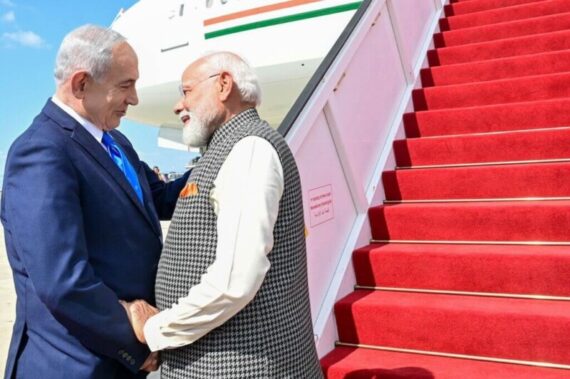
Modi was greeted at Ben Gurion Airport with a personal embrace from Prime Minister Benjamin Netanyahu, who later introduced him to parliament as “Narendra, my dear friend.”
February 26, 2026
I
ndian Prime Minister Narendra Modi received a standing ovation at Israel’s parliament on Wednesday, marking the start of a two-day visit aimed at deepening security, economic and technological cooperation between the two countries.
Modi addressed lawmakers at the Knesset, pledging “friendship, respect and partnership” at a time when Israel faces mounting international criticism over the genocide in Gaza. “Let us ensure that the friendship between India and Israel remains a source of strength in an uncertain world,” he said during a 30-minute speech that was warmly received by members of the governing coalition.
Modi was greeted at Ben Gurion Airport with a personal embrace from Prime Minister Benjamin Netanyahu, who later introduced him to parliament as “Narendra, my dear friend.” The Knesset building in Jerusalem was illuminated in the colors of India’s flag on the eve of his arrival.
Following his address, Knesset Speaker Amir Ohana awarded Modi a medal in recognition of his role in strengthening bilateral relations.
The visit underscores how much ties have grown under Modi, who in 2017 became the first Indian prime minister to visit Israel. Netanyahu reciprocated with a trip to India in 2018, cementing a partnership that has expanded significantly in recent years.
India and Israel established full diplomatic relations in 1992. Since then, defense and technology cooperation have become central pillars of the relationship. India is now Israel’s second-largest trading partner in Asia, with bilateral trade valued at $3.6 billion in the 2025 fiscal year, according to India’s Ministry of Commerce and Industry.
During his speech, Modi emphasized collaboration in security, artificial intelligence, quantum technology and infrastructure development.
“We’re committed to expanding trade, strengthening investment flows and promoting joint infrastructure development,” he said.
Netanyahu praised Modi’s early and unequivocal support for Israel “You didn’t flinch. You didn’t waver. You stood by Israel,” Netanyahu said.
Modi reaffirmed India’s support for a U.S.-backed ceasefire framework for Gaza endorsed by the U.N. Security Council, describing it as a pathway to “a just and durable peace for all the people of the region, including the Palestine issue.”
However, he did not directly address Israel’s newly approved measures to deepen control over parts of the occupied West Bank — steps that India had joined more than 100 countries in condemning earlier this month.
India historically supported the Palestinian cause, but under Modi’s leadership, New Delhi has recalibrated its Middle East policy, strengthening ties with Israel while maintaining diplomatic engagement with Palestinian authorities.
Recommended
The visit also unfolded against the backdrop of domestic political tensions in Israel. Opposition lawmakers briefly walked out of the chamber during speeches by Netanyahu and Speaker Ohana, protesting the exclusion of Supreme Court Chief Justice Yitzhak Amit from the event. They returned for Modi’s address, with opposition leader Yair Lapid assuring the Indian leader that the protest was unrelated to his visit.
Netanyahu, currently on trial for corruption charges, has faced ongoing disputes over judicial reforms that have deeply divided Israeli society.
The high-profile visit is widely seen as a diplomatic boost for Israel as it navigates strained relations with some traditional allies over the Gaza genocide. Modi is scheduled to meet President Isaac Herzog and visit the Yad Vashem Holocaust memorial before concluding his trip.
As Israel seeks to broaden its global partnerships, the public display of solidarity from India — one of the world’s largest economies and most populous nations — signals a deepening strategic alignment between the two governments.
(Source: The Associated Press)

Politics Today is dedicated to publishing insightful analyses in order to understand the changing nature of contemporary politics. It aims to contribute to the sound and constructive discussion of international affairs.
You can see how this popup was set up in our step-by-step guide: https://wppopupmaker.com/guides/auto-opening-announcement-popups/

Stay informed by subscribing to
our weekly newsletter.
You can see how this popup was set up in our step-by-step guide: https://wppopupmaker.com/guides/auto-opening-announcement-popups/
You can see how this popup was set up in our step-by-step guide: https://wppopupmaker.com/guides/auto-opening-announcement-popups/
You can see how this popup was set up in our step-by-step guide: https://wppopupmaker.com/guides/auto-opening-announcement-popups/
You can see how this popup was set up in our step-by-step guide: https://wppopupmaker.com/guides/auto-opening-announcement-popups/