Cost-of-Living Protests Spread to Germany as Hundreds of Thousands March Across France

November 3, 2026

The German demonstrations reflect growing discontent among younger generations over economic pressures, public investment and their role in shaping national policies.
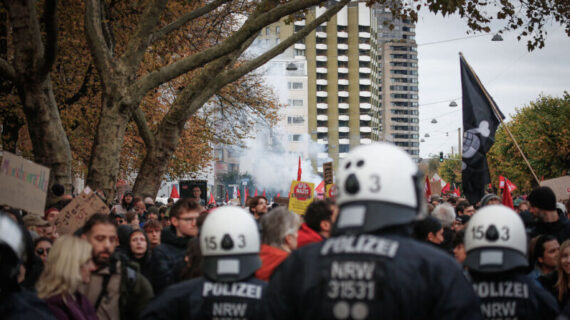
People take part in a protest under the slogan 'GenZ Has Had Enough!' in Cologne, Germany, on 31 October 2026. The nationwide protests denounce cuts to social services and oppose a possible reintroduction of compulsory military service, among other issues. Photo by Anadolu Images.

A

wave of cost-of-living protests spreading across Europe reached Germany over the weekend, as tens of thousands of people joined youth-led demonstrations in major German cities while hundreds of thousands took to the streets across France for another round of rallies.

The demonstrations in Germany, organized under the banner “Gen Z has got this!”, took place on Saturday in cities including Berlin, Frankfurt, Cologne and Munich. Protesters voiced frustration over rising living costs, inadequate funding for schools and universities, environmental concerns and the possibility of reintroducing mandatory military service.

Organizers said approximately 120,000 people participated in demonstrations across Germany, describing the movement as an effort by young people to challenge decisions they believe are being made without their involvement.

“We are young people who no longer want to watch decisions being made about our future without us,” the movement said on its website, emphasizing that its protests were intended to remain peaceful.

The demonstrations coincided with Halloween, a timing organizers said would help increase participation and visibility. Participants were instructed to keep their faces visible, including those wearing costumes.

While the march in Berlin appeared largely peaceful, demonstrations in other cities were marked by clashes and incidents involving emergency personnel.

In Cologne, police deployed water cannons after some demonstrators set off fireworks in the city center. Authorities said their response was directed at individuals engaging in violence rather than peaceful protesters.

In Hamburg, riot police intervened after barriers were set on fire and emergency workers were attacked. Police reported that emergency personnel had been targeted with pyrotechnics and construction materials.

Frankfurt also witnessed serious incidents, including the throwing of Molotov cocktails at emergency personnel and the smashing of shop windows. Police closed part of the Zeil shopping street, arrested a suspect and seized two weapons after windows at a gun shop were broken.

Youth frustration fuels protests across Germany

The German demonstrations reflect growing discontent among younger generations over economic pressures, public investment and their role in shaping national policies.

The movement’s demands extend beyond the immediate cost of living, encompassing concerns about the quality of education, environmental protection and the possibility of compulsory military service.

Authorities had prepared for large demonstrations by deploying additional police officers nationwide. In Berlin, luxury shops along the upscale Kurfürstendamm shopping street boarded up their windows ahead of the rallies as a precaution.

The protests in Germany form part of a wider European wave of demonstrations that has been particularly intense in France, where anger over living costs and public services has merged with the longstanding Yellow Vests movement.

France experienced another nationwide day of demonstrations on Saturday, described by organizers as the third major round of protests following rallies on October 17 and 24.

According to the French Interior Ministry, approximately 320,000 people participated nationwide, including 70,000 in Paris. The turnout was considerably lower than the 550,000 recorded on October 17 and the 410,000 who demonstrated the following week.

By 6 p.m. local time, authorities had detained 296 people across the country.

The French government had warned of a high risk of disorder ahead of the demonstrations. Interior Minister Laurent Nuñez announced restrictions requiring protests to take place outside town centers and ordered the deployment of an additional 70,000 law enforcement officers nationwide.

Most demonstrations remained peaceful, although authorities reported incidents in several cities, including Bordeaux, Toulouse, Rennes, Lille, Nantes, Marseille and Lyon.

The Interior Ministry said groups described as radical elements had attempted to enter city centers with the intention of causing damage and looting. Police said they intervened to prevent those attempts.

France faces renewed security concerns ahead of nationwide strike

Violence has remained a major concern for French authorities since the protests began in late September.

The movement initially emerged among high school students demanding improvements to deteriorating school buildings, action on teacher shortages, additional resources and changes to the university admissions system. It subsequently expanded as other groups, including Yellow Vests protesters, joined demonstrations over economic pressures and government policies.

The scale of the unrest was particularly evident on October 17, when more than 550,000 people demonstrated across France, according to the Interior Ministry. Authorities reported that more than 3,000 shops were attacked or looted, while more than 2,700 people were arrested.

The ministry also said at least 1,193 police officers had been injured since the beginning of the protests, as of October 29.

French President Emmanuel Macron described the violence as a “collective failure,” saying both students and police officers had been caught up in confrontations with serious consequences.

The Halloween weekend added another layer of concern for security forces after calls circulated on social media for separate gatherings invoking the word “purge,” a reference to a film franchise depicting a fictional period during which all crimes are permitted.

Nuñez warned that messages calling for “revolution” and “insurrection” could encourage serious public disorder. He said gatherings linked to those calls would be prohibited.

Paris police also reminded the public that concealing one’s face in public could result in a €150 fine, while carrying a weapon, including a fake one, could lead to a prison sentence of up to three years and a fine of €45,000.

France’s far-right National Rally leader Jordan Bardella called for severe punishment for anyone using improvised incendiary devices against law enforcement.

The latest demonstrations come ahead of November 5, when an inter-union coalition has called for a nationwide strike and mobilization over rising living costs.

With protests spreading beyond France and gaining momentum among younger Europeans, the demonstrations have increasingly highlighted common concerns over economic insecurity, public investment and the influence citizens have over decisions affecting their futures.

(Source: CNN)

Politics Today is dedicated to publishing insightful analyses in order to understand the changing nature of contemporary politics. It aims to contribute to the sound and constructive discussion of international affairs.