T
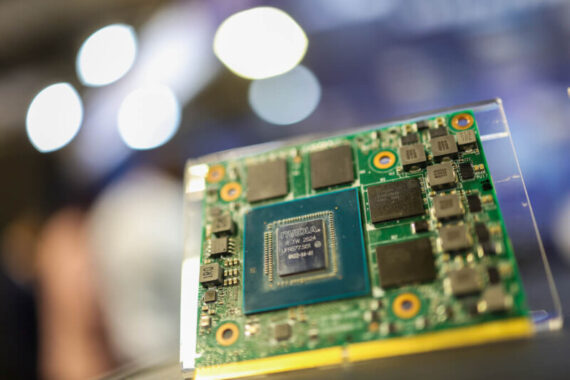
he Trump administration has introduced tighter restrictions on the export of advanced artificial intelligence chips, seeking to prevent China and other countries subject to US arms embargoes from gaining access to sensitive American computing technology.
The Commerce Department announced the new rule on Monday, imposing additional controls on US exports to data centers that provide significant amounts of computing power to companies based in countries such as China, Iran and Russia.
The move comes as President Donald Trump prepares to meet Chinese President Xi Jinping this week, amid growing tensions within his administration over how strictly to regulate the overseas sale of advanced semiconductor technology.
The new restrictions also follow a controversy surrounding Nvidia, the US chipmaking giant, and its former chief executive, Jensen Huang, whose departure has intensified scrutiny of the company’s international business relationships and the government’s export-control policies.
The rule is intended to close loopholes that could allow advanced American chips to reach China indirectly through foreign data centers and intermediary companies. It replaces an export-control policy introduced under former President Joe Biden, which the Trump administration allowed to expire last year after arguing that it placed unnecessary burdens on US businesses.
The Commerce Department’s announcement marks a shift in policy after months of internal disagreement over the restrictions. While some senior administration officials pushed for stronger controls, the department had resisted introducing the measure.
Treasury Secretary Scott Bessent, Secretary of State Marco Rubio and US Trade Representative Jamieson Greer were among those advocating for the new rule, according to sources cited by CNN.
The dispute has highlighted divisions over how Washington should balance national security concerns with the economic and diplomatic consequences of restricting technology exports to China.
Chris McGuire, a senior fellow at the Council on Foreign Relations, described the measure as the first serious attempt in 18 months to address weaknesses in US export controls.
However, experts have cautioned that the effectiveness of the policy will depend largely on how rigorously the Commerce Department enforces it. Although the wording of the regulation appears substantial, its practical impact will be determined by the department’s willingness and ability to investigate potential violations.
The Commerce Department said the rule was written under the direction of the Treasury Department and the National Security Council, an indication of the broader national security concerns driving the decision.

Nvidia controversy exposes divisions within administration
The new restrictions follow growing controversy over Nvidia and its business relationships with foreign data center operators suspected of helping divert advanced American chips to China.
The Commerce and Justice departments began investigating Megaspeed, a Singapore-based data center company and major Nvidia customer, in 2024 as part of a broader investigation into suspected efforts to channel Nvidia chips to China.
The company came under renewed scrutiny following revelations about Huang’s personal relationships, including an extramarital affair with a Chinese woman who worked at Megaspeed. Huang resigned last week after the revelations emerged, including reports that the woman was suspected of having connections to Chinese intelligence.
The scandal has brought renewed attention to the Commerce Department’s responsibility for monitoring the international distribution of advanced American technology.
Earlier this month, Bessent reportedly confronted Commerce Secretary Howard Lutnick during a White House Situation Room meeting, challenging his department’s reluctance to classify Megaspeed as a potential national security threat.
Some officials have argued that Lutnick should have acted more decisively to restrict the company’s access to advanced chips.
The disagreement reflects a wider debate within the administration over whether Washington should prioritize limiting China’s technological capabilities or avoid measures that could provoke an economic and diplomatic confrontation.
Trump acknowledged the differences between Bessent and Lutnick on Monday but dismissed suggestions that the dispute could lead to Lutnick’s dismissal.
Speaking to reporters as he departed the White House for Asia, Trump said the two Cabinet secretaries held different views on how quickly the administration should have acted.
“One wants to be friendly with China, and one wants to have a blow up with China,” he said, adding that both officials were doing well.
Trump also defended the decision to delay designating Megaspeed a national security threat, arguing that immediate action could have triggered a confrontation with Beijing.
He told CNN that Lutnick’s delay was intended to prevent a deterioration in relations with China at a sensitive moment.
Recommended
Beijing response expected after Trump-Xi meeting
The timing of the new restrictions is particularly significant because Trump is scheduled to meet Xi this week. The administration is preparing for a possible Chinese response, although some officials believe Beijing may postpone any retaliation until after the presidential meeting.
According to a senior administration official cited by CNN, China may seek to avoid escalating tensions before the talks.
The new restrictions could nevertheless complicate discussions between the two leaders, as advanced semiconductors and artificial intelligence have become central issues in the broader US-China competition.
Washington has increasingly treated access to advanced computing technology as a national security matter, particularly because powerful chips are essential to developing sophisticated artificial intelligence systems and other military and strategic capabilities.
At the same time, American technology companies have argued that excessive restrictions could weaken their competitiveness by limiting access to international markets and allowing foreign rivals to gain ground.
Trump has sought to balance these competing priorities, emphasizing both the importance of protecting American technology and the need to maintain stable relations with Beijing.
The president also offered support for Huang on Monday, saying he would not object to the former Nvidia chief executive returning to his position.
“I would not mind that,” Trump told reporters, adding that he believed Huang had learned an important lesson.
His comments came amid reports that Huang was considering a possible return to the company. However, a source familiar with the matter told CNN that Nvidia’s board was not considering reinstating him.
Trump has repeatedly praised Huang, describing him as a “legend” following his resignation, despite longstanding national security concerns about the former chief executive among some senior administration officials.
The latest export restrictions therefore come at a critical moment for US technology policy. While the administration is seeking to prevent sensitive chips from reaching China through indirect channels, disagreements over enforcement, commercial interests and relations with Beijing remain unresolved.
(Source: Reuters)