I
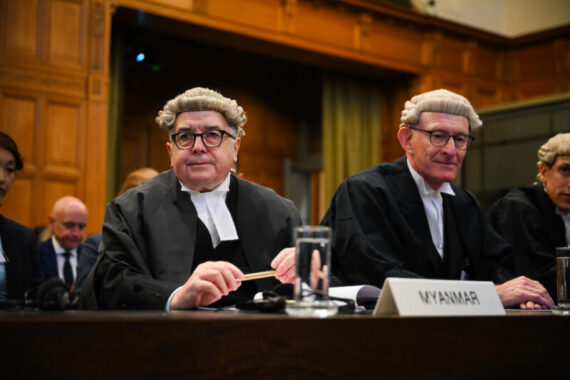
n a landmark decision Thursday, the United Nations’ top court ruled that Myanmar committed genocide against its persecuted Rohingya Muslim minority, holding a state legally responsible for the crime for the first time in the court’s 80-year history.
The International Court of Justice (ICJ), sitting in The Hague, voted nine to six in favor of the ruling following seven years of evidence gathering and witness testimony. Reading the judgment over nearly three hours, presiding judge Iwasawa Yuji stated that the scale and nature of Myanmar’s military operations in northern Rakhine state between 2016 and 2017 revealed “an intention to destroy a substantial part of the group.”
The case was brought in 2019 by The Gambia, a West African nation located thousands of miles from Southeast Asia, in a rare legal move invoking international obligations under the Genocide Convention. While countries such as the United States and Canada had previously labeled the atrocities genocide, the ICJ’s judgment represents the first binding legal determination by the World Court against a nation-state.
Court rejects counterterrorism defense
During the 2016 and 2017 crackdowns, Myanmar’s military burned villages, looted homes, and slaughtered civilians, forcing more than 740,000 Rohingya to flee across the border into neighboring Bangladesh. Survivors reported widespread massacres, sexual violence, and attacks on fleeing families.
Myanmar had argued before the court that its “clearance operations” were legitimate counterterrorism measures targeting Rohingya insurgents rather than an effort to wipe out the population. The ICJ firmly rejected that defense, finding that security forces failed to distinguish between militants and civilians and carried out indiscriminate killings, widespread sexual violence, and extreme violence against children.
On Friday, a spokesperson for Myanmar’s military-backed government dismissed the verdict as “unfair,” pointing to the divided 9–6 vote among the 15 judges. UN human rights chief Volker Türk, however, hailed the ruling as historic, noting its recognition of decades of systemic discrimination and marginalization against the Rohingya.
Global legal and political repercussions
Beyond Myanmar, the ruling carries major implications for international law. The Gambia’s successful bid to bring the case paved the way for South Africa to file its own genocide case at the ICJ against Israel over its war with Hamas in Gaza, which has killed more than 74,000 Palestinians—an allegation Israel denies.
The decision also arrives amid growing friction between international courts and the Trump administration, which has sought to weaken the International Criminal Court and recently criticized the ICJ. Last month, U.S. Ambassador to the UN Mike Waltz accused the World Court of lowering the legal threshold for genocide in the Myanmar case in ways that could be “weaponized” against American troops. Following Thursday’s verdict, a U.S. State Department spokesperson said Washington is reviewing the ruling to assess its implications and warned against the “politicization of the ICJ.”
Recommended
An uncertain future for survivors
For Rohingya survivors, the judgment offered long-awaited validation after nearly a decade in exile. Murshid Alam, 22,who was shot in the ear while fleeing Rakhine state at age 12 and now leads the Rohingya Youth Union in Bangladesh’s sprawling Cox’s Bazar refugee camps—home to over 1.2 million refugees—called the decision a turning point. “It is the difference between being told our history was a tragedy, and being told our history was a crime that must be answered for,” he said.
Still, enforcing the ruling remains a major hurdle. While ICJ judgments are final and binding, the court lacks an enforcement mechanism and relies on the UN Security Council to pass resolutions compelling compliance. The court ordered Myanmar to pay reparations, protect the Rohingya from further persecution, and facilitate their safe, voluntary, and dignified return alongside the restoration of lost property.
Compliance appears unlikely. Myanmar is led by military chief Min Aung Hlaing, who oversaw the 2017 crackdown before seizing power in a coup and has dismissed Rohingya identity as “imaginary.” Meanwhile, Rakhine state is engulfed in civil war, with the ethnic armed Arakan Army controlling much of the territory and Myanmar’s military conducting deadly airstrikes.
In Cox’s Bazar, where refugees face severe aid shortages, restricted work rights, and threats of trafficking, Alam expressed hope that the ruling will eventually lead home. “We want to return to our homeland in Rakhine state with our rights, our citizenship, and our dignity fully restored,” he said.
(Source: CNN)