T
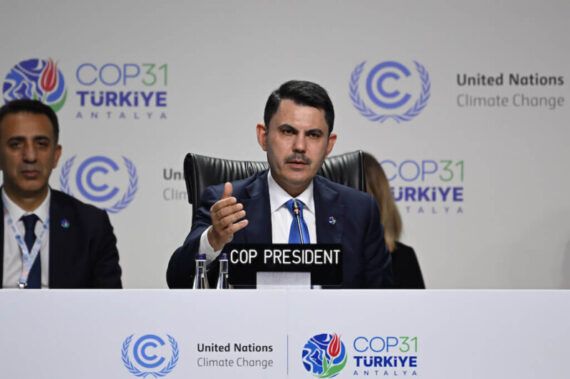
he 31st Conference of the Parties to the United Nations Framework Convention on Climate Change (COP31) concluded with a closing plenary session at the Anadolu Hall within the COP31 venue in Antalya. Addressing delegates, COP31 President and Minister of Environment, Urbanization and Climate Change Murat Kurum emphasized that Türkiye exhausted every avenue for consensus throughout the summit, warning that climate change does not wait for negotiation schedules.
Noting that some countries fell short of the effort required by their historical responsibilities, Kurum stated that while Türkiye respects national priorities, all parties must shoulder greater responsibility on an issue vital to humanity’s shared future. “The world is not waiting, disasters are not waiting, future generations are not waiting,” Kurum said. “As Türkiye, we pushed every possibility for consensus in Antalya. The action agenda we have put forward, the collaborations we have developed, and the international partnerships we have built are the lasting achievements of this effort.”
Diplomatic outreach and a gesture of courtesy to Ghana
Highlighting the intensive two-week diplomatic marathon aimed at ensuring every nation and delegate could voice their views freely, Minister Kurum noted that prior to the closing session, he met with Ghana’s Minister of Environment, Science and Technology, Dr. Zanetor Agyeman-Rawlings, whose remarks had been interrupted during an earlier plenary. Emphasizing that Ghana is a friendly and brotherly nation, Kurum explained that the interruption had occurred solely while maintaining order in the hall to announce a decision, expressing his regret and offering apologies to the Ghanaian government and Minister Agyeman-Rawlings to prevent any misunderstanding.
Kurum explained that preparations and proceedings were guided by close cooperation between Türkiye’s COP31 Presidency, Australia’s Presidency of Negotiations, and the UN Climate Change Secretariat. He recalled that the Antalya Leaders’ Summit, hosted by President Recep Tayyip Erdoğan on November 11–12, brought together 95 countries and seven international organizations at the leader level. To resolve persistent deadlocks, the presidency convened “Divan Meetings,” bringing ministers, negotiating blocs, and observers into the same room to match one country’s obstacles with another’s capabilities. Citing summer heatwaves and wildfires in Spain and France, a glacier collapse in Nepal’s Himalayas in August, and severe flooding in Istanbul in October, Kurum stressed that timely implementation of summit decisions is a moral duty to humanity.

Concrete targets under an “Implementation COP” vision
To ensure COP31 served as a conference of implementation rather than mere negotiation, Türkiye structured its Action Agenda around 10 core priorities bringing together governments, municipalities, financial institutions, businesses, scientists, and civil society. Key milestones highlighted by Kurum include:
- The 35-by-35 Global Electrification Pledge:Nearly 80 countries representing more than half of global energy consumption backed the joint goal of raising electricity’s share in final global energy consumption to 35 percent by 2035, supported by concrete initiatives from over 150 countries, the European Union, 37 cities, and more than 260 companies.
- Global Geothermal 2050 Target:Supported by more than 50 nations, the initiative sets a shared objective to increase global geothermal energy supply twelvefold by 2050.
- Zero Waste and Circular Economy:Building on the global Zero Waste movement championed by First Lady Emine Erdoğan, Chair of the UN High-Level Advisory Board on Zero Waste, the agenda aims to halve the growth rate of municipal solid waste and raise circular material use in production to at least 15 percent by 2035.
- Blue COP and Turquoise Nexus:Launching a “Blue COP” framework to protect seas and oceans, the presidency also strengthened Rio Synergies linking climate, biodiversity, and desertification efforts, while the Turquoise Nexus initiative integrated agricultural production and food security into a unified investment agenda prioritizing women and young farmers. Additionally, global green freight corridors were introduced to advance low-emission logistics.
Recommended
Bridging access to finance and the spirit of “İmece”
Pointing out that turning national climate plans into bankable investments often takes years, Minister Kurum announced the Climate Implementation Bridge (Bridge) to accelerate project preparation, technical assistance, and financing, starting with Ethiopia, Fiji, Indonesia, Pakistan, and Uzbekistan as pilot countries. At the municipal level, Türkiye launched the Sustainable Urban Resilience Financing Facility (SURFF) under İLBANK’s coordination, backed by the World Bank and UN-Habitat.
Kurum underscored that striking the closing gavel does not end Türkiye’s responsibility, pledging close follow-up on every initiative throughout its COP31 Presidency. Invoking the traditional Turkish concept of imece—communal solidarity in which people pool their efforts to accomplish a shared task—he noted that lasting progress happens when municipalities identify needs, scientists measure risks, and financial institutions unlock investment. Concluding the session, Kurum thanked Australian Prime Minister Anthony Albanese, lead negotiator Chris Bowen and the Australian delegation, UN officials, and the residents and local leaders of Antalya for their hospitality throughout the 15-day summit.
(Source: Anadolu Agency)