Abraham Accords 2.0: Saudi–Pakistan Security and a New Middle East
Thus, the Pakistan–Saudi pact should not be seen in isolation. It is part of a larger tectonic movement: the erosion of U.S.-centric hegemony.
September 24, 2025
T
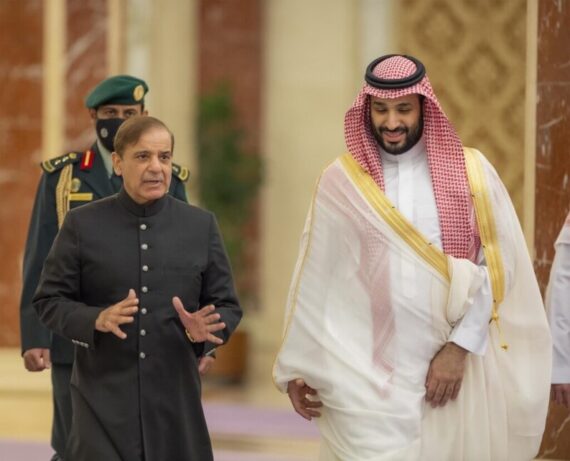
he defense agreement recently concluded between Pakistan and Saudi Arabia is more than a conventional arrangement between two allies. It is a harbinger of a shifting order, signaling how Middle Eastern power is being reconstituted in ways that diminish U.S. centrality while elevating Gulf-driven legitimacy and multipolar alignments. Crystallized against the backdrop of global turbulence, this pact reflects how security, economics, and credibility are being rethreaded into a new fabric of regional architecture.
The Pakistan–Saudi defense agreement carries deep implications. For Saudi Arabia, it adds a new layer of strategic depth. For decades, Pakistan has quietly underwritten Riyadh’s security, particularly through military training and personnel support. By formalizing this cooperation, Saudi Arabia diversifies away from exclusive reliance on Washington at a time when American commitments look increasingly uncertain. For Pakistan, the pact enhances prestige and cements its role as a core partner in shaping Islamic and regional security.
But the broader significance lies in its network effect: once Saudi Arabia anchors itself in such an arrangement, the gravitational pull will inevitably extend across the Gulf Cooperation Council (GCC). The United Arab Emirates, Qatar, Kuwait, Bahrain, and Oman cannot afford to remain outside an emerging defense framework that binds Pakistan and Saudi Arabia together. What begins bilaterally is likely to evolve into a GCC-wide lattice of security arrangements, forming the skeleton of a new Middle Eastern order.
Crucially, Saudi Arabia has positioned this defense pact at the apex of the global power center. It is not framed as a narrow bilateral contract but as part of Riyadh’s sovereign strategy of recalibration: balancing U.S. ties while embedding its security in multipolar circuits that stretch from Islamabad to Beijing and Moscow. This is both hedging and projection, securing the Kingdom against volatility while ensuring that Saudi leadership defines the grammar of regional security. Pakistan, in turn, is elevated from peripheral partner to central architect in this evolving equation.
This realignment intersects directly with the unresolved Palestinian question. For decades, Palestine was treated as a frozen conflict, endlessly deferred while U.S. power guaranteed the regional status quo. That status quo is now unraveling. Recent moves by Western capitals, including recognitions of Palestinian statehood by European governments, are not simply moral awakenings, but signs of the old structure crumbling.
Yet while Europe shows visible adjustment, Washington remains the primary bastion of Israel’s narrative power. Recognition and peace are now treated not merely as ethical gestures, but as instruments of realignment in the global balance of power. In this context, Saudi Arabia’s insistence that normalization with Israel must pass through Palestinian recognition is not mere symbolism; it is a geopolitical condition backed by sovereign wealth, strategic independence, and Chinese leverage.
This places Israel at a crossroads. For decades, it thrived as Washington’s forward outpost, the spearhead of U.S. regional dominance, and the beneficiary of unconditional American support. That model is now fraying. To endure in the emerging landscape, Israel must pivot from reliance on unilateral American security guarantees to anchoring itself within a regionally mediated framework of validity. It must adapt to the logic of what might be called Abraham Accords 2.0: a framework where normalization is inseparable from Palestinian recognition and GCC mediation.
This carries profound political implications inside Israel itself. The maximalist politics embodied by Benjamin Netanyahu, deeply tied to a vanishing unipolar moment, no longer fit the realities of a multipolar Middle East. The future will belong to Israeli leaders capable of embedding their state into regional designs of cooperation, rather than clinging to unilateral hegemony.
What is manifesting is not state collapse, but the rise of a new formation: autonomous regional finance, security, and trade frameworks. Here, the Gulf states are already gaining disproportionate influence, economically, diplomatically, in energy, tech, and investment. The real divide ahead is less Israel vs. Iran and more dependency vs. independence; global alignment vs. regional resilience; old patronage vs. new investment.
Recommended
Within this emerging regional architecture will appear a new Israel, likely post-Netanyahu, integrated into the system rather than dominating it. That transition is already unfolding, not only in the U.S. political arena but within its power structure itself, where competing narratives are contesting Israel’s future place in a Gulf-centered order. In such a system, Israel is no longer the pivot, but one actor among many in a Gulf-dominated framework. And this is precisely why Israel’s strike in Qatar was less about Hamas itself than about disrupting the very system now taking shape.
In this reconfiguration, the U.S. role is instructive not by its dominance but by its erosion. Washington remains powerful, but its monopoly on dictating the terms of Middle Eastern politics is gone. It cannot unilaterally impose solutions in Palestine, nor can it guarantee Israel’s regional acceptance. Instead, the United States is becoming one actor among many, still influential, but increasingly compelled to negotiate with the gravitational fields generated by Riyadh, Beijing, Moscow, and now Islamabad. The very fact that Western recognition of Palestine is accelerating without U.S. orchestration underscores this diffusion of power.
Here, the rise of BRICS is decisive. The alignment of Russia, China, and Iran, anchored in coordinated policy, military cooperation, and alternative financial systems, has forged a new axis of resilience. No longer isolated, Iran is now embedded in a hardened geopolitical circuit: shielded by eastern powers and engaging pragmatically with Gulf actors. What was once styled the “axis of resistance” has matured into an axis of integration. This is not the region’s disintegration, but its reassembly, and therein lies its durability.
Thus, the Pakistan–Saudi pact should not be seen in isolation. It is part of a larger tectonic movement: the erosion of U.S.-centric hegemony, the recalibration of Israel’s place within regional politics, and the repositioning of Palestine from a deferred issue to a litmus test of standing. What begins with a defense pact in Riyadh and Islamabad reverberates through Doha, Abu Dhabi, and beyond, ultimately converging on the question of Jerusalem.
The contours of the emerging landscape are clear. It is multipolar, Gulf-centered, and legitimacy-driven. It binds security to sovereignty, finance to diplomacy, and recognition to survival. In this edifice, neither the United States nor Israel can dictate terms unilaterally. Instead, the power to define regional order now flows increasingly from the Gulf and the Pakistan–Saudi Defense Agreement is one of the clearest signals yet that a new Middle East is being born.

Khalid Latif is an Independent Research Analyst based in Islamabad and a graduate of Tufts University. He can be reached at klatif@gmail.com
You can see how this popup was set up in our step-by-step guide: https://wppopupmaker.com/guides/auto-opening-announcement-popups/

Stay informed by subscribing to
our weekly newsletter.
You can see how this popup was set up in our step-by-step guide: https://wppopupmaker.com/guides/auto-opening-announcement-popups/
You can see how this popup was set up in our step-by-step guide: https://wppopupmaker.com/guides/auto-opening-announcement-popups/
You can see how this popup was set up in our step-by-step guide: https://wppopupmaker.com/guides/auto-opening-announcement-popups/
You can see how this popup was set up in our step-by-step guide: https://wppopupmaker.com/guides/auto-opening-announcement-popups/