At Least 600 Killed as Powerful Earthquake Strikes Afghanistan
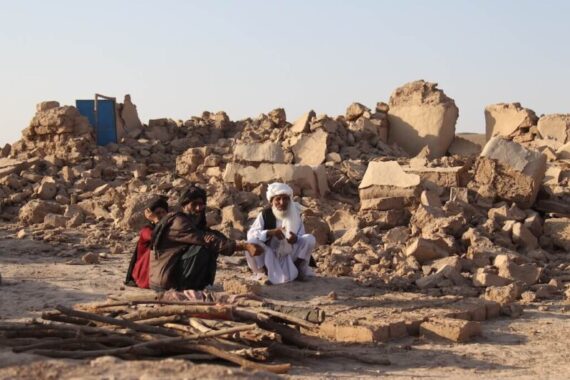
The epicentre of the quake was recorded in Kunar province. Entire villages in Kunar have been badly hit.
September 1, 2025
A
powerful earthquake has devastated eastern Afghanistan, killing at least 610 people and injuring more than 1,300, according to a government spokesman, in one of the deadliest tremors to hit the country in recent years.
The 6.0-magnitude quake struck at 11:47 p.m. local time (19:17 GMT) on Sunday in Kunar province, near the city of Jalalabad in neighboring Nangarhar province, flattening mud and stone homes, destroying villages, and triggering landslides in the mountainous terrain, local officials and residents said.
Another 4.5-magnitude aftershock was recorded a short while later near Basawul in Nangarhar, further shaking already-damaged structures and sending residents scrambling for safety.
“The epicentre of the quake was recorded in Kunar province. Entire villages in Kunar have been badly hit,” said Mohsin Momand, Al Jazeera’s correspondent in Kabul. “Emergency teams are being deployed from Kabul and nearby provinces. Officials are pledging to use all available resources to rescue people and support affected families.”
The disaster struck a region already struggling with poverty and limited infrastructure. Homes in Kunar and neighboring provinces are predominantly built of mud and rocks, unable to withstand the tremor’s force, especially given its shallow depth of just 8 kilometers (5 miles).
“Kunar is an impoverished and mountainous region,” said Kamal Hyder, reporting from Lahore, Pakistan. “The houses there are very vulnerable… It also happened late at night, when a lot of people were inside their homes.”
Rescue efforts have been hampered by rugged terrain, damaged roads, and widespread landslides that have blocked access to remote settlements. Local authorities warned that the death toll could rise significantly as more reports come in from outlying districts.
“Hundreds are feared dead,” Hyder added. “Access is very difficult, because such earthquakes would definitely have caused landslides. Whatever operation is going to be underway has to be within the critical hours to reach those remote locations.”
The quake’s tremors were felt across vast areas of neighboring Pakistan, including Khyber Pakhtunkhwa and Punjab provinces, where residents were jolted awake late at night. No major damage was immediately reported there.
Afghanistan, straddling the collision zone of the Indian and Eurasian tectonic plates, is highly prone to seismic activity. “It’s a very tectonically active area… the Indian plate is moving northwards and sliding past parts of Eurasia,” said Chris Elders, emeritus professor at Curtin University’s School of Earth and Planetary Sciences in Western Australia.
He warned that earthquakes in the region often trigger secondary disasters. “It’s not only the buildings that will shake and become unstable, but the hillsides will also shake and become unstable, and that is what triggers the landslide,” he said.
Taliban officials said emergency relief convoys had been dispatched from Kabul, while local hospitals in Jalalabad and Kunar have been overwhelmed with casualties. Images showed volunteers carrying the wounded on stretchers and loading bodies into ambulances.
“We are mobilizing all available resources to rescue survivors and provide medical assistance,” a government spokesman said, calling on international aid agencies to assist in the response.
The United Nations and the International Federation of Red Cross and Red Crescent Societies said they were monitoring the situation and preparing to deploy emergency relief teams.
Afghanistan has experienced a series of devastating earthquakes in recent years, compounded by decades of conflict and underdevelopment that have left much of its housing stock weak and emergency response capacity limited.
In October 2023, a quake in western Afghanistan killed at least 2,400 people, while in June 2022, a 5.9-magnitude earthquake in Paktika province left over 1,100 dead.
Seismologists warned that the region remains vulnerable to further aftershocks in the coming days. Residents in affected provinces spent the night in open fields and makeshift shelters, fearing more tremors.
Condolences poured in from across the region, with Pakistan’s Prime Minister expressing “deep sorrow over the tragic loss of life” and pledging to send aid convoys. The European Union said it stood ready to provide humanitarian support.
Aid groups, however, cautioned that delivering assistance would be complicated by Afghanistan’s challenging topography and limited international engagement since the Taliban takeover in 2021.
“This is a race against time,” said a representative from Médecins Sans Frontières (Doctors Without Borders). “Landslides, blocked roads, and damaged infrastructure make it extremely difficult to reach those in need. The critical hours for rescuing people alive are already ticking away.”
Recommended

As rescue teams dig through rubble and families bury their dead, many Afghans are expressing frustration over the country’s vulnerability to natural disasters. Decades of war, sanctions, and isolation have left critical infrastructure in disrepair.
“This tragedy shows again how exposed we are,” said Abdul Rahman, a teacher from Jalalabad whose village was partially destroyed. “We need help, not just today, but to rebuild stronger homes and prepare for the future.”
The Afghan government declared three days of mourning and said it would release emergency funds for affected provinces. International observers said the disaster could also become a major test of the Taliban’s governance and its ability to coordinate with foreign relief agencies amid strained relations with much of the world.
(Source: Aljazeera English)

Politics Today is dedicated to publishing insightful analyses in order to understand the changing nature of contemporary politics. It aims to contribute to the sound and constructive discussion of international affairs.
You can see how this popup was set up in our step-by-step guide: https://wppopupmaker.com/guides/auto-opening-announcement-popups/

Stay informed by subscribing to
our weekly newsletter.
You can see how this popup was set up in our step-by-step guide: https://wppopupmaker.com/guides/auto-opening-announcement-popups/
You can see how this popup was set up in our step-by-step guide: https://wppopupmaker.com/guides/auto-opening-announcement-popups/
You can see how this popup was set up in our step-by-step guide: https://wppopupmaker.com/guides/auto-opening-announcement-popups/
You can see how this popup was set up in our step-by-step guide: https://wppopupmaker.com/guides/auto-opening-announcement-popups/