Serbia’s Anti-Government Protests Escalate as Clashes Spread
Serbia witnessed more violent confrontations as anti-government protesters and supporters of President Aleksandar Vucic clashed in several cities.
August 14, 2025
S
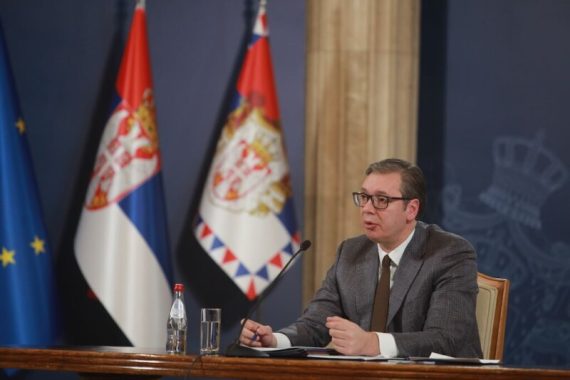
erbia witnessed a second consecutive night of violent confrontations on Wednesday as anti-government protesters and supporters of President Aleksandar Vucic clashed in several cities, marking one of the most turbulent moments in more than nine months of demonstrations.
The unrest has intensified since Tuesday, when violent exchanges in the northwestern town of Vrbas left dozens injured, including 16 police officers, and resulted in multiple arrests. Similar confrontations spread Wednesday to the capital Belgrade, Novi Sad, Kraljevo, Kragujevac, Cacak, and Nis, prompting the deployment of riot police nationwide.
In Novi Sad, a city that has been at the heart of the protests, Vucic’s supporters threw flares toward anti-government demonstrators gathered near the offices of the ruling Serbian Progressive Party (SNS). Protesters responded by smashing the building’s windows. Riot police quickly intervened, forming a security cordon to prevent further damage.
Interior Minister Ivica Dacic confirmed at least one police officer was injured during Wednesday’s confrontations and called for the “return of law and order.”
In Belgrade, thousands took to the streets in separate rallies. Riot police used tear gas in at least one part of the city to disperse anti-government crowds, while elsewhere they maintained a tense line between opposing camps. In the central town of Kraljevo, security forces physically separated rival groups to prevent further escalation.
The wave of protests began in November after a canopy collapsed at a train station in Novi Sad, killing 16 people. The tragedy sparked widespread outrage, with protesters blaming the disaster on corruption and negligence in state infrastructure projects.
Initially led by university students, the demonstrations have since swelled to include hundreds of thousands of participants from across the country, united in their demands for greater government accountability, early parliamentary elections, and the resignation of senior officials, including Dacic.
Vucic has so far refused to call early elections, dismissing the protests as politically motivated attempts to destabilize the country.
In recent weeks, Vucic’s supporters have begun staging counterdemonstrations, often setting up camps outside key government buildings. On Wednesday evening, pro-government media reported that Vucic visited a camp of his supporters outside the presidency building in downtown Belgrade, describing anti-government demonstrators as “thugs.”
The president’s rhetoric has drawn criticism from opposition groups, who accuse the government of inflaming tensions and misrepresenting the nature of the protests. While most demonstrations since November have been peaceful, the past two days have seen a sharp increase in violence.
Protesters claim that government supporters initiated Tuesday’s violence in Vrbas, as well as incidents in Backa Palanka, Novi Sad, and Nis. In Vrbas, images from the scene showed SNS supporters throwing flares, rocks, and bottles at protesters, who responded in kind. Police intervened to separate the groups but reported dozens of injuries.
Police Commissioner Dragan Vasiljevic told state-run RTS television that the protesters “came to attack” the governing party’s supporters outside party offices — a claim the protesters dispute.
Recommended
The unrest poses a challenge for Vucic, who has maintained a firm grip on power for 13 years. Serbia is a formal candidate for European Union membership, but critics say democratic freedoms have eroded under his leadership. At the same time, Vucic has balanced close ties with Russia and China, fueling unease among some Western allies.
The protests come at a sensitive time for Serbia’s foreign policy ambitions. EU officials have repeatedly emphasized that progress toward membership depends on reforms in governance, rule of law, and media freedom. Domestic unrest and allegations of heavy-handed policing risk further complicating accession talks.
Authorities have urged both sides to refrain from violence, but the political polarization shows no sign of easing. Dacic, the interior minister, vowed that police would “continue to secure order on the streets” and warned of more arrests if clashes continue.
Student organizers, meanwhile, have announced that protests will go on until their demands are met. “We will not be silenced by intimidation,” one student leader in Belgrade told reporters. “This is about the future of our country and the right to live without fear and corruption.”
As night fell on Wednesday, Belgrade’s streets were still heavily patrolled by riot police. Protest organizers said they plan to regroup on Thursday, while government supporters vowed to maintain their own presence in public spaces.
For now, Serbia’s political crisis appears set to deepen, with the potential for more confrontations in the days ahead.
(Source: The Associated Press)

Politics Today is dedicated to publishing insightful analyses in order to understand the changing nature of contemporary politics. It aims to contribute to the sound and constructive discussion of international affairs.
You can see how this popup was set up in our step-by-step guide: https://wppopupmaker.com/guides/auto-opening-announcement-popups/

Stay informed by subscribing to
our weekly newsletter.
You can see how this popup was set up in our step-by-step guide: https://wppopupmaker.com/guides/auto-opening-announcement-popups/
You can see how this popup was set up in our step-by-step guide: https://wppopupmaker.com/guides/auto-opening-announcement-popups/
You can see how this popup was set up in our step-by-step guide: https://wppopupmaker.com/guides/auto-opening-announcement-popups/
You can see how this popup was set up in our step-by-step guide: https://wppopupmaker.com/guides/auto-opening-announcement-popups/