Thailand Launches Airstrikes as Border Conflict with Cambodia Reignites
Cambodia’s Defense Ministry said Thai forces launched dawn attacks after “days of provocative actions” but emphasized that Cambodian units had not fired back.
December 8, 2025
T
hailand carried out airstrikes against Cambodian military positions on Monday after heavy fighting erupted along contested sections of their 817-kilometer border, shattering a ceasefire agreement brokered earlier this year by U.S. President Donald Trump and Malaysian Prime Minister Anwar Ibrahim.
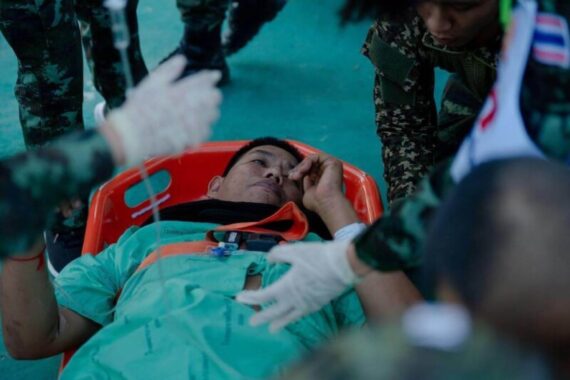
The Thai military said the renewed clashes began around 5 a.m. local time (2200 GMT) when Cambodian forces allegedly opened fire on Thai troops, killing one soldier and wounding eight. Thai Air Force officials said air support was then deployed to “deter and reduce Cambodia’s military capabilities” after Phnom Penh allegedly mobilized heavy weaponry and repositioned combat units near frontline areas.
Cambodia rejected the accusation, saying its forces had come under unprovoked attack at two locations. Its Defense Ministry insisted Cambodian troops had not retaliated and accused Bangkok of “dangerous provocations” undermining the October ceasefire agreement.
The escalation marks the most serious confrontation between the two Southeast Asian neighbors since intense five-day clashes in July left at least 48 people dead—mostly civilians—and forced an estimated 300,000 residents to flee their homes
Thai authorities said more than 385,000 civilians in four border districts were being moved to safety, with over 35,000 already sheltering in temporary facilities set up across Buriram and Surin provinces. Residents described sustained gunfire and explosions.
“It startled me. The explosions were very clear. Boom boom!” said Phichet Pholkoet, a resident of Ban Kruat district. “I could hear both heavy artillery and small arms.”
Across the border in Cambodia’s Oddar Meanchey province, local officials said more than 1,100 families had been evacuated as artillery fire echoed across multiple areas. Opposition politician Meach Sovannara told Reuters from Samroang town that he heard continuous shelling as residents fled deeper inland.
A senior Cambodian provincial official said three civilians were seriously wounded in the latest clashes.
Tensions between the two nations began rising in May, when a Cambodian soldier was killed during a brief exchange of gunfire, the first fatal incident since 2011. The row escalated sharply in July after a landmine blast injured a Thai soldier, prompting Bangkok to recall its ambassador and announce Cambodia’s ambassador would be expelled.
A day later, armed clashes erupted across multiple points along the disputed frontier. Thailand deployed F-16 jets, one of which bombed a Cambodian position. Heavy artillery fire and rocket attacks soon spread, marking the worst fighting in more than a decade.
International mediation intensified. On July 26, U.S. President Trump phoned the leaders of both countries and pushed for a ceasefire, linking progress in border talks to the resumption of separate bilateral negotiations on U.S. trade tariffs. Malaysia, the United States, and China also urged restraint.
On July 28, Cambodian Prime Minister Hun Manet and Thai leaders signed a ceasefire in Putrajaya, Malaysia. A more comprehensive agreement followed on Oct. 26 in Kuala Lumpur, witnessed by Trump, whose involvement drew a Nobel Peace Prize nomination from Cambodia.
By early November, both sides began withdrawing heavy weaponry and conducting de-mining operations. Cambodia said it expected full withdrawal by the end of the year.
But the truce began to fray within days. On Nov. 11, Thailand announced it was halting implementation after a landmine blast severely injured a Thai soldier. Bangkok accused Cambodia of laying new mines—charges Phnom Penh has repeatedly denied.
Reuters reported in October that expert analysis indicated at least some mines recovered along the frontier appeared recently laid.
On Nov. 12, just one day after the Thai move, a Cambodian civilian was killed as both sides again accused each other of opening fire.
The fragile peace broke down completely on Dec. 8, with Thai airstrikes marking the first cross-border aerial operations between two ASEAN member states in years.
Cambodia’s influential former premier Hun Sen—father of current Prime Minister Hun Manet—warned that Thai forces were acting as “aggressors” and trying to “provoke a retaliatory response.” In a Facebook post, he urged commanders “at all levels” to exercise restraint, saying the “red line” for a response had already been set but did not elaborate.
Cambodia’s Defense Ministry said Thai forces launched dawn attacks after “days of provocative actions” but emphasized that Cambodian units had not fired back.
Recommended
Malaysian Prime Minister Anwar Ibrahim, who facilitated the July ceasefire and witnessed the expanded October agreement, warned that renewed fighting “risks unravelling the careful work that has gone into stabilizing relations.”
He urged both sides to maintain communication channels and exercise maximum restraint, noting that cross-border airstrikes between ASEAN countries are exceptionally rare.
The border, originally delineated in French colonial-era maps from 1907, has remained a source of periodic tension. Attempts over the years to demarcate the frontier through bilateral and regional mechanisms have repeatedly stalled, with disputes erupting sporadically—most notably during a weeklong artillery exchange in 2011.
With both sides now exchanging accusations of ceasefire violations and mobilizing additional forces, regional diplomats warn the conflict risks further escalation unless direct communication is restored.
Thailand said operations would continue “to protect sovereignty and ensure the safety of civilians,” while Cambodia said it would not respond unless its troops were attacked again.
As tens of thousands flee their homes for the second time in five months, fears are growing that the latest fighting could spiral beyond limited border skirmishes.
(Source: Reuters)

Politics Today is dedicated to publishing insightful analyses in order to understand the changing nature of contemporary politics. It aims to contribute to the sound and constructive discussion of international affairs.
You can see how this popup was set up in our step-by-step guide: https://wppopupmaker.com/guides/auto-opening-announcement-popups/

Stay informed by subscribing to
our weekly newsletter.
You can see how this popup was set up in our step-by-step guide: https://wppopupmaker.com/guides/auto-opening-announcement-popups/
You can see how this popup was set up in our step-by-step guide: https://wppopupmaker.com/guides/auto-opening-announcement-popups/
You can see how this popup was set up in our step-by-step guide: https://wppopupmaker.com/guides/auto-opening-announcement-popups/
You can see how this popup was set up in our step-by-step guide: https://wppopupmaker.com/guides/auto-opening-announcement-popups/