The Transformation of the Global Defense Economy, NATO and Türkiye

August 11, 2026

The defense industry infrastructure that Türkiye has established over the past 20 years, and in particular its clusters, will provide a significant competitive advantage during this new period of expansion in global defense spending.
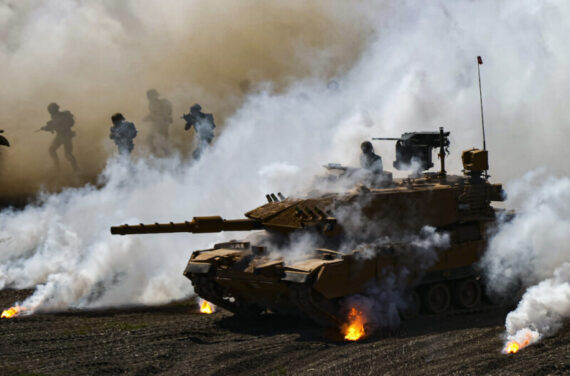
A view of the daytime activities as part of the Distinguished Observer Day of the EFES-2026 Exercise, one of the largest combined joint exercises of the Turkish Armed Forces (TSK) in Izmir, Turkiye, on May 21, 2026. Photo by Anadolu Images.

T

he geopolitical upheavals experienced in the international security environment in recent years are fundamentally altering the position of defense spending within economic policy. Increasing strategic competition on a global scale – particularly deepening security risks in the Middle East, such as the Russia-Ukraine War and the US/Israel-Iran War– alongside energy supply security, supply chain continuity and the global race for critical technologies, is leading to a reshaping of defense spending. In particular, NATO’s decision to raise member states’ defense spending to 5 percent of gross domestic product (GDP) in the long term signals the start of a new era, not only in security policies but also in global industrial production and technology investment. This has sparked a debate as to whether defense spending could become the new engine of economic growth.

For many years, defense spending has been assessed within the framework of the opportunity cost approach. This approach argues that public resources allocated to defense have a restrictive effect—albeit to a relative degree—on economic growth, as they are diverted from productive sectors such as education, healthcare or infrastructure investment. However, the technological transformation and changes in the security architecture over the past twenty years have necessitated a reassessment of this approach. Today, defense expenditure is viewed not merely as current expenditure-focused public spending aimed at building military capability, but as multifaceted investments that support high-tech production, research and development (R&D) activities, and export capacity.

How do defense expenditures affect economic equilibrium?

The economic effects of defense expenditures are now analyzed not only from the perspective of fiscal policy but also from the perspectives of industrial policy and technological transformation. The economic impact of defense expenditures is realized through a multi-stage transmission mechanism. In the first stage, public expenditure stimulates demand, thereby increasing aggregate demand, expanding production volumes, raising capacity utilization rates and supporting industrial production. Due to their high capital intensity, defense projects generate increased production across numerous sub-sectors, notably machinery manufacturing, electronics, metallurgy, composite materials, software and communications technologies. Thus, defense expenditure creates a powerful multiplier mechanism that mobilizes a broad supply chain.

In the second stage, R&D investments come into play. Defense projects involve significant R&D expenditure due to their high-technology nature. Technologies developed within the defense industry are transferred to other sectors over time, thereby creating long-term positive effects on productivity.

The third stage is the external balance channel. Owing to its high technology intensity, the defense industry is one of the sectors with the highest export value per kilogram. The export of defense products contributes to the current account balance and, at the same time, enables countries to move up the global technology value chain. For this reason, the defense industry is today recognized as one of the strategic determinants of high-value-added exports.

However, the effectiveness of this transfer mechanism depends largely on domestic production capacity. In countries that procure defense systems largely through imports, increasing defense budgets lead to significant outflows of foreign exchange, whereas in economies with domestic production capacity, the same expenditure is channeled back into the economy in the form of increased production, employment, technology development and exports. Consequently, the economic return on defense expenditure is linked not so much to the size of the budget as to the extent to which expenditure can be channeled into the domestic industry.

In this new global context, Türkiye’s production capacity constitutes a notable advantage. As a result of the localization policies implemented over the past twenty years, dependence on foreign sources in the defense industry has been significantly reduced. Within the defense industry, capabilities in design, system integration and high-technology production have been markedly enhanced. Consequently, defense expenditure has evolved from a structure heavily reliant on imports to a production model that generates domestic added value.


What is the contribution of Turkish defense industry companies to the economy?

One of the most significant indicators of this transformation is Türkiye’s rise in global defense exports. Over the past twenty years, Türkiye’s share of global defense exports has grown steadily and, as a result, Türkiye has become one of the key suppliers in the global defense market. This rise in export performance demonstrates that the defense industry has transformed into a strategic production ecosystem that competes in international markets, exports technology and generates foreign exchange.

Institutional transformation is equally noteworthy. Whilst in 2009 ASELSAN was the sole company representing Türkiye amongst the world’s top 100 defense industry firms, in recent years TUSAŞ, ROKETSAN, ASFAT and MKE have joined ASELSAN on the same list. The fact that companies such as STM, HAVELSAN, FNSS and BMC have entered the global top 100 defense industry companies in different years demonstrates that Türkiye’s defense industry has evolved from a single-company-centered structure into a multi-stakeholder, deepened and technologically diversified industrial ecosystem.

This rise in international company rankings is directly reflected in Türkiye’s industrial performance. An analysis of the Istanbul Chamber of Industry’s ISO 500 survey reveals that defense industry companies are steadily strengthening their positions among Türkiye’s largest industrial organizations in terms of sales from production. It is particularly noteworthy that, as of 2025, TUSAŞ has become Türkiye’s seventh-largest industrial organization, while ASELSAN has become the ninth-largest. Export performance at the company level also confirms this transformation. While ASELSAN’s export revenues have reached an all-time high in recent years, TUSAŞ has risen to the status of a key manufacturer within global aerospace and defense supply chains, with export volumes hovering at the billion-dollar level. This picture demonstrates that the Turkish defense industry has gained international competitiveness not only in platform production but also in areas such as electronic systems, avionics solutions, software, engineering services and systems integration.

How will defense expenditure take shape in the coming period?

In this regard, NATO’s plan to accelerate defense investments over the next decade is of considerable importance for Türkiye. This does not merely signify a larger export market for Türkiye. It also holds the potential to strengthen Türkiye’s strategic position within the supply chains of NATO countries, thanks to its production infrastructure with high local content, advanced engineering capabilities and defense companies capable of competing on a global scale. The growing demand from Alliance countries for defense industry products is creating long-term investment and export opportunities for the Turkish defense industry.

In conclusion, the global defense economy has entered a new phase of structural transformation. Defense expenditure is regarded not merely as public spending to meet security needs, but as strategic investments that support technology development, high-value-added production and export capacity. In the coming period, competition between countries will be shaped not so much by the size of defense budgets, but by the capacity of industrial ecosystems to convert these budgets into production, technology and exports.

The defense industry infrastructure that Türkiye has established over the past 20 years, and in particular its clusters, will provide a significant competitive advantage during this new period of expansion in global defense spending. For this reason, the defense industry will continue to be one of the key pillars of both national security and Türkiye’s development strategy, which is based on sustainable growth, high-tech production and exports.

(Originally published in Turkish by Kriter)

He received his bachelor's degree in English Economics from Marmara University in2006, his master's degree in Management Sciences from Gazi University in 2013, and his doctorate in English Finance and Banking from Ankara Yıldırım Beyazıt University in2019. Since beginning his professional career in 2007, he has worked at the Scientific andTechnological Research Council of Turkey (TÜBİTAK), the Central Bank of the Republicof Turkey (TCMB), and the Turkish Energy, Nuclear and Mining Research Institute(TENMAK), holding various managerial positions. Since 2023, he has been working atAnkara Medipol University. His primary areas of research include the financial and governance structures of the real sector and the banking sector, as well as data analytics.