T
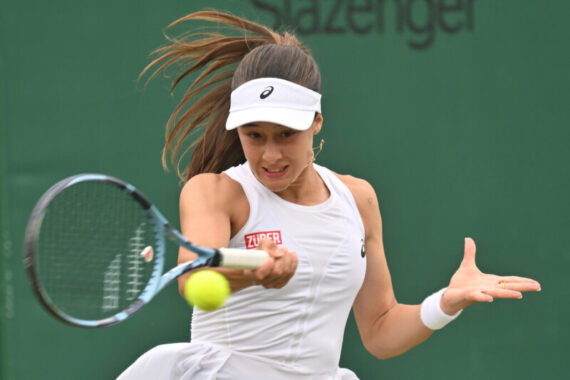
urkish tennis player Zeynep Sönmez has attracted international attention both for her historic performances at Wimbledon and for a symbolic display of solidarity with Palestinians after tournament officials barred her from wearing a pro-Palestinian badge.
The 24-year-old became one of the tournament’s most talked-about players after using a watermelon-shaped vibration dampener on her racket — a symbol widely associated with Palestinian identity and solidarity because it shares the colors of the Palestinian flag.
Sönmez said Wimbledon officials prohibited her from wearing a pro-Palestinian brooch during the tournament, prompting her to adopt the watermelon symbol instead.
“I used to wear a brooch, but tournaments no longer allow me to wear it,” Sönmez told Türkiye’s Anadolu Agency.
She questioned what she described as inconsistent standards governing political expression in tennis, noting that players have been permitted to display Ukrainian symbols while similar expressions of solidarity with Palestinians were not allowed.
“I argued that the Ukrainian flag is allowed, but the Palestinian one is not,” she said. “They told me they would not permit it.”
Unable to wear the badge on her clothing, Sönmez attached the watermelon-shaped dampener to her racket, explaining that tournament officials could not object to her choice of equipment.
Her gesture received widespread praise in Türkiye.
Turkish Youth and Sports Minister Osman Aşkın Bak commended Sönmez’s stance, describing it as an example of sport promoting universal human values. Ömer Çelik, spokesperson for Türkiye’s ruling Justice and Development Party (AK Party), also praised her expression of solidarity with Palestinians.
Sönmez thanked supporters, saying the encouragement she received from Türkiye made her feel she was “never alone” on court.

From ball girl to national trailblazer
Born in Istanbul on April 30, 2002, with family roots in the Black Sea town of Arhavi, Sönmez began dreaming of a professional tennis career while working as a ball girl at a Women’s Tennis Association tournament in Istanbul.
Watching fellow Turkish player Çağla Büyükakçay win a WTA title inspired her ambition to reach the sport’s highest level.
Coached by Issam Jellali and Mehmet Bayraktar, Sönmez transformed her game following a difficult Wimbledon qualifying defeat several years ago, adopting a more aggressive playing style while building on her speed and athleticism.
She has also earned recognition for her sportsmanship, including a widely praised fair-play moment during a tournament in Monastir, where she and opponent Eva Lys corrected line calls in each other’s favor.
Sönmez has enjoyed the strongest period of her career over the past two seasons.
She captured her first WTA 250 singles title in Mérida, Mexico, in 2024 before continuing her rise through the rankings.
Her performances elevated her to a career-high world ranking of No. 51, making her the highest-ranked Turkish woman in WTA history, surpassing Çağla Büyükakçay’s previous national record.
Sönmez also became the first Turkish player—male or female—in the Open Era to reach the third round at Wimbledon in 2025.
She matched that achievement at the 2026 Australian Open, defeating Anna Bondár and upsetting 11th seed Ekaterina Alexandrova before exiting in the third round.
Earlier this season, she earned the first top-10 victory of her career by defeating Italy’s Jasmine Paolini at the Porsche Tennis Grand Prix in Stuttgart.
Recommended
Wimbledon campaign ends
Sönmez’s 2026 Wimbledon singles run concluded in the second round with a 7-5, 6-3 loss to American Claire Liu.
Despite the defeat, her performances on court and her symbolic show of support for Palestinians made her one of the tournament’s most prominent figures, drawing international attention both for her sporting achievements and her advocacy.
(Source: Aljazeera English)