Xi’s Visit and the China-Egypt Strategic Partnership
One of the most important steps taken to strengthen military relations between Beijing and Cairo was the “Eagles of Civilization 2025” exercise.
September 25, 2026
C
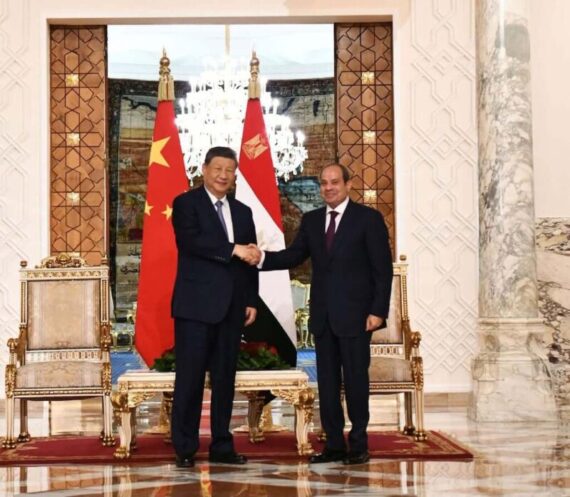
hinese President Xi Jinping visited Egypt on September 1, marking the first such visit in a decade. Taking place on the 70th anniversary of the establishment of diplomatic relations between the two countries in 1956, Xi’s visit carried symbolic significance and served as a key indicator of the growing momentum in relations between Beijing and Cairo in recent years. The statements made by the leaders of both countries regarding the visit, in which they emphasized the importance they attach to bilateral relations, further underscore this trend.
Another notable aspect was that both leaders highlighted the broader regional implications of these bilateral ties. In this context, Chinese President Xi, highlighting Egypt’s dual Arab and African identity, emphasized the need to strengthen cooperation by noting that Cairo plays “an important role in promoting the collective cooperation between China and Arab states as well as between China and African countries.” Meanwhile, Egyptian President Abdulfettah el-Sisi similarly highlighted that his country was the first Arab and African state to recognize China, emphasizing that Cairo is a key actor in Beijing’s efforts to develop relations with both Arab and African states.
It can be said that China-Egypt relations, which had limited opportunities for development in the 20th century, began to develop rapidly from the beginning of the 21st century, as Beijing’s relations with Africa gained momentum. The elevation of the relationship to the level of a comprehensive strategic partnership during President Sisi’s official visit to China in 2014 marked a significant step.
As is the case with China’s relations with many other countries, economic ties constitute the most concrete and significant aspect of the relations that have developed during this period. China’s annual trade volume with Egypt, which stood at approximately $0.9 billion in 2000, reached approximately $20.8 billion by 2025. Another key indicator of these economic ties is China’s investments in Egypt. Beijing’s investments in Egypt have exceeded $10 billion, with investments in the industrial sector being particularly noteworthy.
The Suez Economic and Trade Cooperation Zone project, launched in 2008 to encourage China’s industrial investments in Egypt, is one of the most significant steps taken in this direction. As of 2025, with over $3.8 billion in investments made in the zone, nearly 200 companies are operating there, providing employment for approximately 10,000 people. China has also provided $7.7 billion in loans to Egypt between 2000 and 2024.
In contrast to economic relations, the security dimension of relations between the two countries has been an area with limited scope for development until recently. However, it is possible to say that significant activity has taken place in this area, particularly in 2025. In this context, claims that emerged during the year, that Egypt procured the HQ-9B air defense system from China and signed a deal worth approximately $400 million for the procurement of 10 WJ-700 UAVs, represent significant developments in arms trade between the two countries. The signing of a memorandum of understanding between Egypt and China’s North Industries Corporation for joint UAV production during this period was a step demonstrating the two countries’ intention to develop defense industry cooperation.
Recommended
One of the most important steps taken to strengthen military relations between Beijing and Cairo was the “Eagles of Civilization 2025” exercise. Held in Egypt, this large-scale exercise, the first joint air exercise between the two countries, also holds symbolic significance as it represents one of China’s most important military activities on the African continent. The second iteration of the exercise, “Eagles of Civilization 2026,” was conducted immediately prior to Xi’s visit.
China-Egypt cooperation, which is generally built on a foundation of strong economic ties, is evolving into a strategic partnership that increasingly encompasses the security dimension, as intended by both sides. However, it is fair to say that sustaining the momentum achieved in these relations will become increasingly difficult. The primary reason for this is the concerns that the deepening of Beijing-Cairo relations, particularly in the security sphere, will raise on the U.S. side. A key reason for Washington’s concerns is that, as part of its global competition with China, Beijing’s development of security ties with Egypt could allow it to gain military influence in a strategically important region.
Another major source of concern for the U.S. relates to Israeli interests. Egypt’s efforts to reduce its dependence on the U.S. in this area by developing military ties with China, and to enhance its military capabilities independently of the U.S., will be viewed as a threat by Israel. Driven by similar concerns, Washington intervened in the military relations Egypt developed with Russia in the second half of the 2010s, as well as in significant arms procurements, by applying pressure through the threat of sanctions against Cairo. The trajectory of China-Egypt security relations also holds the potential to trigger similar interventions.
(Originally published in Turkish by the Middle East Africa website)

Melih Yıldız graduated from the Department of International Relations at the Faculty of Political Sciences, Sakarya University in 2019. In 2023, he became a research assistant at the Middle East Institute, Sakarya University, where he is pursuing his doctoral studies. His areas of expertise include Egyptian and Sudanese politics, the Eastern Mediterranean, and arms and security.
You can see how this popup was set up in our step-by-step guide: https://wppopupmaker.com/guides/auto-opening-announcement-popups/

Stay informed by subscribing to
our weekly newsletter.
You can see how this popup was set up in our step-by-step guide: https://wppopupmaker.com/guides/auto-opening-announcement-popups/
You can see how this popup was set up in our step-by-step guide: https://wppopupmaker.com/guides/auto-opening-announcement-popups/
You can see how this popup was set up in our step-by-step guide: https://wppopupmaker.com/guides/auto-opening-announcement-popups/
You can see how this popup was set up in our step-by-step guide: https://wppopupmaker.com/guides/auto-opening-announcement-popups/