Are The Abraham Accords The New Sykes-Picot?
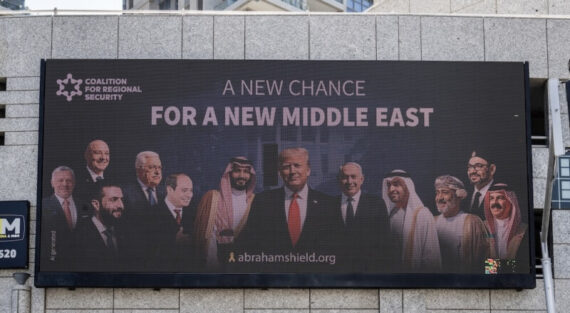
The Abraham Accords aimed at normalizing Israel in the region to secure its existence while indirectly integrating the entire Middle East region into U.S .military and economic control.
August 5, 2025
O
ver the past year and a half, we have witnessed how the attack launched by the United States and Israel in October 2023, with the support of the G-7 countries, on the grounds of eliminating Hamas in the Gaza Strip, gradually spread to Syria, Lebanon, and Yemen, reaching Iran.
Just hours before the United States’ B-2 strategic bombers, equipped with munitions of unprecedented destructive power in military history, were set to deploy from the Pacific Ocean toward the Middle East to target Iran’s nuclear facilities, on June 21, President Erdoğan warned the international community at the Organization of Islamic Cooperation summit in Istanbul with the following words:
I appeal once again to countries that have influence over Israel: do not give credence to Netanyahu’s poisonous words wrapped in praise. The region cannot withstand another war. We will not allow a new Sykes-Picot agreement. The fate of Istanbul is inseparable from the fate of Damascus, Baghdad, Tehran, Mecca, Medina, Gaza, and Jerusalem.
At this point, it is worth revisiting the message delivered on May 25 by Tom Barrack, the new U.S. Ambassador to Ankara and Special U.S. Envoy for Syria. The U.S. Ambassador said, “A century ago, the West imposed maps, mandates, borders drawn at the table, and foreign administrations. Sykes-Picot divided Syria and a wider region not for peace, but for imperialist gain. This mistake has cost generations. We will not do this again.”
By emphasizing that the era of “Western intervention” has come to an end, Barrack argued that the future will be determined by regional solutions, partnerships, and respectful diplomacy.
Ambassador Barrack’s observation is accurate but incomplete. The Sykes-Picot map, designed by the United Kingdom (England), the Russian Empire, and France, is only one aspect of the issue. As economist Jeffrey Sachs points out, the conflicts that are still ongoing today in the Middle East, Africa, South Asia, and Latin America are rooted in the legacy of global British hegemony, which was effective from the 18th century to the mid-20th century.
The British first promised Middle Eastern territories of the Arabs in the McMahon agreements of 1915-1916, to the French and Russians in the 1916 Sykes-Picot Map, and to the Jews in the 1917 Balfour Declaration. In pursuit of its goal of winning World War I, Britain marketed the same product to three different buyers. After World War II, when Britain abandoned its colonies, it left behind the chaos of its diplomatic deception.
Efforts to establish a new order at the end of the First Cold War paved the way for the U.S. to attack Iraq under the pretext of liberating Kuwait, plunging the Middle East into a new quagmire. The invasions of Iraq and Afghanistan did not yield sustainable results for the U.S., and the failure to resolve the Palestinian issue shook the foundations of the unipolar world order that was hoped to be shaped around the U.S.-Israel axis.
The West, which believed that the collapse of the Soviet Union in December 1991 and the Warsaw Pact would solve all problems, failed to recognize the rights of the Palestinian people and withheld the prosperity it demanded for itself from the Middle East, pushing Europe in particular out of the game. Since the 2008 global economic crisis, the European Union has been losing ground not only in economy but also in technology, defense, and geopolitics, while the U.S. put forward its own solution for the Middle East in 2017 during Donald Trump’s first presidential term: the Abraham Accords.
In its simplest form, the series of agreements aimed at normalizing Israel’s relations with Arab and Islamic countries sought to secure Israel’s existence while indirectly integrating the entire Middle East region into U.S .military and economic control and eliminating the growing influence of the People’s Republic of China in the region.
When evaluating the U. S’s current criticism of the Sykes-Picot map, it is necessary to approach with skepticism whether the Trump administration respects the right of regional countries to determine their own destinies. In the simplest terms, it is important not to overlook the fact that the U.S. desires new borders and spheres of influence to be shaped within the framework of the “Abraham Accords.” The U.S. wants to redesign the Middle East borders established during the Industrial Revolution and the early 19th and 20th centuries, when cotton and coal dominated international markets, through the Abraham Accords, with a focus on oil, natural gas, and rare earth elements.
Therefore, it is useful to evaluate the statements coming from various levels of the U.S. administration, which have been aiming to include both Lebanon and Syria in the Abraham Accords since limiting Hezbollah’s influence in Lebanon and the overthrow of the Assad regime in Syria. The lifting of sanctions against Syria on June 30, despite objections from within the Republican Party, is based on the objectives of the “new map” that is being envisioned.
The US does not only want Lebanon and Syria to normalize relations with Israel. It is directing its diplomacy with the goal of bringing these countries’ energy reserves and other underground resources, as well as their ports and trade routes, under US control.
The Abraham Accords process, which began during Donald Trump’s first term but lost momentum during Biden’s presidency, started in August 2020 with the United Arab Emirates. Bahrain, Sudan, and Morocco then joined the process. It is hoped that the scope of the agreements will gain momentum through the pressure currently being exerted on Iran. Trump’s primary target for inclusion in the Abraham Accords is Saudi Arabia.
For Trump, bringing this country, which has the region’s greatest economic potential, into the process means closing the region’s doors to the People’s Republic of China. Israel, on the other hand, believes that if an agreement is reached with Saudi Arabia, it will completely destroy the Palestinian front, which it has been unable to eliminate in the Arab world since 1948.
For this reason, Israel is attempting to negotiate an agreement with Saudi Arabia by either completely eliminating the Palestinian population in the Gaza Strip and the West Bank or immediately abolishing all the rights recognized by United Nations resolutions. Ultimately, if there are no Palestinians or Palestinian cities left, Saudi Arabia and other countries in the region will have no “two-state solution for Palestine” to bring to the table.
Recommended

Does Donald Trump’s goal of solving the Middle East problem with a “Pax Americana” by putting all his eggs in the “Abraham Accords” basket have any basis in the realities of the region?
Trump, with his typical American approach of viewing the region from 10,000 kilometers away, ignores the historical depth and past conflicts of the major players in the region, reducing inter-country interactions to the level of economic relations, and acts under the assumption that a solution is possible. The manifestation of this flawed discourse can be seen in Trump’s messages about transforming the Gaza Strip into a resort town dotted with five-star hotels.
Firstly, neither Turkey, Qatar, Egypt, Saudi Arabia, nor even Azerbaijan—which has recently gained strength through its energy resources—would accept the vacuum created by Iran’s decline in power being handed over to Israel.
It is impossible to say that the balances that prevailed in 2010 along the axis stretching from the Black Sea to the Eastern Mediterranean, from the Suez Canal to the Strait of Hormuz, and even in the Caucasus, are the same as today’s situation. It is necessary to carefully evaluate examples that reveal the speed of change in the region’s balances, such as the fact that the plan hatched by Israel, the Greek Cypriot Administration, and Greece to encircle Turkey in the Mediterranean and sever its ties with Cyprus, which has been in place since 2010, is no longer valid.
In such a volatile environment, Israel’s attempt to impose a 21st-century Sykes-Picot Agreement, relying on U.S. military power, will fail as an initiative that, in the words of President Erdoğan, “the regional balance of power will not allow.”

Turkish author and security expert who writes on Ukraine, Russia, NATO and African politics. Prigozhin Died for Wagner to Live On.
You can see how this popup was set up in our step-by-step guide: https://wppopupmaker.com/guides/auto-opening-announcement-popups/

Stay informed by subscribing to
our weekly newsletter.
You can see how this popup was set up in our step-by-step guide: https://wppopupmaker.com/guides/auto-opening-announcement-popups/
You can see how this popup was set up in our step-by-step guide: https://wppopupmaker.com/guides/auto-opening-announcement-popups/
You can see how this popup was set up in our step-by-step guide: https://wppopupmaker.com/guides/auto-opening-announcement-popups/
You can see how this popup was set up in our step-by-step guide: https://wppopupmaker.com/guides/auto-opening-announcement-popups/