Turbulence in India-US Relations
However much Delhi appears to have shed its past perceptions, distrust towards Washington has always existed and always will.
September 10, 2025
I
n the global context, in recent years, almost all attention has been focused on the relations between the United States (referred to as America in the text), China, Russia and India, and what these countries are doing in international relations. In the global system, China’s rise, Russia’s visible resurgence under Vladimir Putin, and Moscow and Beijing’s pursuit of closer relations triggered America’s relative decline, prompting Washington to update its allies and its regional and global policies.
This is where India comes into play. India has emerged as the only democratic power in Asia capable of counterbalancing China’s potential hegemony. Based on this reality, the relationship Washington envisions, which superficially involves New Delhi joining the ranks of American allies, is not working out so well between the two, as India, which hands out blue beads to just about everyone, is here and there. This article provides a broad overview and summary assessment of the past, present and future of these relations.
Of course, this is not based on scientific evidence, but I would like to begin the article with the following words: Great friendships begin with hatred. There was once an India that had the misfortune of experiencing British colonialism, and this experience dictated that it should stay away from imperialist powers and, consequently, from the West, primarily the United States. From its independence until the 1990s, it displayed an extremely protectionist and monopolistic attitude in both its economic policy and its regional approach, pursuing a ‘monopolistic isolation’ in its neighborhood and backyard of South Asia and the Indian Ocean region.
Meanwhile, Delhi, which had a problematic and risky, volatile relationship with its long border neighbor Beijing, maintained ties with Moscow, whose domestic and foreign policy perspectives or socialist prisms appeared to be compatible with its own at the time. These ties were built on a foundation of friendship and developed upon this basis.
The changes in the global economy and world politics in the 1990s pushed India towards economic liberalization. At the same time, China’s emergence as a potential regional hegemon and its entry into the Indian Ocean region, to which India is extremely sensitive, prompted Delhi to revise its regional and global approach. The need to shed emotionalism, or more bluntly, timidity and relative strategic or monopolistic isolation, led Delhi to seek a more interconnected worldview. This orientation is most evident in its attitude towards America and the West.
However, the principle of ‘strategic autonomy’—which implies ‘not being an ally’ and ‘not being fully aligned’ in its foreign policy, alongside the time-tested friendship with Russia—appears as two important caveats in this orientation, reflecting an understanding of not completely severing ties with its essence. The third important caveat is that, although it is now referred to as a liberal economy, economic protectionism continues to a large extent.
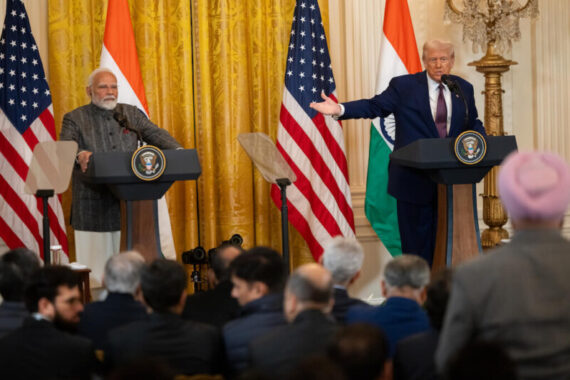
The fundamental factor bringing India and America together was simple: the China factor. However, the main catalyst for the change in Delhi’s negative perception of America was Washington’s ‘favor’ of a civil nuclear agreement with India in the early 2000s. Since then, relations between the two countries have deepened significantly. It was as if Delhi had shed all its past perceptions. Obama declared that US-India relations would be the most special relationship of the 21st century. This rhetoric from the former American president took on a clearer form during Trump’s first term.
However, however much Delhi appears to have shed its past perceptions, I must state very clearly that distrust towards Washington has always existed and always will. Meanwhile, this distrust in the relationship also exists in America. In other words, both sides harbor a ‘strategic fear of abandonment’ towards each other in their bilateral relations. However, for Delhi, there is an additional nuance to this distrust: finding itself completely dragged along in Washington’s wake. Nevertheless, due to the impact of Trump’s first term and the general course of relations between the two countries, there was considerable sentimentality in New Delhi towards Trump’s second term. It was believed that Trump’s wrath would never be directed at them.
Trump began his second term on a harsher note. The issue of reciprocal tariffs, which he first announced in April and then withdrew for a while, appeared to be a ray of hope for Delhi, which was already looking forward to Trump’s second term with emotional enthusiasm. This could divert trade away from China, which could be a ‘once-in-a-lifetime opportunity’ for Delhi, according to Indian Trade Minister Piyush Goyal. Beyond that, according to the administration in Delhi, tariffs could be a catalyst for the economic reforms India needed. After all, external shocks had triggered the country’s first wave of reforms.
August began with an external shock for Delhi, but this is not that kind of thing. Relations between the two countries, once characterized by Modi (during the Biden era) as ‘from the depths of the ocean to the heights of the sky,’ now appear to have entered a period of disruptive turbulence, and this is being done by Trump, who publicly displays a very close friendship. We now know how Trump reflects his displeasure or frustration when things don’t go his way; it’s extremely arbitrary, reckless, and even crude.
However, Delhi did not expect the same rhetoric to be directed at India, which came as a shock. He called the Indian economy a ‘dead economy’; moreover, Delhi had been busy boasting about its ‘vibrant and bright’ economy in recent years. That wasn’t enough; he described it as a country with ‘the heaviest and ugliest non-monetary trade barriers among all countries.’ That wasn’t all; it threatened further sanctions if India continued to purchase oil from Russia.
Delhi may be shocked by all this, but it has reacted with extreme caution and is clearly trying to maintain its cautious optimism. Optimism is always present in India-US relations. This is based on a high level of bipartisan consensus in Washington on deepening relations between the two countries. And despite everything, Delhi, which is neither America’s ally nor its enemy, maintains this unique position and will continue to do so in the foreseeable future. In other words, the current period of turbulence will not change the overall course of relations. Bilateral relations are based on strategic and geopolitical foundations. So, what happened to make Trump’s anger spill over to Delhi?
The reason cited for Trump, who acted as a mediator in the Russia-Ukraine War but was unable to bring Moscow to heel, may be that India is buying Russian oil; however, let me tell you the real reason clearly: in the midst of trade negotiations between the two countries, this is a tactic by Trump or Washington to put pressure on Delhi. Washington wants protectionist India to open up more to America so that it can navigate the Indian market more easily in terms of trade and business.
In other words, Russian oil is, in a sense, an excuse or the icing on the cake. Aware of this, the Delhi government (despite facing considerable criticism from the opposition) has responded with extreme calm and caution; however, I do not expect Delhi, which is already in the process of trade negotiations with the American delegation, to show much strategic vulnerability at the end of the day, and it is highly unlikely that it will halt Russian oil purchases. If Trump continues to wield such a heavy stick or persists in playing hardball, then India will be forced to show some vulnerability, but it will still not give the U.S. everything it wants.
In fact, what Trump or America wants from India is to bring it into line, that is, to develop a kind of band wagoning relationship in the long term. However, under current conditions, this is presented not solely as a classic military alliance, but also as a package with an ‘operational’ nature aimed at protecting Washington’s interests in areas other than security, such as trade. Although the RIC forum, representing the Russia-India-China trio, or BRICS, which also includes Brazil and South Africa, and the Shanghai Cooperation Organization (SCO) are discussed here as hedging alternatives, there is a great deal of uncertainty surrounding these issues.
However, one of the four clear points is Delhi’s discomfort with China and Russia seemingly positioning themselves more openly against America and the West with each passing day. Today, Western countries represent Delhi’s closest and most strategic partnerships. The United States, meanwhile, is still not an actor that wants to be antagonistic, but rather one that wants to continue a ‘cautious embrace.’ Another factor, however, is Delhi’s enduring ties to Moscow. These ties are still based on more than 50 per cent Russian-made military equipment for the Indian army. And thirdly, the nature of India’s relations with Beijing cannot be built entirely on friendship. This reality is fueled by parameters such as borders, water, Kashmir and Pakistan factors, as well as threat perception and security dilemmas. Fourthly, Delhi’s unease over the strategic closeness between Beijing and Moscow.
When all these dynamics are melted down in a pot, the following reality emerges: India is not exactly following the path shown by America, but neither does any other path outside Washington hold much promise, and Delhi’s interconnectedness is of little use in a highly interconnected world. And for New Delhi, the following set of rules emerges: As a criticism and suggestion brought by the opposition; focus on image building, focus on national interests, be free of sentimentality, strive to be more realistic rather than more popular, strengthen your domestic economy and domestic front, trust no one and develop a clearer stance, but this should not be perceived in the context of choosing sides…
In the context of relations with Washington, three major issues remain: America’s insistence on imposing exactly the kind of relationship it wants on Delhi, pressure on Delhi to limit its ties with Moscow, and the current ambiguity surrounding both how the China factor will be handled in bilateral relations (which is clearly not being addressed at all) and what position each will take on bilateral relations with Beijing. However, despite these three issues, it is highly unlikely that India will impose restrictions on its ties with Russia, nor is it highly likely that it will break away from China or align itself with China.
Recommended
At the same time, Delhi, which is also concerned about the possibility of America somehow aligning itself with Beijing, should not expect either a complete break or full alignment in its bilateral relations with Washington. The current situation can be interpreted as a temporary period of turbulence or Trump’s ‘short-term stick-wielding phase’ based on his feeling that he has not fully reaped the rewards of the ‘carrots’ America occasionally offers. And this phase actually began not in August, but rather in May, when a brief but fierce Kashmir conflict erupted between India and Pakistan.
Trump’s stance, which undermined Delhi’s sensitivity to ‘completely removing Kashmir from the international agenda,’ which it had painstakingly woven, and his seemingly pro-Islamabad attitude had already set off warning signals in New Delhi regarding American ties. Ultimately, neither Trump nor America is taking India’s red lines into account, nor is it considering its security sensitivities or showing respect for its reputation. For India, the turbulence actually began three months ago. Yes, Delhi’s relations with Washington are not as ‘special’ as it thought. The period of complacency is over; it is now time to play more realistically.
(Originally published in Turkish by Kriter)

Dr. Duygu Çağla BAYRAM is Ankara-based India specialist. She has a PhD in Int'l Relations and is the author of New Course in Turbulent Waters.
You can see how this popup was set up in our step-by-step guide: https://wppopupmaker.com/guides/auto-opening-announcement-popups/

Stay informed by subscribing to
our weekly newsletter.
You can see how this popup was set up in our step-by-step guide: https://wppopupmaker.com/guides/auto-opening-announcement-popups/
You can see how this popup was set up in our step-by-step guide: https://wppopupmaker.com/guides/auto-opening-announcement-popups/
You can see how this popup was set up in our step-by-step guide: https://wppopupmaker.com/guides/auto-opening-announcement-popups/
You can see how this popup was set up in our step-by-step guide: https://wppopupmaker.com/guides/auto-opening-announcement-popups/