A
s global attention has been absorbed by Trump’s obvious foreign policy manoeuvres from renewed interventionism on Venezuela to provocative remarks on Greenland, other, less theatrical but strategically weightier developments have unfolded with far less scrutiny. Last month, U.S. President Donald Trump went on television to announce a sweeping $11 billion arms sale to Taiwan. Unprecedented in both scale and financial weight, the decision reopened the Taiwan file, one of the most sensitive fault lines in U.S.–China relations and predictably triggered sharp condemnation from Beijing, and recently Chinese sanctions on American defense companies. More importantly, it marked a deliberate escalation in Washington’s competitive posture toward China, raising the likelihood that the Taiwan Strait will witness more frequent and more assertive Chinese military activity. The waters of the Indo-Pacific, already unsettled, are heating up further.
What makes this sale different and why it matters
Valued at roughly $11 billion and structured across eight separate deals, this package is not merely larger than previous arms transfers; it is qualitatively different in strategic intent. At its core lies a clear ambition to furnish Taiwan with a Ukraine-style defensive shield, particularly in air and missile defense. The package includes 82 HIMARS launchers, 420 ATACMS missiles, self-propelled howitzers, drones, advanced military software, Javelin and TOW anti-tank systems, helicopter spare parts, and refurbishment kits for Harpoon missiles.
What makes this sale escalatory is not volume alone, but the convergence of three distinct effects. Materially, the systems supplied are optimised for denial rather than signalling, complicating PLA operational planning by raising the costs of achieving air and missile dominance. Politically, the scale of the package signals a deeper U.S. commitment to Taiwan’s long-term defense posture rather than episodic reassurance. From a reputational vantage point, it narrows Beijing’s room for calibrated response by framing restraint as weakness at a time when Taiwan has been elevated by Chinese leadership into a core marker of national resolve.
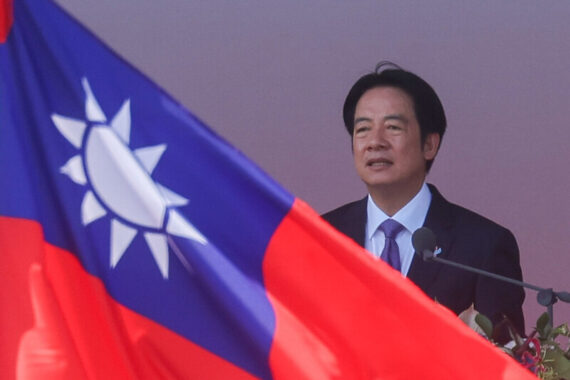
The scale is telling. This single sale exceeds the $8.4 billion in arms transfers approved over the entirety of the Biden administration, underscoring a sharp recalibration in Washington’s approach to Taiwan’s defense. It also aligns closely with Taipei’s own reassessment of threat perception. President Lai Ching-te pledged to raise defense spending to 3.3 per cent of GDP by 2026 and to 5 per cent by 2030, which are levels more commonly associated with states preparing for sustained strategic pressure rather than abstract deterrence. Parallel to this, Taiwan plans to develop a $40 billion, multi-layered air defense architecture, the so-called “T Dome”, between 2026 and 2033.

Beijing’s response and the erosion of old guardrails
Beijing does not view the Trump administration’s arms package through the legal framework Washington prefers to cite. The 1979 Taiwan Relations Act, which authorises the provision of defensive weapons to Taiwan, carries little weight in China’s interpretation. Instead, Beijing frames such sales as interference in its internal affairs and a destabilizing provocation threatening regional peace. Its preferred reference point remains the 1982 Joint Communiqué, which envisaged a gradual reduction in U.S. arms sales to the island.
Yet, this argument rests on selective memory. President Ronald Reagan made clear at the time that any reduction would depend on China’s behaviour in the Taiwan Strait. That behaviour has moved decisively in the opposite direction. PLA exercises in 2025 reveal the maturation of a far more expansive hybrid warfare doctrine, one that is no longer confined to symbolic naval signalling. On April 1–2 alone, 68 of 135 Chinese aircraft crossed the so-called median line in the Taiwan Strait, marking the most brazen incursion since Nancy Pelosi’s 2022 visit to Taipei.
Beyond air activity, China has conducted simulated precision-strike drills targeting Taiwan’s energy and logistics networks, rehearsed attacks on civilian infrastructure, and expanded coast-guard operations into adjacent zones. Together, these actions indicate a strategy aimed at stretching operational boundaries while gradually reducing Taiwan’s strategic space. Against this backdrop, Beijing’s indignation over U.S. arms sales rings increasingly hollow.
Escalation amid constraint: why pressure has not delivered results
None of this suggests that Beijing faces an unconstrained path toward military action. A Taiwan contingency would impose severe economic costs, risk accelerated technological decoupling and potentially undermine China’s carefully cultivated relations across the Global South. Despite notable advances, uncertainties and limitations persist regarding PLA joint-force integration, amphibious lift capacity, and the ability to sustain high-tempo operations under contested conditions.
Nevertheless, these constraints have not produced restraint. Instead, they appear to have incentivised a strategy of sustained coercive signalling short of war. Repetitive military exercises, however, have failed to deliver meaningful deterrence. If pressure alone were sufficient to coerce Taiwan toward unification, or even to dissuade it from pursuing new arms acquisitions, China would have achieved that outcome long ago. It has not. The uncomfortable reality for Beijing is that its familiar playbook is no longer producing results, even as it increases the risk of miscalculation.
Residual deterrence in an era of U.S. strategic retrenchment
Warnings from U.S. War Secretary Pete Hegseth that China could be militarily ready to invade Taiwan by 2027 should therefore not be dismissed as alarmism. In the current strategic climate, they resemble less a worst-case fantasy than a plausible scenario of Indo-Pacific risk. The picture grows more complex when Japan enters the equation. Long at odds with China over the Senkaku Islands, Tokyo has sharpened its rhetoric, with Japanese Prime Minister Takaichi last month stating that a Chinese invasion of Taiwan would constitute a survival threat to Japan. With a binding mutual defense pact linking Tokyo and Washington, Japan’s potential role in a Taiwan contingency remains a critical and unresolved variable.
Complicating matters further is the release of the new U.S. National Security Strategy, which reframes Washington’s global priorities in striking ways. Rather than doubling down on an Indo-Pacific–first posture, the document restores a Western Hemisphere–centred strategic hierarchy, explicitly committing the United States to enforcing a “Trump Corollary” to the Monroe Doctrine. Homeland security, border control, hemispheric primacy, and economic reindustrialization dominate Washington’s strategic bandwidth. China is no longer framed as the singular or “pacing” threat, but primarily as an economic competitor and a supply-chain risk, with the Indo-Pacific ranking below the Americas in priority.
This shift raises an uncomfortable but necessary question. Do recent arms sales and heightened signaling toward Taiwan reflect genuine preparation for confrontation, or are they better understood as residual deterrence measures operating alongside a broader U.S. strategic retrenchment toward its traditional sphere of influence? If American attention and resources are increasingly oriented toward Latin America, the credibility of extended deterrence in the Taiwan Strait may rest less on intent than on perception, precisely the ambiguity that fuels instability.
Recommended
An uncertain endgame
What makes this moment particularly striking is how sharply it departs from assumptions prevalent only a few years ago. Analyses of China’s expanding footprint in regions such as the Gulf—including some of my own—once argued that Beijing remained constrained by unresolved problems in its immediate neighborhood. Today, China’s growing assertiveness over Taiwan suggests a different trajectory: A power increasingly willing to test the limits of its regional sphere of influence and to project power across the Indo-Pacific.
Which vision ultimately prevails remains an open question. Will the comforting but increasingly fragile “Silicon Shield” theory, which is premised on Taiwan’s centrality to global semiconductor supply chains, continue to deter Chinese aggression? Or will the darker realist logic outlined by John Mearsheimer in “Say Goodbye to Taiwan,” which posits that a stronger China will eventually seek dominance within its own hemisphere, prove prescient?
The answer may well determine not only the future of Taiwan, but the strategic fate of the Indo-Pacific and the credibility of deterrence in an era of shifting American priorities.