Rafah Crossing Reopens for Limited Travel as Israeli Violations Continue
Egypt has repeatedly warned against any attempt to use the crossing to forcibly displace Palestinians, insisting it must function as a two-way passage.
February 2, 2026
G
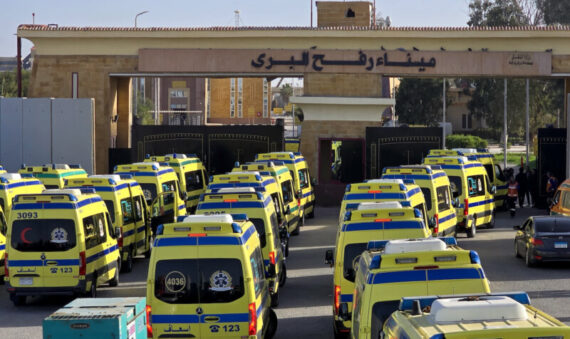
aza’s Rafah border crossing with Egypt reopened on Monday for limited passenger traffic, marking a significant—though largely symbolic—step in the implementation of the Israeli-Hamas ceasefire, according to Egyptian officials.
Egyptian authorities said the crossing would initially allow 50 Palestinians to travel in each direction per day, with no commercial goods permitted. The reopening comes amid growing humanitarian pressure, as Gaza health officials estimate that around 20,000 people, many of them children, are in urgent need of medical evacuation after more than two years of devastating genocide.
An Egyptian official involved in ceasefire implementation talks, speaking on condition of anonymity, confirmed the limited scope of the reopening. Israeli officials and Egyptian state media also acknowledged the move, describing it as a trial phase that could expand if security arrangements prove workable.
Israeli Prime Minister Benjamin Netanyahu said Israel would permit 50 medical patients per day to leave Gaza, each accompanied by up to two relatives. In addition, approximately 50 Palestinians who were stranded outside Gaza during the war will be allowed to return daily, according to an official familiar with the negotiations.
Israel and Egypt will jointly vet travelers passing through Rafah. The crossing will be overseen by European Union border assistance personnel, alongside a limited Palestinian administrative presence. Israeli officials said the number of travelers could gradually increase if the arrangement is deemed successful.
Israeli forces seized control of the Rafah crossing in May 2024, citing efforts to prevent arms smuggling by Hamas. It was only briefly reopened during a short-lived ceasefire in early 2025 to allow medical evacuations. Israeli resistance to reopening Rafah eased last week after the recovery of the remains of the final Israeli officer held in Gaza.
Before the war, Rafah served as Gaza’s primary exit and entry point for people, as all other crossings are controlled by Israel. Under current ceasefire terms, Israeli troops continue to control the corridor separating Rafah from Gaza’s main population centers.
Egypt has repeatedly warned against any attempt to use the crossing to forcibly displace Palestinians, insisting it must function as a two-way passage. Historically, Egypt has screened Palestinians seeking to cross.
Recommended
The Rafah reopening coincides with the transition of the U.S.-brokered ceasefire, which took effect on October 10, 2025, into its second phase. The truce halted more than two years of genocide that began on October 7, 2023.
While the first phase focused on hostage-prisoner exchanges, humanitarian aid, and a partial Israeli troop withdrawal, the second phase envisions far more complex steps, including the establishment of a new Palestinian governing committee in Gaza, the deployment of an international security force, Hamas’ disarmament, and the launch of reconstruction efforts.
However, the ceasefire remains fragile. On Sunday, the European Union sharply criticized Israel for what it described as repeated violations of the truce.
“We condemn the repeated violations of the ceasefire in Gaza, where hundreds of Palestinians were killed and injured by Israeli strikes over the weekend,” said Hadja Lahbib, the EU commissioner for equality, preparedness, and crisis management.
According to Gaza’s media office, 524 Palestinians have been killed and 1,360 injured by Israeli attacks since the ceasefire began, despite commitments to halt hostilities.
Lahbib emphasized that international humanitarian law must be fully respected and that civilians must be protected “everywhere and at all times,” underscoring mounting international concern that the ceasefire could unravel without stronger enforcement mechanisms.
(Source: The Associated Press and Anadolu Agency)

Politics Today is dedicated to publishing insightful analyses in order to understand the changing nature of contemporary politics. It aims to contribute to the sound and constructive discussion of international affairs.
You can see how this popup was set up in our step-by-step guide: https://wppopupmaker.com/guides/auto-opening-announcement-popups/

Stay informed by subscribing to
our weekly newsletter.
You can see how this popup was set up in our step-by-step guide: https://wppopupmaker.com/guides/auto-opening-announcement-popups/
You can see how this popup was set up in our step-by-step guide: https://wppopupmaker.com/guides/auto-opening-announcement-popups/
You can see how this popup was set up in our step-by-step guide: https://wppopupmaker.com/guides/auto-opening-announcement-popups/
You can see how this popup was set up in our step-by-step guide: https://wppopupmaker.com/guides/auto-opening-announcement-popups/