Japan’s Place in the Shifting Nuclear Order
Tokyo still upholds its official non-nuclear principles, but its broader security posture is becoming more complex and strategically ambiguous than its public doctrine suggests.
March 13, 2026
A
s powerful nations are getting alarmingly entangled in active confrontation, the world stands dangerously close to a catastrophic war. The destructive nature of modern-day warfare means that even a single misstep could have irreversible consequences. Therefore, making the preservation of state sovereignty and independent security capabilities a critical priority for states across the international system.
Military interventions, whimsical enforcement of international law, and shifting strategic commitments contribute to the growing skepticism regarding the reliability and commitments of American leadership. An increasing number of states have begun to reassess their dependence on U.S. security umbrella.
Coinciding with the dramatic rise of China, East Asia has emerged as one of the most strategically significant regions in global politics. Nowhere is this risk of miscalculation more pronounced than in the maritime and territorial fractures of the Far East. The rapid economic and military rise of China challenges the long-standing regional dominance of the United States and intensified geopolitical competition across the Indo-Pacific.
Within this framework, the U.S.–Japan alliance is central in maintaining regional stability and deterrence. Following the atomic bombings of Hiroshima and Nagasaki in 1945, Japan was made to adopt a post-war security framework centered on constitutional pacifism and peaceful coexistence. During the American occupation, the United States oversaw the drafting of the new Japanese constitution, fundamentally reshaping the country’s political and military structure. At the core of this framework was Article 9, which renounced war as a sovereign right and prohibited Japan from maintaining traditional military forces capable of waging offensive conflict.
For decades, this constitutional restriction defined Japan’s global identity. The country projected an image built on economic power, diplomatic engagement, and a deliberately restrained defense posture. Yet, over the decades, Japan’s strategic role evolved as one of the most critical logistical platforms for American military operations in Asia.
Geopolitically, Japan occupies a key position within the First Island Chain, a series of islands stretching from Japan through Taiwan and the Philippines that effectively forms a maritime barrier limiting Chinese and Russian naval access to the wider Pacific Ocean. Control over this chain is central to maintaining naval dominance in East Asia.
Taiwan is at the geographic center of this strategic arc; its location gives it disproportionate strategic importance. Should Beijing gain control of the island, the structural integrity of the First Island Chain would be fundamentally altered. The barrier constraining China’s naval expansion could effectively be breached.
Such a shift may dramatically reshape the regional balance of power. Control of Taiwan would provide China with direct access to deeper Pacific waters, allowing its submarine forces greater freedom of maneuver beyond the confined seas near its coastline. For nuclear-powered submarines carrying ballistic missiles, the ability to operate in deep-water environments is crucial for survivability and credible second-strike capability.
Presently, Japan serves as the primary logistical hub for U.S. military activity across the Indo-Pacific. The United States maintains more than 55,000 troops stationed across Japanese territory, its largest overseas deployment anywhere in the world. Japan is the world’s fourth-largest economy, providing a stable, high-tech industrial base that is deeply integrated into the U.S. supply chain, particularly in high-technology sectors such as semiconductors, advanced manufacturing, and precision engineering.
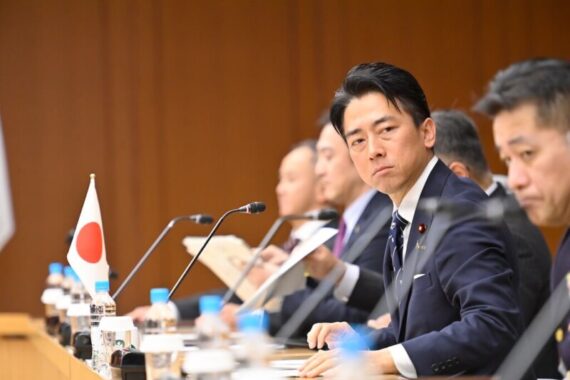
Tokyo still upholds its official non-nuclear principles, but its broader security posture is becoming more complex and strategically ambiguous than its public doctrine suggests. Domestically, a gradual rise in nationalist sentiment and increasing anxiety over territorial disputes, particularly surrounding the Senkaku Islands, further amplified calls for a more assertive security doctrine. These pressures are generating internal debates that challenge Japan’s long-standing postwar identity as deemed to be a pacifist state.
In the February 8, 2026, general election, Prime Minister Sanae Takaichi led the Liberal Democratic Party to a historic landslide victory, securing a postwar record of 316 seats in parliament. For the first time in the postwar era, a strongly hawkish conservative government commands a single-party supermajority.
As of March 2026, Japan is beginning to display clear “self-ambitions”, driven by the fear that the U.S. is becoming an unpredictable and “objective-only” actor, Tokyo is aggressively pursuing the idea of strategic autonomy. While Japan is not currently a nuclear power, it is a “paranuclear” state, possessing the advanced technology and plutonium stockpiles necessary to develop a nuclear deterrent in as little as six months.
Recommended
U.S.-Japan alliance has entered a phase of ‘Managed Rivalry.’ While the 2026 U.S. National Defense Strategy maintains the First Island Chain as a priority, the transactional nature of the new administration’s ‘America First’ posture has introduced a ‘credibility gap.’ This has compelled Japan to accelerate its own counterstrike capabilities, most notably the March 2026 deployment of long-range standoff missiles, further antagonizing Beijing and tightening the ‘Triangular Trap’.
The logic driving these developments ultimately returns to the unique role of nuclear weapons in international geopolitics. The destructive nature of nuclear weapons provides what is often described as “ultimate deterrence.” While the possession of nuclear weapons raises profound moral and humanitarian concerns, the geopolitical reality remains that the five recognized nuclear powers under the Treaty on the Non-Proliferation of nuclear weapons, along with India Pakistan, Israel and North Korea, continue to modernize their arsenals rather than dismantle them. This ongoing modernization risks leading to collapse of long-term viability of the global non-proliferation regime.
Compounding this instability is the erosion of the broader nuclear arms control architecture. With the expiration of the New START treaty, which previously limited the number of deployed strategic nuclear warheads and delivery systems possessed by the United States and Russia, the global system of nuclear restraint has effectively entered an unregulated era. For the first time in more than five decades, there is no comprehensive, legally binding agreement constraining the nuclear arsenals of the world powers.
This development has generated deep unease among technologically advanced non-nuclear states that rely on extended deterrence guarantees. Countries such as Germany, Japan, and South Korea are now openly debating whether long-standing commitments to nuclear proliferation remain viable in an increasingly unstable security environment.
Tokyo is gradually asserting the capabilities necessary to defend its interests with greater autonomy. While it cannot abandon the alliance with Washington, Japan’s ongoing rearmament and doctrinal evolution signal that the era of complete strategic dependency may be drawing to a close. As such, Japan is preparing for a possibility that its geographic position will once again require it to act as a fully sovereign strategic power rather than merely an extension of American regional policy.

Noor Eman is an undergraduate student at Istanbul Aydin University, specializing in International Relations and Political Studies. Her work focuses on combining research, analysis, and storytelling to shed light on complex social and political issues.
You can see how this popup was set up in our step-by-step guide: https://wppopupmaker.com/guides/auto-opening-announcement-popups/

Stay informed by subscribing to
our weekly newsletter.
You can see how this popup was set up in our step-by-step guide: https://wppopupmaker.com/guides/auto-opening-announcement-popups/
You can see how this popup was set up in our step-by-step guide: https://wppopupmaker.com/guides/auto-opening-announcement-popups/
You can see how this popup was set up in our step-by-step guide: https://wppopupmaker.com/guides/auto-opening-announcement-popups/
You can see how this popup was set up in our step-by-step guide: https://wppopupmaker.com/guides/auto-opening-announcement-popups/