Iraq’s New Approaches to the Kirkuk-Ceyhan Oil Pipeline
The topics on the agenda between Ankara and Baghdad point to a broader framework than merely the technical operation and capacity expansion of the Kirkuk–Ceyhan pipeline.
July 16, 2026
W
hen one thinks of the Middle East and Iraq, the first thing that springs to mind is often oil. However, developments in Iraq over recent weeks have once again demonstrated that oil is no longer merely an economic resource, but a strategic factor that determines state capacity, foreign policy and the regional balance of power.
Following the tensions between Iran and the West, the reopening of the Strait of Hormuz provided short-term relief in global energy markets. However, for Iraq, this process did not merely signify a return to normal oil sales. The Baghdad administration has also brought back onto the agenda its long-delayed objectives of increasing production and securing a higher quota within OPEC.
Whilst this may appear at first glance to be merely a matter of energy policy, there is a larger story behind the issue. As is well known, oil is both the most vulnerable and the seemingly strongest aspect of the Iraqi economy. Oil revenues bear the main burden of the state budget. Many sectors, ranging from public sector wages to infrastructure investment, and from security expenditure to social payments, are dependent on this revenue. Consequently, every fluctuation in international markets comes to the attention not only of the economic bureaucracy but also of political decision-makers in Baghdad. Even a slight decline in oil revenue can place significant pressure on the state.
The messages conveyed by the Iraqi government in recent weeks are therefore noteworthy. On the one hand, new international investments are being discussed; on the other, it is stated that production capacity can be rapidly increased. The recent interest shown by major energy companies in oil fields suggests that Baghdad wishes to draw up a long-term growth plan. The recent increase in production in the southern oil fields also emerges as a development serving the effort to boost capacity.
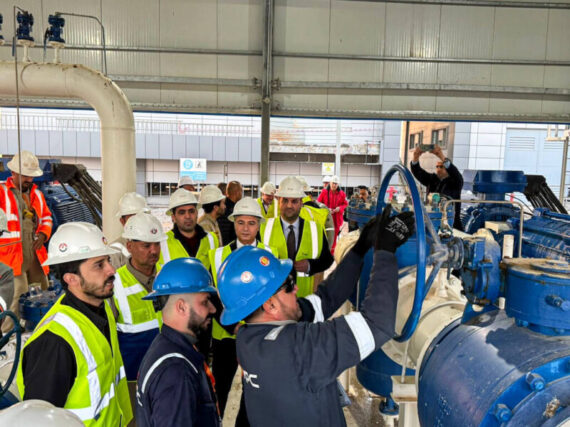
However, the main issue in Iraq is not merely about producing oil. The real challenge facing Iraq is determining via which routes, with what political guarantees and within what economic framework it will deliver the oil it produces to the world market. From this perspective, the renewed intensive energy talks between Turkey and Iraq carry particular significance. The topics on the agenda between Ankara and Baghdad point to a broader framework than merely the technical operation and capacity expansion of the Kirkuk–Ceyhan pipeline: oil, natural gas, electricity, energy supply security and the energy dimension of the Development Corridor.
The Kirkuk–Ceyhan pipeline, which has passed through Turkey for years, has become one of the most critical elements of this equation. The recent talks between Ankara and Baghdad, which have focused on energy cooperation, do not merely signify the renewal of a technical agreement. It appears that the two countries are seeking ways to establish a new energy architecture that will adapt to the changing regional geopolitical landscape. The duration of the agreement, the pipeline’s capacity, the transport of oil to the Mediterranean, and Iraq’s need to diversify its export routes are all being discussed at the same table.
The situation is equally significant not only from Iraq’s perspective but also from Turkey’s. Turkey has long aimed to be a country that manages energy corridors. One of the fundamental and most important pillars of this strategy is the secure delivery of Iraqi oil to the Mediterranean. For this reason, stable energy relations with Baghdad will also serve as a key tool in building political trust. An energy corridor stretching from southern Iraq to the north, and from there to Turkey and the Mediterranean, will form part of a broader picture encompassing regional trade, transport and security.
Iraq, meanwhile, has learnt the hard way in recent years the risks of relying on a single export route or a single regional balance of power. Crises in the Strait of Hormuz, the prospect of regional war and the occasional disruption of export routes in the north are prompting Baghdad to develop alternative routes. Iraq must now define its energy security not only in terms of production capacity but also through the diversity of its export routes. Consequently, the future of the Kirkuk–Ceyhan pipeline has become a key indicator of Iraq’s capacity for economic sovereignty.
Recommended
Amidst all this, another notable development has been the anti-corruption operations being carried out domestically. The operations in Baghdad, which have targeted high-ranking figures, send a significant message regarding the corruption networks that have long been the subject of discussion within state institutions. Of course, it cannot be expected that a few operations will eliminate decades-old institutional problems. However, the rule of law and transparency in public administration will be just as decisive as oil in shaping international investors’ view of Iraq.
Similarly, the US’s resumption of dollar transfers to Iraq should not be interpreted merely as a technical financial decision. This step demonstrates that economic ties between Washington and Baghdad have not been completely severed, but that issues of security, militias and financial oversight remain on the table. It has once again become clear that economic and security issues cannot be addressed in isolation from one another.
Viewed in the light of these developments, Iraq today stands at what is perhaps one of the most critical economic thresholds of the post-2003 era. Whilst the country is striving to attract major energy investments on the one hand, on the other it is seeking to strengthen public administration, strike a balance in its foreign relations and keep as far away as possible from regional crises. If successful, it could not only become a country that increases its oil production but also emerge as a new regional actor at the centre of energy, trade and transport corridors.
However, it is clear that oil revenues alone will not be sufficient for this to happen. Institutional reforms, legal predictability, investment security and sustainable relations with neighbours are just as important as new oil fields. The fundamental challenge facing Iraq is not actually extracting oil, but utilising oil revenues for the benefit of the state. To the extent that Baghdad succeeds in this, it may cease to be a conflict zone where regional crises persist.
From Turkey’s perspective, too, it would be insufficient to view developments solely through the prism of the oil trade. Iraq’s transformation into a stable, economically strengthening country open to regional integration will serve Ankara’s interests across many areas, from security to trade, and from logistics to energy. Consequently, in the coming months, we will be monitoring not only whether Iraq can produce more oil, but also whether it can channel this oil into political stability and economic development.
(Originally published by Middle East Africa website in Turkish)

After completing his bachelor’s degree in International Relations at Sakarya University in 2012, Recep Tayyip Gürler began his master’s studies in the Department of Middle Eastern Studies at Sakarya University that same year and graduated with a master’s degree with a thesis titled “The Role of Shiite Actors in Iraqi Politics.” He subsequently completed his doctoral dissertation titled “Reflections of Lockean and Kantian Culture in Iraq’s Policy Toward Iran: Competition, Conflict, and Friendship (1958–2020).” Recep Tayyip Gürler began working as a research assistant at the Institute of Social Sciences at Sakarya University in 2012 and currently continues his work as an Assistant Professor at the Institute of Middle Eastern Studies. He teaches courses at the Institute of Middle Eastern Studies and the Department of International Relations within the Faculty of Political Sciences.
You can see how this popup was set up in our step-by-step guide: https://wppopupmaker.com/guides/auto-opening-announcement-popups/

Stay informed by subscribing to
our weekly newsletter.
You can see how this popup was set up in our step-by-step guide: https://wppopupmaker.com/guides/auto-opening-announcement-popups/
You can see how this popup was set up in our step-by-step guide: https://wppopupmaker.com/guides/auto-opening-announcement-popups/
You can see how this popup was set up in our step-by-step guide: https://wppopupmaker.com/guides/auto-opening-announcement-popups/
You can see how this popup was set up in our step-by-step guide: https://wppopupmaker.com/guides/auto-opening-announcement-popups/