Red Sea Shipping Slows After Houthi Attacks on Saudi Oil Sites

July 27, 2026

Shipping data from Kpler showed that only 11 commodity vessels transited the Bab el-Mandeb Strait on Sunday, reflecting a sharp decline in traffic as ship operators reassessed risks following the latest escalation.
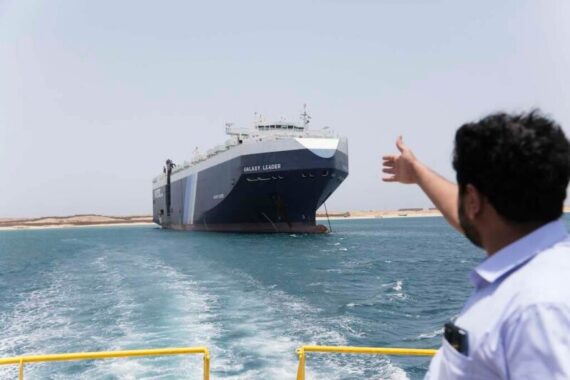
A view of a cargo ship called the 'Galaxy Leader' remains anchored off the Red Sea coast in Al-Hudaydah, Yemen on May 12, 2024. On November 19, Iran-backed Houthis in Yemen seized the cargo ship belonging to an Israeli businessman in the Red Sea and took it to the shores of As-Salif. Photo by Anadolu Images.

C

ommercial shipping through the Bab el-Mandeb Strait dropped to its lowest level in months after Yemen’s Houthi movement launched attacks on Saudi oil installations along the Red Sea coast, raising fresh concerns over maritime security and global energy supplies.

Shipping data from Kpler showed that only 11 commodity vessels transited the Bab el-Mandeb Strait on Sunday, reflecting a sharp decline in traffic as ship operators reassessed risks following the latest escalation. The disruption comes as the Tehran-aligned Houthis seek to impose a blockade on Saudi exports, broadening the regional fallout from the ongoing U.S.-Iran conflict.

The reduced vessel traffic has already pushed physical crude prices in the Middle East, Europe, and Africa to two-month highs, highlighting growing concerns over the stability of key global shipping routes.

Among the vessels that passed through the strait were seven oil tankers, including two very large crude carriers (VLCCs) bound for Saudi Arabia’s Yanbu port to load crude oil. Another tanker linked to Russia also entered the Red Sea.

Hong Kong-flagged New Explorer

Meanwhile, four tankers exited the Red Sea carrying crude destined for Asian markets. These included the Hong Kong-flagged New Explorer, transporting approximately 2 million barrels of Saudi and Emirati crude to Ningbo, China, another tanker carrying 1 million barrels of Russian crude for China, and a vessel delivering roughly 750,000 barrels of Saudi crude to Pakistan.

A second Hong Kong-flagged VLCC, New Pearl, carrying 2 million barrels of Saudi crude to Zhoushan, China, was also reported leaving the Red Sea, becoming the fourth Chinese supertanker to transit the route since the Houthis declared a naval blockade.

The Houthi military said it targeted facilities operated by Saudi state-owned oil giant Aramco in the Red Sea cities of Yanbu and Jizan on Saturday, further escalating tensions in the region.

Traffic through the Strait of Hormuz also remained subdued over the weekend despite a pause in direct U.S. and Iranian strikes. Fewer than 10 commodity vessels crossed the strategic waterway each day, according to Kpler data.

On Sunday, seven vessels transited Hormuz, including three Iranian-linked product tankers leaving the Gulf. The previous day, only three vessels passed through the strait with their tracking systems switched off, including a VLCC heading to Qatar, a liquefied petroleum gas tanker bound for the United Arab Emirates, and a tanker carrying Qatari naphtha to Japan.

The continued disruption across both the Bab el-Mandeb Strait and the Strait of Hormuz underscores mounting risks to global shipping and energy markets as regional tensions remain high.


Politics Today is dedicated to publishing insightful analyses in order to understand the changing nature of contemporary politics. It aims to contribute to the sound and constructive discussion of international affairs.