T
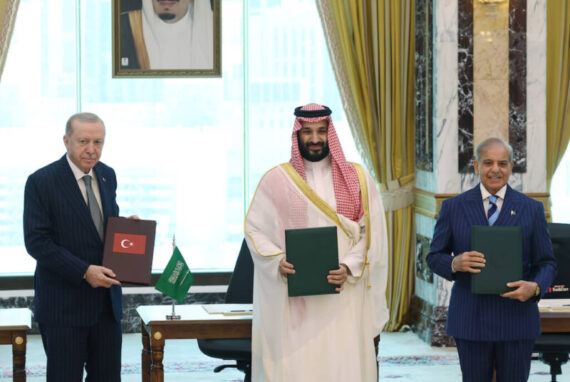
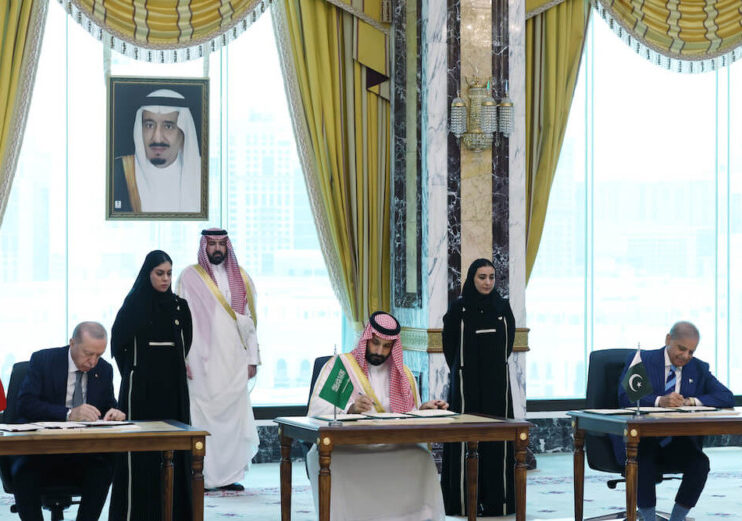
he Mecca Joint Defense Agreement, signed on August 7, 2026, in Mecca between Turkey, Saudi Arabia and Pakistan, marks a significant transformation in the security equation between the Middle East and South Asia. At the heart of the agreement lies the principle that an armed attack directed against one of the parties shall be deemed to have been directed against all three states. This provision goes beyond traditional defense cooperation to establish a new security mechanism based on the principle of collective deterrence.
The agreement’s primary significance in terms of international relations stems from the convergence of the signatory states’ diverse power elements within a single security framework. Turkey possesses NATO’s second-largest military force, advanced operational capabilities and a defence industry that has grown significantly in recent years. Pakistan is the only Muslim state to possess nuclear weapons. Saudi Arabia, meanwhile, stands out for its energy resources, financial capacity and influence in Gulf geopolitics. For this reason, the Mecca Agreement constitutes a strategic configuration of complementary capabilities formed by complementary strategic capabilities, rather than a traditional military alliance between three similar states.
The international context in which the agreement emerged is also significant. Rising military tensions in the Middle East, the security of energy transport routes, Iran-centred conflict dynamics and the tendency of regional states to diversify their security guarantees are reinforcing the search for a new regional security order. Within this framework, the Mecca Agreement can be interpreted as a demonstration of the will of regional states to support their security needs increasingly through mechanisms established amongst themselves, rather than through guarantees provided from outside.
The concept of strategic autonomy is particularly significant here. Since the end of the Cold War, one of the fundamental pillars of the Middle Eastern security system has been the US military presence and bilateral security relations. The Mecca Agreement does not directly abolish this system. It is also explicitly stated that the parties’ existing bilateral or multilateral obligations remain in force. However, the agreement demonstrates the will of regional actors to establish their own deterrence mechanisms alongside the Washington- centred security architecture. This situation can be interpreted as a transition from a dependence on a single security centre to a multi-layered security architecture.

The significance of the agreement for the participants
From Turkey’s perspective, the agreement also has a unique dimension. Turkey is a member of NATO. The Mecca Agreement, whilst enabling Ankara to maintain its NATO membership, also allows it to expand its institutionalised defense relations with regional powers outside NATO. Turkey is thus positioning itself strategically from which it can forge links between the Euro-Atlantic security system and the Middle East–South Asia security spheres. However, the relationship between the collective defense obligation under the Mecca Agreement and Article 5 of the NATO Treaty will require detailed legal and strategic scrutiny in the coming period, particularly in the event of simultaneous crises.
Pakistan’s participation in the agreement, meanwhile, shifts the deterrence debate to a different level. Pakistan’s nuclear capability enhances the agreement’s psychological and strategic weight. However, it cannot be concluded from current statements that Pakistan’s nuclear deterrence has been extended to Turkey or Saudi Arabia. Saudi officials have also stated that the agreement is not linked to nuclear purposes or an arms race. Consequently, based on the current data, it does not appear appropriate to characterise the Mecca Agreement as a nuclear umbrella agreement.
From Saudi Arabia’s perspective, the agreement represents a continuation of its policy of diversifying security partnerships. By linking its economic capacity with Turkey’s defense industry and Pakistan’s military capabilities, Riyadh may secure a greater degree of strategic manoeuvre. To the extent that this framework extends to areas such as defense industry investments, joint production, technology transfer, training, intelligence sharing and maritime security, it will acquire a lasting institutional character.
The principle of collective defense
Perhaps the most striking aspect of the Agreement is the principle of ‘an attack on one is an attack on all’. This provision is reminiscent of NATO’s logic of collective defense. However, there is currently a significant institutional difference between the two organizations NATO is an institutional alliance with over seventy years’ history, underpinned by a military command structure, joint defense planning, force structure, standards and permanent political bodies. The implementation mechanisms of the Mecca Agreement, however, are not yet as transparent, based on the information made public.
For this reason, the true strength of the agreement will be measured not so much by its signing as by the extent to which it becomes institutionalized. Should a joint military committee be established, joint operational plans drawn up, regular exercises conducted, an intelligence-sharing mechanism put in place and defense industry projects undertaken jointly, the Mecca Agreement could evolve into a genuine collective defense system.
From Iran’s perspective, interpreting the agreement as a direct counter-alliance requires caution. The parties have specifically emphasized that the agreement does not target any particular state. Given Turkey’s shared border with Iran, its economic ties and regional diplomatic channels, the agreement’s potential to take on a sectarian dimension could entail significant strategic costs for Ankara. Consequently, the sustainability of the agreement will depend on maintaining a balance between the principle of collective defense and the policy of avoiding regional polarization.
Towards a new regional security architecture
From Israel’s perspective, the new framework presents a distinct area for strategic calculation. The convergence of Turkey’s NATO capabilities, Pakistan’s military strength and Saudi Arabia’s regional influence within a common security mechanism holds the potential to influence the balance of power in the Middle East. However, it is not possible to draw a definitive conclusion from current statements suggesting that the agreement constitutes an alliance formed against Israel.
A broader implication of the Mecca Agreement is the possibility of institutionalizing security cooperation within the Islamic world. Whilst the Organization of Islamic Cooperation is a broad political organization with 57 members, it lacks an effective collective defense mechanism. The tripartite structure emerging in Mecca could, if successful, form the core of a narrower yet highly operational security platform that could expand with the participation of other states.
At this point, the fact that the agreement is named ‘Mecca’ also carries symbolic significance. The signing of the agreement at the most important holy centre of the Islamic world lends it political and historical visibility beyond that of a purely military text. However, the agreement’s future legitimacy will be shaped not so much by its symbolic value as by its contribution to regional peace, its compliance with international law, and its capacity to prevent crises.
Recommended
Article 51 of the United Nations Charter
From the perspective of international law, the fundamental basis is the right to individual and collective self-defense, as set out in Article 51 of the United Nations Charter. Consequently, the pact’s legal legitimacy rests on the organization of collective defense against armed attack, rather than on the formation of an aggressive alliance.
In these respects, the Mecca Joint Defense Agreement forms a new strategic triangle along the Ankara-Riyadh-Islamabad axis. Turkey’s military and technological capabilities, Saudi Arabia’s economic power and Pakistan’s military-strategic weight are all being integrated into the same security framework. Whether this will evolve into a regional alliance will be determined not so much by the text of the agreement as by the institutions to be established in the future, joint defense plans and the political will demonstrated by the parties in times of crisis.
To describe the Mecca Agreement as an ‘Islamic NATO’ at this stage appears premature from an analytical perspective. A more accurate characterization would be that of a new strategic security core, based on regional ownership and collective deterrence, emerging at a time when the US-centered security order is beginning to shift. If the tripartite mechanism becomes institutionalized and expands to include new participants, August 7, 2026, may come to be regarded as one of the starting points of a new era in the Middle East’s security architecture.
(Originally published in Turkish by Kriter)