Deadly Wildfires Rage across Southern Europe as Heat and Winds Fuel Blazes
Europe has endured repeated heatwaves this summer, with temperatures remaining well above seasonal averages across much of the continent.
July 30, 2026
W
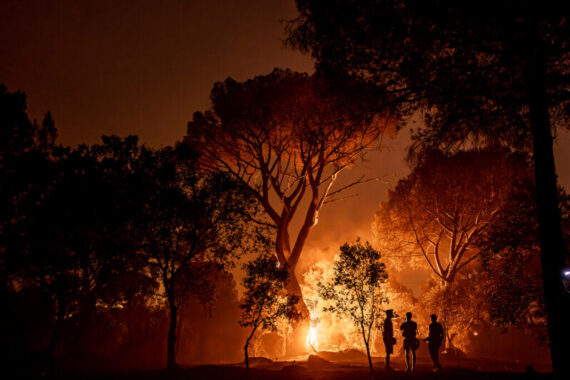
ildfires continued to burn across France, Spain and Greece on Thursday as scorching temperatures, strong winds and dry conditions fueled blazes that have killed firefighters, forced mass evacuations and destroyed thousands of hectares of land.
In southwestern France, authorities said a wildfire near Bordeaux was brought under control overnight after burning around 42,000 hectares of forest. Police arrested two people on suspicion of arson, though officials released no further details.
The fires have forced about 220,000 residents and tourists to evacuate, although around 60,000 have since returned as conditions improved. Businesses that had temporarily closed were gradually reopening.
Weather conditions around Bordeaux were expected to improve later Thursday, with forecasts of cooler temperatures, higher humidity and possible thunderstorms. However, authorities warned that the fire danger remained high.
In Greece, three firefighters were killed as crews battled separate wildfires driven by gale-force winds.
Two firefighters died after becoming trapped between advancing fire fronts on the island of Crete, where hundreds of residents and tourists were evacuated by land and sea from communities threatened by fast-moving flames. A third firefighter was killed while responding to another wildfire in the Peloponnese.
Strong winds prevented firefighting aircraft from operating over parts of Crete, hampering efforts to contain the blaze.
Spain also remained on alert as firefighters battled at least 10 active wildfires across the country.
Prime Minister Pedro Sánchez described the situation as “extreme,” citing high temperatures, low humidity and powerful winds that have created dangerous fire conditions.
The largest fire continued to spread in the eastern province of Castellón, where more than 9,300 hectares have burned. Fire officials said crews worked overnight to secure the fire’s 82-kilometer perimeter in hopes of stabilizing it before temperatures rose again.
New wildfires also broke out in the northwestern provinces of Zamora and León, forcing more than 1,300 people to leave their homes, including residents near Arribes del Duero Natural Park.
Recommended
Sánchez said he had asked European Commission President Ursula von der Leyen to support establishing a European Union wildfire response center for the western Mediterranean on Spain’s Balearic Islands.
Europe has endured repeated heatwaves this summer, with temperatures remaining well above seasonal averages across much of the continent.
Scientists say prolonged drought, extreme heat and strong winds have increased the frequency and intensity of wildfires across southern Europe, where emergency services have faced near-continuous firefighting operations in recent weeks.
The current wildfire season has already burned more land across the European Union than at the same point last year, underscoring the growing challenge posed by increasingly severe summer fire seasons.
(Source: Reuters)

Politics Today is dedicated to publishing insightful analyses in order to understand the changing nature of contemporary politics. It aims to contribute to the sound and constructive discussion of international affairs.
You can see how this popup was set up in our step-by-step guide: https://wppopupmaker.com/guides/auto-opening-announcement-popups/

Stay informed by subscribing to
our weekly newsletter.
You can see how this popup was set up in our step-by-step guide: https://wppopupmaker.com/guides/auto-opening-announcement-popups/
You can see how this popup was set up in our step-by-step guide: https://wppopupmaker.com/guides/auto-opening-announcement-popups/
You can see how this popup was set up in our step-by-step guide: https://wppopupmaker.com/guides/auto-opening-announcement-popups/
You can see how this popup was set up in our step-by-step guide: https://wppopupmaker.com/guides/auto-opening-announcement-popups/