R
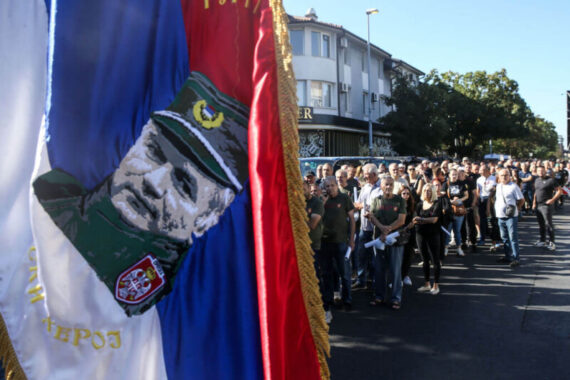
atko Mladic, the former Bosnian Serb army commander convicted of genocide and other war crimes, was buried in Belgrade with full military honors on Monday, drawing thousands of mourners and renewed condemnation from European officials and relatives of victims of the Bosnian war.
Mladic, who died on August 27 at the age of 84 while serving a life sentence in The Hague, remains a revered figure among some Serbian nationalists despite his conviction by a United Nations-established tribunal. His funeral highlighted continuing divisions over Serbia’s wartime legacy and its relationship with the European Union.
Thousands of mourners gathered at the Serbian Orthodox Church of St. Luke in Belgrade, where Mladic’s body lay in state. His military cap and saber were placed on his coffin, while men dressed in military-style fatigues stood nearby.
Patriarch Porfirije, head of the Serbian Orthodox Church, led the funeral service. Serbian army soldiers later carried Mladic’s coffin, wrapped in the national flag, to the cemetery as mourners applauded and a military orchestra played.
The ceremony was broadcast live by pro-government media and attended by prominent figures, including Bosnian Serb nationalist leader Milorad Dodik and Russian Ambassador to Serbia Alexander Botsan-Kharchenko.
Srebrenica victims condemn glorification
Mladic was sentenced in 2017 for his role in some of the worst atrocities of the Bosnian war. He was convicted of orchestrating the 1995 Srebrenica massacre, in which more than 8,000 Muslim men and boys were killed, as well as the prolonged siege of Sarajevo and other war crimes.
He was also found guilty of crimes involving detention camps where non-Serb civilians and enemy soldiers were held.
The funeral prompted anger from victims’ relatives and organizations in Bosnia and Herzegovina. The Mothers of Srebrenica, a group representing relatives of those killed in the massacre, called on the European Union to respond to the public celebration of Mladic.
The group warned that the funeral risked becoming a major gathering for supporters of fascism in Europe and said the glorification of genocide was a source of shame rather than honor.
The Srebrenica massacre occurred after the United Nations had designated the town a safe haven for Bosnian Muslims. Bosnian Serb forces overran the area, separated men and boys from their families and killed them, with victims later buried in mass graves.
The European Union’s foreign service also condemned the public glorification of Mladic. It said honoring convicted war criminals, denying genocide and attempting to revise the historical record were incompatible with European values and had no place in EU member states or candidate countries.
The criticism comes as Serbia continues its long-running bid to join the EU. Marta Kos, the European commissioner responsible for enlargement, canceled a planned visit to Serbia in protest over the celebrations surrounding Mladic’s death.
Recommended
Serbia defends funeral amid political tensions
The Serbian government has sought to distance itself formally from the funeral arrangements, which were organized by Mladic’s family. However, the government sent a plane to return his remains to Belgrade, while Serbian soldiers carried his coffin during the ceremony. A military commemoration was also held at an official Serbian army venue on Saturday.
President Aleksandar Vucic described the gathering as an “emotional response” rather than an event approved by the government. He said the funeral had “nothing to do” with whether Serbian authorities had formally authorized it.
Vucic, a former nationalist politician who supported Serbia’s expansionist policies during the Bosnian war, has increasingly used anti-Western rhetoric as Serbia approaches an early parliamentary election expected next month.
He accused Western countries of repeatedly persecuting and blaming Serbs, arguing that many Serbs had grown unwilling to accept what he portrayed as “decades of pressure and discrimination.”
Vucic did not attend the funeral.
Serbia has remained defensive about its role in the Bosnian war, during which Belgrade supported Bosnian Serb forces. Serbian authorities have repeatedly accused Western governments of maintaining an anti-Serb position over the conflict.
The war, which ended in 1995 with a US-brokered peace agreement, killed more than 100,000 people and displaced more than one million.
Mladic’s funeral has therefore become more than a ceremony for his supporters. It has exposed unresolved disputes over Serbia’s interpretation of the war and placed additional pressure on the country’s already complicated relationship with the European Union.
(Source: CNN)