The Voice of the Global Conscience and the Will to Rebuild

October 12, 2026

The phrase “The world is bigger than five,” first articulated by President Erdoğan from the UN podium in 2013 and subsequently becoming a defining theme of Türkiye’s approach to global politics, is described as having evolved into a sophisticated international law project.
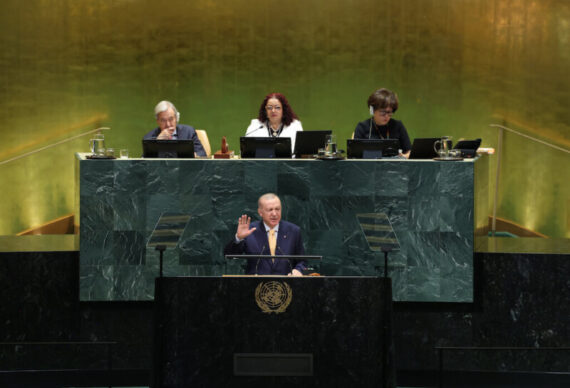
Turkish President Recep Tayyip Erdogan addresses the 81st session of the United Nations General Assembly, which brings together leaders and senior representatives of UN member states in New York, United States, on September 22, 2026. Photo by Anadolu Images.

O

ver the years, President Recep Tayyip Erdoğan’s addresses to the United Nations General Assembly  have reflected the strategic deepening of Türkiye’s foreign policy vision and the global projection of the “Century of Türkiye” perspective. Taken together, these speeches constitute a manifesto for an emerging order-building actor at a time when the Western-centered established order has reached an impasse.

Over the past five years, the rhetorical trajectory of Türkiye , and consequently that of President Erdoğan , has undergone a marked acceleration in parallel with shifts in the global system. Türkiye’s evolution -from an actor seeking to heal the wounds of the pandemic and test its mediation capacity at the 77th General Assembly in 2022 to a power shaping the debate on a broad range of global issues, from cyberterrorism and artificial intelligence ethics to regional conflicts and global injustice, at the recently convened 81st General Assembly- confirms its positioning as an indispensable actor in the reconstruction of the global architecture.

The first stage of this strategic continuity was the period in which Türkiye demonstrated its active mediation and humanitarian diplomacy capabilities to the international community.

Mediation and the search for systemic reform

The 77th and 78th General Assemblies, held as the Russia-Ukraine war activated major geopolitical fault lines, marked a period in which Türkiye institutionalized its identity as a facilitator and mediator. The diplomatic rhetoric of the period was shaped by the confidence that came with being an actor capable of maintaining a balance between the parties to a conflict.

Türkiye’s most tangible achievements during this period were undoubtedly the Istanbul Agreement and the Black Sea Grain Initiative. This initiative, which enabled 33 million tonnes of grain to reach global markets, helped stabilize food prices and served as a global bridge against the threat of hunger. The initiativewas presented as one of the United Nations’ most significant diplomatic achievements of recent years and as one of the most successful applications of the principle of “functionalism” in international relations, demonstrating Türkiye’s capacity to resolve concrete crises.

The principle that “there are no winners in war and no losers in a just peace” became the central tenet underpinning the speeches at the 77th and 78th General Assembly.

During this period, Türkiye’s criticism of the UN Security Council largely remained constructive, focusing on improving the system through greater transparency, efficiency and democratization. Türkiye had not yet reached the conclusion that the system had completely collapsed. Instead, it continued to leave room for optimism that the existing structure could be reformed and made more effective in the pursuit of peace and justice.

However, during the 79th and 80th General Assemblies, this constructive language rooted in mediation would later give way to a much sharper and more systemic confrontation as Türkiye’s discourse evolved into an expression of the global conscience.

Exposing a moral collapse

The 79th and 80th General Assembly sessions coincided with a period in which Israel’s attacks on Gaza exposed what the article describes as the moral and humanitarian failure of the modern international system. President Erdoğan’s speeches during this period moved beyond the limits of pragmatic diplomacy toward a language of “conscience diplomacy” in opposition to global injustice.

The statement, “Not only children are dying in Gaza; the UN system is dying too,” was among the most striking expressions of Erdoğan’s 80th General Assembly address. The figures cited in the speech were presented as evidence of systematic and deliberate destruction, including nearly 100,000 civilian casualties, more than 20,000 children killed, and 146 children who reportedly died as a result of starvation being used as a weapon.

References in the 80th General Assembly speech to amputations carried out “without anesthesia” and to millions of people forced to search for food in garbage were presented as evidence that the demand for justice could no longer be addressed merely by reforming the existing system, but had become an urgent necessity.

The comparisons made in the 79th and 80th speeches between Israeli Prime Minister Benjamin Netanyahu and Hitler, and the reference to what was described as a “murder network,” were presented not simply as rhetoric but as historical evidence of the post-1945 order violating the very values it had pledged to protect.

The inability of the UN Security Council to prevent the killing of 326 UN personnel by Israel, as cited in the article, and the tearing of the UN Charter at the UN podium by Israel’s permanent representative were described as evidence of the system’s failure.

At this stage, Türkiye sought to move its criticism onto the terrain of international law by calling for legal mechanisms, including the 1950 “Uniting for Peace” resolution, to be activated. This period, when systemic criticism reached its peak, was followed at the 81st General Assembly by a shift toward proposing a new regional and global architecture.

Türkiye as an “order-building” power and the evolution of the “The World Is Bigger Than Five” Doctrine

President Erdoğan’s address to the 81st General Assembly is presented as evidence of Türkiye’s transition from a crisis-managing actor to an order-building power seeking to shape a new global and regional system beyond individual crises.

The speech reflected a stage in which Türkiye sought to demonstrate its capabilities through concrete solutions and norm-setting, rather than merely criticism.

The vision outlined for Syria following the December 8 Revolution is presented as one of the clearest examples of this new period. Türkiye advocates a regional stability model centered on Syria’s territorial integrity and the legitimate expectations of its people, as well as a region free from terrorism, under the principle of “regional ownership.”

At the strategic level, the Development Road Project and the Organization of Turkic States were presented as potential “global centers of attraction,” reflecting Türkiye’s economic and political integration capacity.

The most notable aspect of the 81st General Assembly, however, was Türkiye’s emphasis on its role as a norm-setter. Warnings about cyberterrorism and technological hegemony demonstrated what the article describes as an advanced perspective on the security risks of the digital age.

The emphasis on artificial intelligence ethics, the Zero Waste movement , which has gained the support of 105 countries , and “climate justice” through Türkiye’s hosting of COP31 were presented as manifestations of Türkiye’s ambition to help establish global standards.

The phrase “The world is bigger than five,” first articulated by President Erdoğan from the UN podium in 2013 and subsequently becoming a defining theme of Türkiye’s approach to global politics, is described as having evolved into a sophisticated international law project.

During the 77th and 78th General Assemblies, the slogan emphasized reform within the existing system, including greater transparency, accountability and democratic representation at the Security Council.

During the 79th and 80th sessions, amid the Gaza war, it evolved into a criticism of the veto power as a shield protecting those accused of genocide. The 81st General Assembly then took the argument further, calling for alternative mechanisms and what the article characterizes as a legal transformation.

According to approach, the will of more than 190 countries should not be subordinated to that of five. When the Security Council becomes deadlocked, mechanisms such as the “Uniting for Peace” resolution and regional defense and development alliances could be used to bypass institutional paralysis.


Defending human nature against global cultural hegemony

The increasingly prominent emphasis on protecting the family in Erdoğan’s speeches is presented as evidence of Türkiye’s principled opposition to what it views as ideological impositions in global social policy.

Beginning with the 78th General Assembly, the speeches argued that global ideological pressures were increasingly targeting human nature and the social fabric. At the 79th General Assembly, references to the opening ceremony of the 2024 Paris Olympics were used to argue that policies surrounding gender had evolved from matters of individual choice into what Türkiye viewed as a broader challenge to sacred values, human nature and the family.

Türkiye joined the UN’s Group of Friends of the Family, presenting the protection of the traditional family structure, human nature, children and the future of societies as interconnected objectives.

Despite lobbying pressure, this defense of what the article calls human nature is portrayed as a reflection of Türkiye’s determination to resist externally imposed global norms.

Türkiye’s social-policy agenda beyond political issues extends into three additional global areas.

Firstly, the Zero Waste initiative launched under the patronage of First Lady Emine Erdoğan was adopted at the UN General Assembly with the participation of 105 countries and developed into a global awareness campaign. In his recent speeches, President Erdoğan has highlighted the fact that more than 2 billion tonnes of food are wasted globally each year and called on developed countries to fulfill their historical responsibilities. Environmental issues have been framed around climate justice and the need to confront excessive consumption.

Secondly, Türkiye has played a leading role in efforts that resulted in March 15 being designated as the International Day to Combat Islamophobia. Ankara has also continued to press for the implementation of a UN decision to appoint a Special Representative on combating Islamophobia. The speeches have emphasized that attacks against religious beliefs and places of worship cannot be legitimized under the guise of freedom of expression.

Thirdly, Türkiye has supported the UN Technology Bank in response to global inequalities in access to technology. It has also stressed that artificial intelligence and digital technologies should not become new instruments of domination or technological polarization. In his latest address, President Erdoğan called for the protection of children’s rights in the digital world and the creation of a binding and fair global legal framework for artificial intelligence.

Taken together, these themes demonstrate how Türkiye has sought to use the UN podium not merely as a platform for discussing geopolitical crises, but as a venue for articulating a comprehensive vision of global conscience and civilization encompassing the family, environment, freedom of belief and technology.

In conclusion, Türkiye has moved beyond being a critic that voices the world’s problems and is seeking to position itself as one of the global architects of a new international order centered on justice, conscience and collective wisdom.

(Originally published in Turkish by Kriter)

Ensar Kıvrak graduated from the Department of Political Science and Public Administration at Kocaeli University in 2015. He earned his master's degree in Political Science from Sakarya University in 2018. In 2024, he earned his doctorate from the same university with his thesis titled "The Sociopolitical Possibilities of De-nationalized Patriotism: A Theoretical Discussion." He worked as a research assistant at the Department of Political Science and Public Administration at Sakarya University between 2018 and 2025. He is currently a faculty member at the Department of Political Science and Public Administration at Eskişehir Osmangazi University. He is married and has three daughters.