Oman Proposes Preferential Trade and Investment Agreement with China

November 2, 2026

Sultan Haitham of Oman's visit to Beijing signals a push to expand economic cooperation, with proposed joint investments spanning renewable energy, artificial intelligence, digital technology, space and defense.
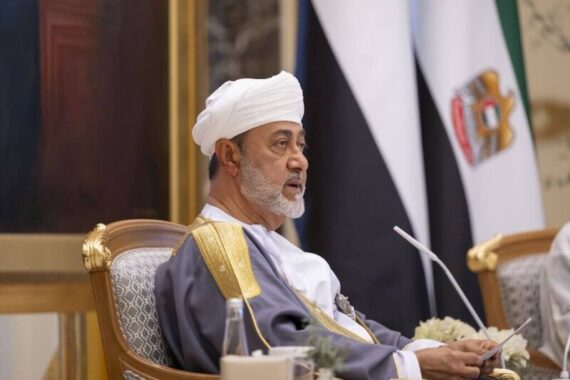
President of United Arab Emirates, Mohamed bin Zayed Al Nahyan meets with Sultan of Oman Haitham bin Tariq at Qasr Al Watan in Abu Dhabi, United Arab Emirates on April 22, 2024. Photo by Anadolu Images.

O

man has proposed a preferential bilateral trade and investment agreement with China as the two countries seek to deepen economic ties and expand cooperation across strategic industries.

Sultan Haitham bin Tariq al-Said made the proposal during a meeting with Chinese President Xi Jinping at the Great Hall of the People in Beijing on Monday, describing the agreement as a way to create new opportunities for trade and investment.

“We are confident that such an agreement would open new avenues for trade and investment, facilitate and enhance commercial and investment exchanges between our two nations,” Haitham told Xi, according to remarks reported by Oman’s state-run news agency.

The proposal comes as Oman seeks to increase trade with its largest commercial partner and attract investment into sectors that form part of its efforts to diversify its economy beyond oil exports.

Haitham said Muscat was interested in establishing joint investment funds covering renewable energy, artificial intelligence, digital technologies, space and defense.

The discussions also emphasized closer cooperation between financial and investment institutions, suggesting that the proposed partnership could extend beyond conventional trade in goods and energy.

Xi described closer relations with Oman as a “shared strategic choice” for both countries, saying he was ready to work with Haitham to elevate their strategic partnership and contribute to regional stability and prosperity.


Energy and technology at the center of economic cooperation

China is Oman’s largest trading partner, with bilateral economic relations supported by Omani exports of crude oil and other energy products to the Chinese market.

The two countries have also been developing commercial and tourism links. Direct flights between Beijing and Muscat began in November 2025, providing additional connectivity for business and travel.

Oman is seeking to expand its renewable energy supply chains and digital commerce as it pursues broader economic diversification. Cooperation with China could provide access to investment, technology and industrial expertise in areas including clean energy and advanced digital infrastructure.

The proposed joint investment funds would offer a framework for financing projects in several emerging sectors. However, the announcement did not specify the size of the funds, their investment timelines or the projects that would receive priority.

Haitham also highlighted the importance of cooperation between financial institutions, indicating that strengthening investment channels would be an important part of the proposed economic relationship.

The talks reflect China’s continuing efforts to strengthen its economic and diplomatic partnerships across the Middle East, where energy trade, infrastructure investment and technology cooperation have become increasingly important areas of engagement.

Historic visit underscores growing strategic ties

Haitham arrived in Beijing on Sunday for a two-day state visit, the first by an Omani head of state since the two countries established diplomatic relations in 1978.

His arrival was followed by an official welcoming ceremony on Monday, where he and Xi reviewed an honor guard at the Great Hall of the People.

Although the regional conflict was not directly addressed in Haitham’s opening remarks, the Omani leader praised China’s efforts to promote international security, stability and cooperation.

“We further express our deep appreciation for China’s positions on key issues concerning our region,” he said.

The visit comes as Beijing seeks to maintain diplomatic engagement across the Middle East amid continuing regional tensions. China’s Foreign Ministry said last week that Beijing would soon send special envoys to countries in the region to encourage dialogue and de-escalation.

Oman’s proposal therefore carries both economic and diplomatic significance, although the discussions announced on Monday focused primarily on bilateral trade, investment and strategic cooperation.

The two governments have described the visit as an opportunity to establish a new phase in their relationship. Whether that ambition produces a formal preferential trade agreement and concrete investment commitments will depend on subsequent negotiations.

(Source: Reuters)

Politics Today is dedicated to publishing insightful analyses in order to understand the changing nature of contemporary politics. It aims to contribute to the sound and constructive discussion of international affairs.