A
lthough discussions regarding Hezbollah’s weapons have been part of Lebanese politics since the Taif Agreement in 1989; the events of October 7, which saw Hezbollah lose its entire senior command, Israeli attacks on its weapons depots, and, particularly with the Syrian revolution, the decline of Iran’s regional influence, paved the way for negotiating Hezbollah and its weapons in such a clear and forceful manner for the first time.
From the beginning of 2025, Lebanon achieved relative stability with the election of a president and the formation of a new government, and began to chart a new course in domestic and foreign policy to determine its place in the regional equation. However, the issue of dismantling the military wing of Hezbollah, which has long been the country’s most important armed force, and disarming the group has once again brought the political deadlock in the country to the fore.
Although Hezbollah is currently weaker than ever, the failure to achieve concrete results from the negotiations, the government’s inability to manage the process well, and the continuation of Israeli attacks on Lebanon indicate that a possible weapons handover process will be more painful than expected. Accordingly, questions surrounding the issue of weapons, which involves the Lebanese state-Hezbollah-society triangle, are increasingly being raised.
Will the weapons be surrendered?
The issue of disarming Hezbollah, which was the first item on the agenda of Nawaf Salam, who became prime minister of the new government on February 8, 2025, entered a new phase when Salam accepted Tom Barrack’s proposal on August 5, and decided that there should be no armed elements in Lebanon. The transition to this new phase was significantly influenced by the expansion of the scope of the UN Security Council resolution adopted after the 2006 war within the framework of Barrack’s Hezbollah-centered disarmament project.
Indeed, as stated above, the issue of Hezbollah’s weapons began to be discussed in the 1990s and was resolved in 2006. In line with this decision, it was envisaged that there would be no armed forces other than the Lebanese army in southern Lebanon. However, after the Israel-Hezbollah war that began on October 8, 2023, Amos Hochstein, the Biden administration’s Middle East adviser, brought the UN resolution back to the agenda in the first month of the war and made statements saying that UN Resolution 1701 is not enough and that the United States is working to devise a formula to end the conflict once and for all, indicating that security strategies against Hezbollah had been determined much earlier.
At this point, it is understood that the clause in the proposal presented by Tom Barrack, which calls for the removal of Hezbollah weapons not only from southern Lebanon but also from Dahiye, Bekaa, Baalbek and all areas held by the group, had been planned by Washington and Tel Aviv for a long time.
Hezbollah’s self-restraint
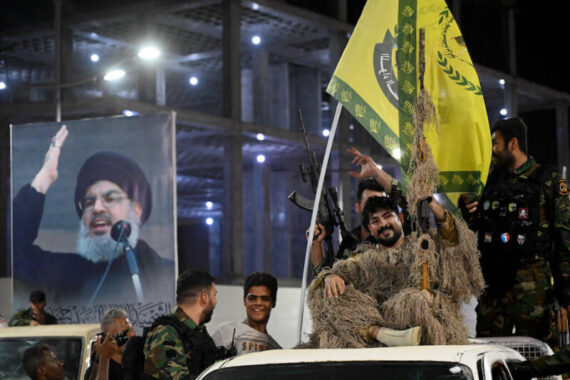
Hezbollah Secretary-General Naim Qassem, who strongly opposed the draft against the Lebanese government that ratified the U.S. decision, stated that despite all of Israel’s violations after the November 26 ceasefire agreement, there had been no response from South Lebanon to Israel. He argued that Hezbollah had complied with the conditions to secure peace, but Israel had continued its occupations and attacks, stating that national security would be completely threatened by the project to disarm Hezbollah.
This situation, a clear sign that they will not comply with what Naim Qassem sees as an Israeli and U.S. plan, is bringing the tension between Hezbollah and Amal on one side and the Lebanese government and its allies on the other to a more critical point. On the other hand, Hezbollah’s continuation of its ‘Resistance: Sovereignty’ slogan indicates that the process will be stalled for some time and that no concrete progress will be made until December 2025, the deadline set for the state to take control of the weapons.
Naim Qassem’s current call for the Lebanese government to reverse its decision and for joint action against this external threat to Lebanon, developing a discourse based on national consciousness, indicates that he is seeking political support within Lebanon. Although Qassem’s statement that Lebanon’s national security is under threat has not been met with a response, his room for maneuver has been significantly reduced due to the low level of support he has received, even from Amal movement leader Nabih Berri. The Lebanese army does not have a deterrent force capable of confronting Hezbollah, besides the Lebanese government’s inability to chart a course for disarmament that would not lead to internal conflict. These are all clear signs that the group will not back down in the short term.
Another point to note at this stage is that if Israel withdraws from the occupied territories and a permanent ceasefire is achieved, it remains to be seen in what context Hezbollah will bring the issue of its weapons to the negotiating table. Indeed, the leader of Hezbollah has stated from the outset that they will not surrender their weapons by any means whatsoever. Following the permanent ceasefire expected to be signed between Israel and Lebanon, scenarios are emerging in which Hezbollah will act in cooperation with the Lebanese army and Hezbollah soldiers may be integrated into the Lebanese army. This plan, rejected by the Lebanese government and, naturally, the U.S., appears to be the only alternative offered by Hezbollah.
On the other hand, statements made by Israeli Finance Minister Bezalel Smotrich that Israel will not withdraw from the five points it occupies in southern Lebanon leave Hezbollah with no alternative but to cooperate in order to maintain its military presence. Therefore, pressure exerted during the negotiation phase will mobilize Hezbollah’s social base, which refuses to accept coexistence with Israeli occupiers in the south and will widen the gap between society and the state.

What does Iran’s support for Hezbollah mean?
Shortly after Nawaf Salam accepted the U.S. proposal, the visit of Ali Larijani, Secretary of Iran’s Supreme National Security Council, to Beirut and the tension that arose between him and President Joseph Aoun and Prime Minister Salam during the visit showed that Hezbollah had caused a stalemate between Iran and Lebanon. In this context, although Larijani proposed dialogue on the issue of weapons, he emphasized that his country would continue to support Hezbollah, stating that the resistance was a strategic asset and that ‘Tehran needs Hezbollah’s support at least as much as Hezbollah needs it,’ thus indicating that Iran would not abandon Hezbollah.
In contrast to Salam, who reacted harshly to Larijani’s remarks, Iranian Foreign Minister Abbas Arakchi, seeking to adopt a more moderate stance, stated that they were not interfering in Lebanon’s internal affairs but supported Hezbollah’s national security strategy, indirectly expressing their desire for Iran’s continued presence in Lebanon.
At this stage, it appears that Iran, while beginning to prioritize its internal defenses against a potential renewed conflict with Israel, is striving to maintain its influence over the Lebanese Shiites and Hezbollah, who need it more than ever. On the other hand, considering that the decline in its regional influence does not mean Iran’s withdrawal from the region, that Tehran is closely monitoring the ongoing instability in Syria, and that Saudi Arabia’s reluctance regarding Lebanon continues, it is likely that Iran will maintain its strategic support for Hezbollah.
What do the Lebanese people think?
At the end of August, Naim Qassem threatened ‘internal conflict’ in response to the forcible collection of weapons. This led to some members of parliament, primarily from the Lebanese Forces Party, filing a lawsuit against Naim Qassem on the grounds that he was threatening national security, which became a hot topic in Lebanon. While comments suggesting that Naim Qassem wants to provoke civil war in Lebanon have increased in the wake of these developments, it is worth noting that the reflection in the mirror belongs not only to Hezbollah and Naim Qassem, but also to the Shiite community.
Hezbollah’s weapons represent an ‘identity’ for the Shiites and that they will not relinquish Hezbollah, which has been solely responsible for establishing their political, social, economic and sectarian foundations for over 40 years. For Shiites, who believe that the end of Hezbollah’s military presence will lead to the questioning of its political legitimacy, it seems unacceptable for the process to proceed without conflict.
Indeed, Tom Barrack’s words, ‘Hezbollah must go,’ indicate that its representation in parliament will also be eroded. Therefore, Shiites who believe that Hezbollah will rise again as a force, despite losing motivation with the death of Hassan Nasrallah, are showing stronger support for Hezbollah, acting on the assumption that Amal cannot adequately represent them.
Recommended
The Shite community
At the same time, Shiites, who do not ignore the support coming from Iran on the issue of disarmament, argue that not only Hezbollah but the entire Shiite community has a say in the surrender of weapons.
Outside of the Shia community, there is a consensus regarding Hezbollah’s weapons. In this sense, although the Lebanese people do not have complete trust in the government and the army, they express a shared belief that Hezbollah cannot eliminate the Israeli threat. However, aware of the power of Hezbollah’s social and political network, the Lebanese society believes that the handover of weapons will be contentious and that a spark in Lebanon could ignite a conflagration. Consequently, the possibility of renewed conflict in Lebanon preoccupies the public mind.
In the current situation, it appears that the countdown has begun in Lebanon for the disarmament of Hezbollah. The government is faced with the condition that, even to overcome the country’s economic problems outside of Hezbollah, the surrender of weapons must first be secured and the Lebanese army strengthened. However, Lebanon, which has not received a guarantee from the U.S. regarding the end of the Israeli occupation, does not prefer to pressure Hezbollah either. Lebanon’s successful emergence from this critical process is proportional to Washington’s reduction of Tel Aviv’s tense stance towards Lebanon. Otherwise, Lebanon will have to contend with a new crisis due to Israel’s increasing attacks and Hezbollah’s resistance to disarmament.