AfD Leads in Northeastern Germany as Merz Suffers Worst State Election Result Since 1949

September 21, 2026

The AfD was projected to win 38.3% of the vote in Mecklenburg-Western Pomerania, narrowly ahead of the centre-left Social Democratic Party (SPD), which was projected at 35.4%, according to ARD public television.
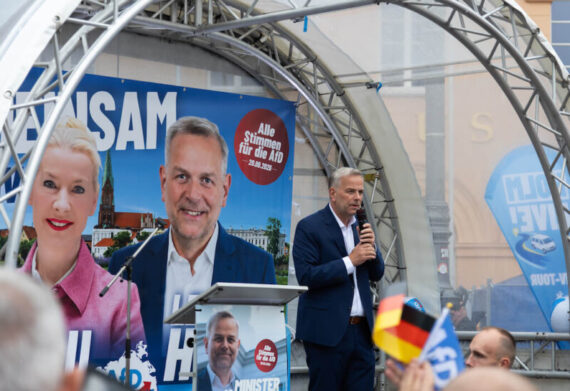
Alternative for Germany (AfD) politicians Leif-Erik Holm, Ulrich Siegmund and Petra Federau attend the party's final election campaign rally, one day before the Mecklenburg-Vorpommern state election, in Schwerin, Germany, on September 19, 2026. Photo by Anadolu Images.

G

ermany’s far-right Alternative for Germany (AfD) emerged as the strongest party in a state election in northeastern Germany on Sunday, according to voting projections, dealing a major setback to Chancellor Friedrich Merz’s conservative party and increasing pressure on his coalition government.

The AfD was projected to win 38.3% of the vote in Mecklenburg-Western Pomerania, narrowly ahead of the centre-left Social Democratic Party (SPD), which was projected at 35.4%, according to ARD public television. Merz’s conservative bloc, meanwhile, stood at 4.9%, below the 5% threshold required to enter the state parliament.

The result represented the worst performance by Merz’s mainstream conservative party in a German state election since the end of World War Two, according to Reuters. Merz described the outcome as “a disaster” but said he intended to remain in office and continue pursuing his reform program.

The result came after the AfD had already achieved a major breakthrough earlier this month by finishing first in Saxony-Anhalt. The party also leads national opinion polls, although Germany’s other major parties have so far refused to enter governing coalitions with it.

The latest vote has therefore renewed debate over the long-standing political “firewall” designed to keep the AfD out of government.

AfD gains momentum as Merz defends reform agenda

The election results added to challenges facing Merz, who entered office last year promising reforms aimed at reviving Germany’s sluggish economy. His government has struggled to win broad public support amid criticism of pension, tax and healthcare reforms, as well as rising household costs.

Marcel Fratzscher, president of the Berlin-based DIW economic research institute, told Reuters that the results could make it more difficult for the federal government to build political support for fundamental reforms.

He warned that if governing parties maintain their existing political red lines, Germany could face greater political paralysis and continued economic weakness, while the AfD could benefit further ahead of the 2029 federal election.

Merz, however, rejected suggestions that the election result should lead to a retreat from his reform programme. He argued that Germany needed determination and patience to address its economic problems.

He described the reforms as a response to what he called the growing appeal of authoritarianism in German society.

In Mecklenburg-Western Pomerania, SPD state premier Manuela Schwesig also campaigned by criticising both the AfD and the federal government’s policies. Schwesig said opposition to Germany’s financial and military support for Ukraine was an important factor behind the AfD’s support in the state.

She also pointed to continued interest among some voters in restoring energy links through the Nord Stream pipelines, which transported Russian gas to Germany before being damaged in explosions in 2022.

German Vice-Chancellor Lars Klingbeil, who leads the SPD, meanwhile signalled that the government should pay greater attention to voters’ concerns, including issues surrounding pension reforms.

The election campaign was also shaped by economic pressures. Voters in Mecklenburg-Western Pomerania highlighted rising living costs, energy prices and household financial difficulties as major concerns.


Berlin vote highlights wider political fragmentation

The elections also brought significant changes in Berlin, where the far-left Die Linke emerged as the leading party in projections.

Die Linke was polling at 25.3%, while Merz’s conservatives had fallen to 19%. The AfD also increased its support to 16.3% in the traditionally liberal capital.

The result marked the first time Die Linke had topped the vote in Berlin. The party has campaigned on policies including nationalizing housing held by corporate landlords and imposing rent controls.

The simultaneous gains by both the far right and far left highlighted the increasingly fragmented political landscape facing Germany’s established parties.

The AfD’s latest state-level success follows its strong performance in Saxony-Anhalt on September 6, where it came close to securing an outright majority. The party has sought to capitalise on concerns over migration, energy policy and the economic situation while advocating tougher measures to deport foreigners who have no legal right to remain in Germany.

It also supports restoring energy ties with Russia and leaving the euro, positions that have helped transform the party from a fringe eurosceptic movement into one of Germany’s most prominent political forces.

The party’s rise has intensified debate over whether the established parties can continue to exclude it from governing coalitions while maintaining support among voters who increasingly back the AfD.

For Merz, Sunday’s results add to the political difficulties confronting his government. Despite calling the outcome a “disaster,” he has made clear that he intends to remain chancellor and press ahead with his reform agenda.

The elections therefore leave Germany facing a combination of economic pressure, growing political fragmentation and an increasingly prominent far-right opposition as the country moves toward the 2029 federal election.

(Source: Reuters)

Politics Today is dedicated to publishing insightful analyses in order to understand the changing nature of contemporary politics. It aims to contribute to the sound and constructive discussion of international affairs.