AIPAC Spending Dominates Michigan Senate Campaign Race
El-Sayed has argued that Stevens' campaign has become dependent on outside financial support tied to pro-Israel interests.
August 3, 2026
T
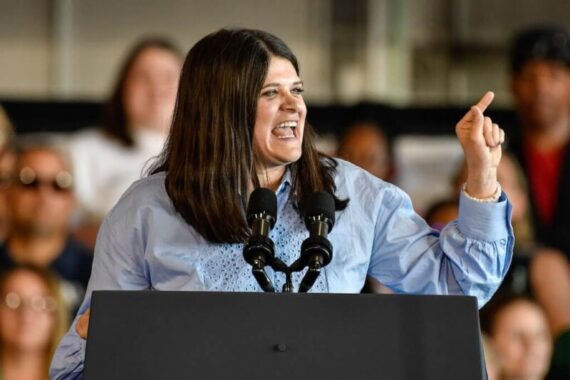
he Democratic primary for Michigan’s open U.S. Senate seat has become one of the most expensive and closely watched congressional races in recent history, with pro-Israel lobbying group AIPAC and affiliated political action committees pouring more than $60 million into efforts to support U.S. Representative Haley Stevens and defeat progressive challenger Abdul El-Sayed.
The race, which will determine the Democratic nominee to replace retiring Senator Gary Peters, has evolved into a national referendum on campaign finance, U.S. policy toward Israel and the growing influence of pro-Palestinian voices within the Democratic Party.
El-Sayed, a physician, epidemiologist and former public health official, has made opposition to outside political spending a central theme of his campaign, arguing that wealthy special interests are attempting to shape the outcome of the election. Stevens, a four-term congresswoman, has defended her record while distancing herself from the independent expenditures made on her behalf.
According to Federal Election Commission records cited by Al Jazeera, AIPAC’s political arm, the United Democracy Project (UDP), has spent more than $30.6 million on the Michigan race, the largest expenditure by the organization in a single contest. Combined with spending by other political action committees and an estimated $6.5 million from a nonprofit advocacy group, outside support for Stevens has exceeded $60 million.
The spending has eclipsed previous records for Senate primaries and has intensified scrutiny of the role of super PACs and nonprofit organizations in U.S. elections.
AIPAC directs the United Democracy Project and is also its largest donor, contributing roughly $30 million of the PAC’s $100 million fundraising total this election cycle. The remaining funding comes largely from wealthy pro-Israel donors, including hedge fund manager Paul Singer, businessman Robert Kraft, investor Marc Rowan and entertainment executive Haim Saban, according to campaign finance disclosures.
Additional support for Stevens has come through a network of newly established political committees and nonprofit organizations.
One of the largest, A Stronger Michigan, has spent more than $17 million and is backed primarily by the nonprofit Center Forward. Other committees, including Michigan Forward 2026, Center Forward Committee and Unite to Win, have also invested heavily in television advertising and voter outreach. Some of these groups receive funding from corporations, trade associations and nonprofits whose donors are not fully disclosed under U.S. campaign finance laws.
Although the campaigns themselves cannot legally coordinate with independent expenditure groups, the unprecedented level of outside spending has dominated the political debate ahead of Tuesday’s primary.
At a campaign rally in Dearborn, a city with one of the country’s largest Arab American communities, supporters repeatedly criticized AIPAC rather than Stevens herself.
Michigan state legislator Alabas Farhat told supporters they would make the organization “burn” millions of dollars by electing El-Sayed, while several speakers, including Representatives Rashida Tlaib and Ilhan Omar, criticized U.S. support for Israel’s military campaign in Gaza.
El-Sayed has argued that Stevens’ campaign has become dependent on outside financial support tied to pro-Israel interests.
Speaking at a recent rally, he said America’s political system allows “billionaires and corporations and special interests like AIPAC to buy and sell politicians.” During a televised debate, he linked Stevens’ congressional votes supporting aid to Israel with the organization’s financial backing of her campaign.
Stevens has rejected suggestions that the outside spending defines her candidacy.
During a recent debate, she argued that campaign finance reform remains a broader national issue affecting candidates across the political spectrum, saying there was little difference between super PACs supporting either campaign. Critics, however, point to the disparity in spending, noting that groups backing El-Sayed have spent only about $3.5 million.
Recommended
While outside groups have dominated television advertising, El-Sayed has outraised Stevens in direct campaign contributions from individual donors. Campaign finance records show El-Sayed has raised approximately $14.5 million compared with Stevens’ $11.9 million, reflecting strong grassroots fundraising despite the flood of independent expenditures supporting his opponent.
AIPAC has defended its involvement, saying it represents Americans who believe a strong U.S.-Israel relationship serves both countries’ interests.
The organization has rejected claims that it acts on behalf of a foreign government, describing itself as a coalition of pro-Israel Americans participating in the democratic process. In a recent message to supporters, AIPAC described the Michigan Senate contest as “critical.”
Political analysts say the outcome of the race could have implications far beyond Michigan.
A victory for El-Sayed would represent one of the highest-profile electoral successes for a progressive candidate critical of unconditional U.S. support for Israel and could signal changing attitudes among Democratic voters, particularly after months of debate over the wars in Gaza and the Middle East. Supporters argue such a result would weaken AIPAC’s influence within the Democratic Party, while opponents view the race as an important test of mainstream Democratic support for the U.S.-Israel alliance.
The contest also carries national political significance because the Michigan Senate seat is expected to be highly competitive in November. The Democratic nominee will likely face former Congressman Mike Rogers, and the outcome could help determine which party controls the U.S. Senate after the general election.
(Source: Aljazeera English)

Politics Today is dedicated to publishing insightful analyses in order to understand the changing nature of contemporary politics. It aims to contribute to the sound and constructive discussion of international affairs.
You can see how this popup was set up in our step-by-step guide: https://wppopupmaker.com/guides/auto-opening-announcement-popups/

Stay informed by subscribing to
our weekly newsletter.
You can see how this popup was set up in our step-by-step guide: https://wppopupmaker.com/guides/auto-opening-announcement-popups/
You can see how this popup was set up in our step-by-step guide: https://wppopupmaker.com/guides/auto-opening-announcement-popups/
You can see how this popup was set up in our step-by-step guide: https://wppopupmaker.com/guides/auto-opening-announcement-popups/
You can see how this popup was set up in our step-by-step guide: https://wppopupmaker.com/guides/auto-opening-announcement-popups/