Glacier Collapse Triggers Deadly Floods on Nepal-Tibet Border

August 27, 2026

It is too soon to say definitively whether climate change caused the glacier collapse at the Nepal-Tibet border, but the disaster fits a broader pattern of accelerating glacial melt across the Himalayas.
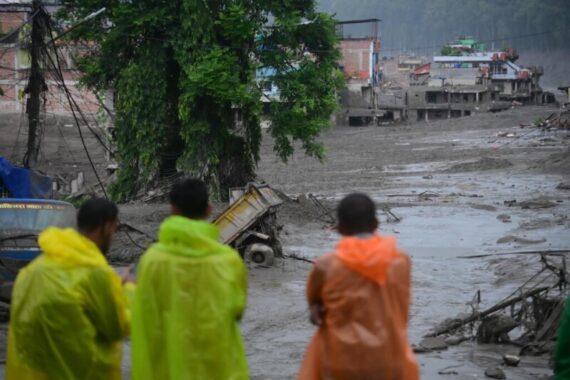
Search and rescue operation continue after flash flood and mudslides on the Nepal-China border on August 26, 2026 in Nuwakot, Nepal. The death toll from a devastating flash flood on the border climbed to 97 as at least 384 tourists and travelers, as well as soldiers and police, were reported missing. Photo by Anadolu Images.

A

section of a Himalayan glacier broke away on Wednesday morning, setting off a catastrophic flash flood that has killed at least 160 people and left nearly 1,500 missing across Nepal and Tibet, including more than 800 foreign nationals.

The flooding struck at roughly 8:40 a.m. local time along the Nepal-Tibet border, surprising residents and officials because there had been no rainfall to explain it. Nepal has confirmed 157 deaths, while Chinese authorities report three fatalities in Tibet’s Gyirong County.

Satellite imagery indicates that a chunk of glacier broke off at an elevation of about 5,200 meters (17,000 feet) and plunged roughly 1,200 meters down a mountainside, picking up rock and sediment along the way. The resulting avalanche slammed into the Lhende River in Tibet, temporarily damming it before the debris gave way and sent a wall of water downstream.

The event initially registered as a magnitude 4.4 earthquake, but the U.S. Geological Survey later determined the seismic signature came from the landslide itself, not a tectonic quake — ultimately measuring magnitude 5.2.

Where the flooding hit

The surge moved from the Lhende Khola into the Bhote Koshi and then the Trishuli River, with water levels in the Trishuli rising as much as 9 meters (27 feet) in just half an hour. Nepal’s Rasuwa district — including the towns of Timure and Syabru Besi — bore the brunt of the damage, with flooding also reaching Nuwakot and Dhading districts further downstream. Across the border, mud and debris struck Gyirong Port in Tibet’s Shigatse region. At least 19 bridges and roughly 40 kilometers (25 miles) of roads were destroyed.

Rescue crews have recovered 157 bodies in Nepal, and at least 65 injured people are being treated in local hospitals and in Kathmandu. More than 5,000 army and police personnel have been deployed with helicopters, drones and search dogs, though high water, mudslides and washed-out roads have slowed efforts to reach the worst-hit villages.

Local accounts describe scenes of sudden devastation. One Nepali businessman said relatives called in tears after their home was swept away entirely, while a teacher reported watching multiple trucks — with people inside — carried off by the floodwaters.

Nearly 1,500 people remain unaccounted for. In Nepal, 826 are missing, including close to 600 foreign nationals from more than two dozen countries — among them 177 from India, 63 from the United States, 34 from Australia, 33 from the United Kingdom and 25 from Canada. In Tibet’s Gyirong County, Chinese state media put the missing at 558, including 260 foreigners. Many of those affected were pilgrims en route to Kailash Mansarovar.


International response

India sent a rescue plane with roughly 10 tonnes of emergency supplies, and Prime Minister Narendra Modi pledged support in a call with his Nepalese counterpart, Balendra Shah. The Red Cross federation (IFRC) released 1.2 million dollars in emergency funding for relief operations in Nepal. The United Nations has deployed staff in Nepal and offered assistance in Tibet, with Secretary-General António Guterres offering condolences. The European Union activated its Copernicus satellite mapping service to help assess damage.

South Korea formed a task force after several of its nationals working at a hydropower project went missing, and plans to send a rapid-response team. The United States is sending a disaster response adviser and $500,000 in aid. Canada’s Prime Minister Mark Carney called the floods “absolutely devastating.” China’s President Xi Jinping ordered an all-out search-and-rescue effort in Tibet and called for measures to prevent further disasters.

It is too soon to say definitively whether climate change caused the glacier collapse, but the disaster fits a broader pattern of accelerating glacial melt across the Himalayas. Glaciers across the Hindu Kush Himalaya range lost ice 65% faster between 2011 and 2020 than in the prior decade, and Nepal’s glaciers have shed nearly a third of their volume over roughly 30 years. Satellite data showed unusually warm conditions and reduced snow cover around the glacier before it collapsed, and researchers are examining whether that instability played a role.

Officials expect the death toll to climb as rescue teams reach areas still cut off by damaged roads, high water and thick mud. In Tibet, authorities are also watching a still-dammed lake upstream from the disaster zone in Gyirong that could pose an additional flood risk.

(Source: Aljazeera English)

Politics Today is dedicated to publishing insightful analyses in order to understand the changing nature of contemporary politics. It aims to contribute to the sound and constructive discussion of international affairs.