I
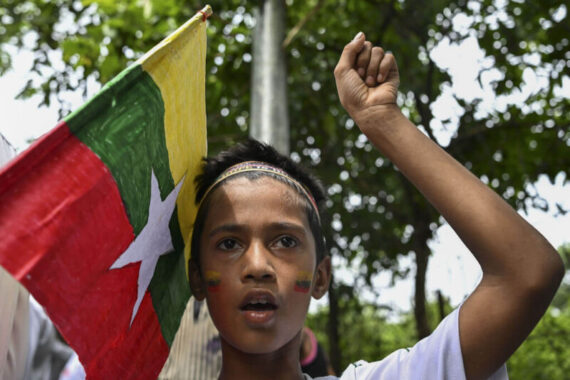
t has been nine years since the Rohingya were driven from their homes in Myanmar’s Rakhine State. More than one million now live in exile in Bangladesh, most of them in the overcrowded refugee settlements of Cox’s Bazar. They remain stateless, displaced and dependent on humanitarian assistance, while the possibility of returning home safely and with dignity is increasingly remote.
Conditions inside Myanmar are really distressing. A recent report by the United Nations Human Rights Council, examining the situation of Rohingya Muslims and other minorities in Myanmar, documents record continuing abuses against Rohingya. Among the accounts is one particularly harrowing detail about how a child was forced to clear the bones and skulls of victims of a massacre.
In Rakhine, the report documents widespread and systematic violations against the Rohingya by both the Myanmar military and the Arakan Army. Tun Khin, president of the Burmese Rohingya Organization UK (BROUK), spoke of the implications of this changing scenario to Politics Today.
“The AA now controls most of Rakhine State and is the de facto authority. That reality has to be recognized. But control of territory cannot be allowed to legitimize the AA while it continues to commit serious abuses against the Rohingya.”
Tun Khin pointed to what he described as a growing pattern of abuses documented by BROUK, alongside reporting by the UN and other human rights organizations.
“As the AA consolidates its power, persecution of the Rohingya is becoming more systematic and entrenched, replicating many of the discriminatory policies and abuses used against Rohingya for decades by the Burmese military.”
Allegations of killings and detentions
The allegations include killings, arbitrary detention, enforced disappearances, forced recruitment and forced labor, restrictions on movement, extortion and sexual violence.
An armed group fighting a military accused of some of the world’s gravest crimes can simultaneously become an authority accused of committing abuses against the same minority that the military once drove from its homeland. How tragic.
The Myanmar conflict is particularly complicated because the military junta in Naypyidaw is aligned with Moscow and Beijing, condemning its atrocities allows Western capitals to perform moral leadership at zero geopolitical cost. Western capitals comfortably adopt the language of human rights, framing the People’s Défense Forces (PDFs) and Ethnic Armed Organizations (EAOs) as pro-democracy freedom fighters. The United States has provided non-lethal assistance to Myanmar’s democratic opposition through measures including the BURMA Act, while stopping short of becoming a direct military participant in the conflict.
Consider the stark asymmetry between Gaza and Myanmar. In the Middle East, where Israel serves as the primary security and technological anchor for Western interests, state-inflicted mass civilian casualties are diplomatically shielded, vetoed at the UN, and sanitized as the unavoidable ‘collateral damage’ of counterterrorism. The grievances of the occupied are flattened under an absolute ‘terrorism’ framework to criminalize political negotiation and delegitimize resistance.
The two conflicts are not identical. However, the international response to civilian suffering is rarely detached from geopolitical interests be it in Myanmar or Gaza.
Human rights suspended
Where strategic stakes are high, human rights frameworks are suspended; where strategic stakes are low, human rights language is weaponized, and when humanitarian management is cheaper than political resolution, statelessness and exile are simply left to become permanent.
Neither the displaced Rohingya in Cox’s Bazar nor the civilians trapped under military airstrikes in Rakhine carry intrinsic weight in the grand strategy of Western capitals.
In my recent exchange with a Stimson Center scholar Yun Sun, she observed that critical Chinese assets, such as the Kyaukphyu deep-sea port and cross-border energy pipelines, remain physically secure simply because no warring faction is “willing or risk-neutral enough to target the port” or its energy pipelines. Yet, while realpolitik protects hard assets, the international community treats human displacement as an inconvenience to be managed. With repatriation quietly written off in favor of local host absorption, making statelessness the institutionalized status quo.
Myanmar is not democratic, the military Junta has committed grave abuses, Rohingya people have been denied citizenship and political belonging for decades now. Another frightening reality, however, is that the Rohingya are victims of the international system whose mechanism of protection continues to prove itself profoundly limited.
I asked Tun Khin where he thinks the Rohingya crisis stands nine years on.
“Governments keep managing the consequences: funding refugee camps, talking about repatriation and responding to dangerous sea journeys, trafficking and exploitation, while failing to apply the political pressure needed to end the persecution that prevents Rohingya from returning home. The international community keeps trying to manage the consequences of genocide instead of ending it.”

Recommended
Generational statelessness
Nine years of exile has created the conditions for statelessness to turn generational. Rohingya children born after the mass exodus have never known life in their homeland. They are coming of age in refugee camps without recognized citizenship, while those inside Myanmar continue to live under restrictions that deny them basic rights.
There is, Tun Khin believes, a very real danger that this statelessness is becoming permanent. “An entire generation is growing up without citizenship, while Rohingya inside Burma continue to be denied their basic rights.”
The Rohingya repeatedly find themselves on the margins of calculations made by far more powerful actors. Their suffering is acknowledged, investigated, and condemned, but international acknowledgment has never translated into the political leverage necessary to dismantle their displacement.
Prolonged displacement is gradually becoming normalized, institutionally, politically and internationally.
Managing the fallout of genocide without confronting its geopolitical architects is simply another way of permitting it.