India’s Gen Z Turns Social Media against Modi Government amid Student Protests
“If nothing, we are televising our revolution,” protester Avanshika Singh said during the anti-Modi government demonstrations in India.
July 23, 2026
I
ndia’s student protest movement has gained momentum online after demonstrations against examination paper leaks triggered a wave of social media posts criticizing Prime Minister Narendra Modi’s government.
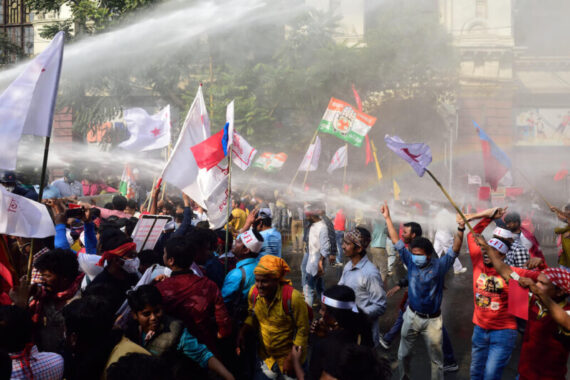
The protests, led by students demanding the resignation of Education Minister Dharmendra Pradhan, intensified after a march toward Parliament on July 20 brought central New Delhi to a standstill.
According to protesters, more than 100 students were injured during a police crackdown. Police denied allegations of excessive force, but videos recorded by demonstrators circulated widely across social media platforms.
The footage showed scenes from the protests, including clashes between police and demonstrators, tear gas, baton charges, and students fleeing the area. The videos quickly spread on Instagram and other platforms, generating memes, commentary, and calls for further demonstrations.
“If nothing, we are televising our revolution,” protester Avanshika Singh told Al Jazeera during the demonstrations.
Young protesters said social media had become a central tool for documenting events and mobilizing support.
Posts criticizing the government and demanding accountability over repeated examination paper leaks have spread widely, while official posts by the ruling Bharatiya Janata Party have reportedly been flooded with comments calling for the education minister’s resignation.
The protests have also inspired demonstrations in other Indian cities, including Mumbai, Bengaluru, Patna, Lucknow, and Aizawl.
The demonstrations are being organized by the Cockroach Janta Party, a political pressure group formed after remarks by India’s chief justice comparing young people to “cockroaches” and “parasites” sparked backlash online.
The group has said protests will continue peacefully until three demands are met: the resignation of Education Minister Dharmendra Pradhan, assurances that criminal cases will not be pursued against protesters, and compensation for families of students who died by suicide following exam paper leaks and cancellations.
Recommended
Political analysts say the movement represents a significant shift in India’s online political landscape.
Modi and the BJP were among the earliest political forces in India to effectively use social media to build support. However, analysts say Generation Z protesters are now using the same platforms to challenge the government’s narrative.
Cultural critic Anurag Minus Verma described the protests as an example of online irony and meme culture being transformed into a political organizing tool.
“The criticism and hate directed at Modi in the capital is not only acceptable now, but even cool,” Verma told Al Jazeera.
Prime Minister Modi addressed the issue on social media, saying that “nothing is more important than the welfare and future of our youth” and noting that the government had established fast-track courts to punish those responsible for examination paper leaks.
The response was quickly challenged online by leaders of the Cockroach Janta Party, who continued to criticize the government’s handling of the crisis.
As protests continue in New Delhi, organizers say social media remains central to their strategy, allowing students to document events in real time and build support beyond the streets of the capital.
(Source: Aljazeeera English)

Politics Today is dedicated to publishing insightful analyses in order to understand the changing nature of contemporary politics. It aims to contribute to the sound and constructive discussion of international affairs.
You can see how this popup was set up in our step-by-step guide: https://wppopupmaker.com/guides/auto-opening-announcement-popups/

Stay informed by subscribing to
our weekly newsletter.
You can see how this popup was set up in our step-by-step guide: https://wppopupmaker.com/guides/auto-opening-announcement-popups/
You can see how this popup was set up in our step-by-step guide: https://wppopupmaker.com/guides/auto-opening-announcement-popups/
You can see how this popup was set up in our step-by-step guide: https://wppopupmaker.com/guides/auto-opening-announcement-popups/
You can see how this popup was set up in our step-by-step guide: https://wppopupmaker.com/guides/auto-opening-announcement-popups/