India’s Silent Response to the Iran War
The Iran War is not India’s war. Yet the fact that India is a close neighbor of critical importance to the region’s security and stability is a reality that is largely overlooked, even within India itself.
April 10, 2026
I
ndian Prime Minister Modi had told Russian President Putin in the context of Ukraine, “This is not a time of war.” India had not condemned Russia either, but it must have realised it could not say the same to Trump. Many countries, likely including India, had assumed that the conflict between Iran, Israel and the US would come to a swift end. New Delhi was probably among those who thought this way and had hoped to weather the storm through silence. It now seems this approach has not been very effective.
As the Iran War escalates, we are witnessing how decision-makers in the US and Israel have miscalculated Iran’s resilience and resolve. At the same time, they have underestimated Tehran’s leverage over the Strait of Hormuz. As the world is shaken by the consequences of the Iran War, India is striving to maintain its neutrality whilst managing the risks and interests in the Middle East and beyond amidst the expanding conflict. India has a large diaspora in Arab states, as well as significant trade and investment ties.
Delhi, which keeps communication channels open with all parties, believes it is managing the situation well. Is that really the case? Iran’s refusal to compromise and its resolve in the face of constant missile attacks by the US and Israel offer lessons for the world, but they also hold a mirror up to India. Modi never shies away from saying that the world is watching India. It certainly is watching, but how?
India has also been severely affected by rising fuel prices, pressure on the rupee and strained diplomatic relations. According to Goldman Sachs, whilst approximately 14 per cent of its exports to Gulf countries pass through the Strait of Hormuz, remittances sent home by the roughly 10 million Indian workers employed in the Middle East account for 40 per cent of the annual total. For India, the Strait of Hormuz is a vital energy source through which approximately 90 per cent of its LPG imports and around 50 per cent of its crude oil imports pass.
On the one hand, Indians are forming long queues outside LPG distribution centres with empty LPG cylinders, while on the other hand, four of India’s Union states are preparing for elections in April (the repatriation of many Indians will significantly impact these and other Indian elections over the next 12 months), and meanwhile, New Delhi—balancing public silence with diplomatic flexibility—is conducting intensive consultations with all stakeholders.
India’s top priority is to maintain access to all actors. The Iran War may have granted India a 30-day exemption advantage for Russian oil (though this is characterised by some Indian commentators as humiliation, and they are not entirely without a point – consider that your trade policy is shaped, or could be shaped, by another power in this situation, subject to US approval), but a far greater blow is being felt in its strategic relations across Asia, including the Gulf.
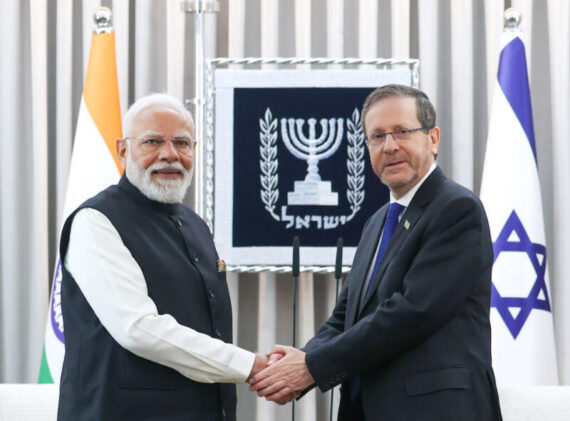
The Iran War began on 28 February, yet Modi was in Israel on 25–26 February. During his visit, which elevated bilateral relations to the level of a special strategic partnership, Modi—greeted as a brother by Netanyahu—stated in the Israeli parliament, the Knesset: “India stands firmly by Israel’s side, both now and in the future.” It remained a matter of speculation whether Modi was aware of the attack launched 1.5 days later. However, this visit and his subsequent prolonged silence on critical issues amounted to a loss of prestige for India and a strategic detriment to its long-term interests. Delhi did not condemn the US and Israeli attacks on Iran, but supported a draft resolution at the United Nations Security Council (UNSC) condemning Iran’s attacks on various Gulf states.
In the Iran crisis, it appears that India’s efforts to remain in the background have pushed it into the sidelines. It is positioning itself through quiet rhetoric rather than action. It is expressing its concerns to Gulf leaders regarding Iranian attacks in the context of the safety of Indian workers, but at the same time, it seems to be opting to turn a blind eye to US and Israeli attacks.
New Delhi is driven by a desire to become a major power. It argues that it is entitled to a permanent seat on the UN Security Council. It is on its way to becoming the world’s fourth-largest economy. At every opportunity, India states that recognizing its global role would also mean giving a voice to the Global South and the developing world, which are currently unrepresented on the UN Security Council. However, this is now highly open to question. A perception has emerged that India is not a neutral player in the conflict, but rather is aligning itself with the US-Israel camp, even if it does not explicitly state so.
The torpedo attack by an American submarine on the Iranian naval vessel IRIS Dena, which had been invited to participate in the MILAN exercise held in Visakhapatnam by New Delhi on 4 March, has made matters even more difficult for the Indian government. Not a single word was spoken to the US. The Indian Navy’s statement made no mention of the attack that sank the vessel or of any regret over the sailors’ deaths. Of course, the ship was outside Indian waters and India bore no legal or political responsibility. However, Delhi had previously gone to great lengths to prove and establish its role as the ‘clear security provider’ in the Indian Ocean region. Yet in this incident, the same Delhi went to great lengths to clarify that the Indian Ocean was not India’s ocean. This formalistic perspective on such a serious incident was, in a sense, an attempt to justify the American action and Delhi’s lack of responsibility.
India, which has expended immense effort to establish itself as the “voice of the Global South”, now faces not only the challenge of safeguarding the image of Global South leadership it has sought to build, but also the handicap of protecting the strategic autonomy it has jeopardized in pursuit of a special relationship with the US and Israel. India’s stance appears to amount to nothing more than hoping the problems will resolve themselves. Just as Venezuelan President Maduro did during his ousting by the Americans in January 2026.
Some circles in India view Delhi’s silent response to the war as a cool-headed calculation aimed at safeguarding the interests of a rising power across multiple fronts. In their view, silence is a legitimate strategic tool when there is no bargaining power. This is theoretically defensible, but there is a difference between an ambiguous silence and principled restraint. Not only did it refrain from condemning the death of Iran’s religious leader, but it even avoided sending an official message of condolence.
The Ministry of External Affairs explicitly instructed all Indian ambassadors in world capitals not to sign any book of condolence opened by their Iranian counterparts without prior authorization from New Delhi. Ultimately, in the face of mounting domestic criticism, the Indian Foreign Minister visited the Iranian embassy to convey his condolences. However, the initial stance went beyond mere silence. This gives the impression that silence was used not as a strategic tool, but rather as a reflexive means to please the US and Israel.
Given its immense interests in the Gulf, Delhi’s choice to remain silent and defend this stance strategically may, in one sense, be a justified position. Yet, in another sense, it is incomplete. For India, Iran is not merely a trading partner. Nor is the issue solely about its energy imports via the Strait of Hormuz. For India, Iran represents a way to bypass the China-Pakistan axis. It is about bypassing Pakistani control in land access to Central Asia.
It is the cornerstone of the International North-South Transport Corridor and the gateway to the Chabahar port. India has invested at least 120 million dollars, diplomatic capital, infrastructure resources and long-term strategic planning into this framework over a period of more than twenty years. And for India, Iran represents a bond extending to cultural ties, as Foreign Minister Jaishankar has noted (for instance, even whilst the British were attempting to conquer the subcontinent, Persian remained at the heart of Indian court life).
Meanwhile, India currently holds the presidency of BRICS. BRICS is a multilateral coalition established with the aim of challenging American financial hegemony. Iran is a BRICS member and enjoys the support of China, Russia and South Africa. Consequently, Delhi finds itself at odds with other BRICS member states, particularly during the year it holds the group’s presidency. It is ironic to lead a multipolar coalition whilst sending mixed signals as if orbiting a unipolar power.
It is true that foreign policy requires caution. However, India has failed to apply this in this crisis. Taken as a whole, although it might be termed ‘strategic silence’, India’s omissions—which show a marked bias towards Israel and the US—are creating the perception that Delhi is on the side of the aggressors in this war. Those with a realistic perspective know that in international politics, words are worthless and actions are more effective than words.
However, one must not overlook the fact that, ultimately, the pressure of US sanctions has strained India’s relations with Iran. It has significantly reduced its oil imports and has almost entirely divested its stake in the Chabahar port. It may have concluded that it must position itself alongside the US, Israel and the Gulf states to maintain its dominance in this war. If so, it must have reached this conclusion at the cost of damaging its future credibility.
Using international diplomacy as a ploy to buy time and lull the Iranians into a false sense of security, the targeted assassination of a president who was not in hiding, false claims regarding the right to pre-emptive strikes, the torpedoing of a ship returning from a fleet inspection, Israel’s occupation of Lebanese and Syrian territory. Delhi has remained silent on all of these. Modi addressed the Knesset, received his medal, and departed with a series of defense-technology agreements. Just 36 hours after returning from Israel, Israeli-US missiles began bombing Iran.
Even without prior knowledge, speculation about a possible US-Israeli attack had been rife for weeks, and the timing inevitably drew attention. Could it be that India had agreed to align its foreign and security policies with American interests? The US Deputy Secretary of State said at the 2026 Raisina Dialogue in New Delhi: “India must understand that we will not make the same mistake with India that we made with China 20 years ago.” In other words, he is saying we will not allow India’s economic development to reach the point where it becomes a commercial rival. Were those who believed Delhi could become a major power by clinging to the coattails of a superpower mistaken?
Recommended
India is no longer a minor player today. It is one of the world’s largest economies. A key defence partner of Israel. The world’s third-largest energy consumer, with a significant portion of its crude oil imports coming from Gulf states. It maintains diplomatic channels operating simultaneously with the US, Russia, Iran, Saudi Arabia and the UAE. It is not a treaty ally of the West. It is not aligned with China’s opposition to the West. When such an actor signals visible closeness to Israel at a time of escalating tension, the diplomatic framework shifts.
It is not difficult to conclude that Modi’s visit to Israel was ill-timed on the eve of war. It is hard to believe that the Indian government was unaware of the impending attack. If that were the case, however, it would expose further shortcomings in Delhi’s intelligence and foreign policy institutions. Whilst Modi’s visit appears to have granted political legitimacy to Israel and Prime Minister Netanyahu, India—once the leader of the non-Western world—seems to have been reduced to an insignificant role, having failed to uphold the moral stance it historically championed.
In any case, New Delhi’s recent stance remains ambiguous. The Iran War is not India’s war. Yet the fact that India is a close neighbor of critical importance to the region’s security and stability is a reality that is largely overlooked, even within India itself. The Iran War has clearly highlighted four things in the Indian context: it is currently in an inadequate position to help bring the war to an end on the international stage; despite its global profile, it still lacks genuine bargaining power; its approach to handling the current crisis has undermined its standing in the Global South; and its standard claims regarding leadership and multipolarity have proved hollow.
The assassination of Iran’s Supreme Leader Ayatollah Ali Khamenei in the US-Israeli attack was one of the most significant geopolitical events of recent years, yet India remained silent. It took Delhi five days to send a message of condolence, and neither the Prime Minister nor the Foreign Minister made a public statement, nor did any senior leader from the government acknowledge the assassination.
No condemnation was issued regarding the sinking of an Iranian vessel by an American torpedo and the deaths of over 70 naval cadets. Silence prevailed over the bombing of a school in Minab, which resulted in the deaths of 165 civilians, most of whom were girls aged between 7 and 12. Taken together, this silence actually screams one thing: India has raised its global profile but not its influence; it has befriended everyone but failed to influence anyone. New Delhi’s muted response has now cast a huge question mark over its willingness and ability to play a significant role in such crises.

Dr. Duygu Çağla BAYRAM is Ankara-based India specialist. She has a PhD in Int'l Relations and is the author of New Course in Turbulent Waters.
You can see how this popup was set up in our step-by-step guide: https://wppopupmaker.com/guides/auto-opening-announcement-popups/

Stay informed by subscribing to
our weekly newsletter.
You can see how this popup was set up in our step-by-step guide: https://wppopupmaker.com/guides/auto-opening-announcement-popups/
You can see how this popup was set up in our step-by-step guide: https://wppopupmaker.com/guides/auto-opening-announcement-popups/
You can see how this popup was set up in our step-by-step guide: https://wppopupmaker.com/guides/auto-opening-announcement-popups/
You can see how this popup was set up in our step-by-step guide: https://wppopupmaker.com/guides/auto-opening-announcement-popups/