Israel-US Attacks, Iran Retaliation Close Gulf Airspace
Data from FlightAware showed nearly 2,800 cancellations on Saturday and more than 3,400 flights scrapped across the Middle East region’s seven main airports on Sunday.
March 4, 2026
T
he escalating confrontation between Israel, the United States and Iran has forced sweeping airspace closures across the Gulf region, severely disrupting global aviation networks centered on some of the world’s busiest transit hubs.
In the early hours of February 28, Israel and the U.S. launched joint airstrikes against targets inside Iran. Tehran responded with strikes targeting U.S. military bases and logistical facilities in several Arab countries, prompting widespread airspace restrictions across the Middle East.
According to Flightradar24, airspace over Iran, Iraq, Israel, Qatar, Bahrain, Kuwait and Syria was largely closed as of Monday, while parts of the UAE and Saudi Arabia remained only partially open.
Abu Dhabi Airports reported in a now-deleted post on X that an incident at Zayed International Airport left one person dead and seven others injured, underscoring heightened security concerns at key aviation facilities.
The European Union Aviation Safety Agency declared a “high risk to civil aviation” across the region, advising airlines to exercise extreme caution when operating near conflict zones.
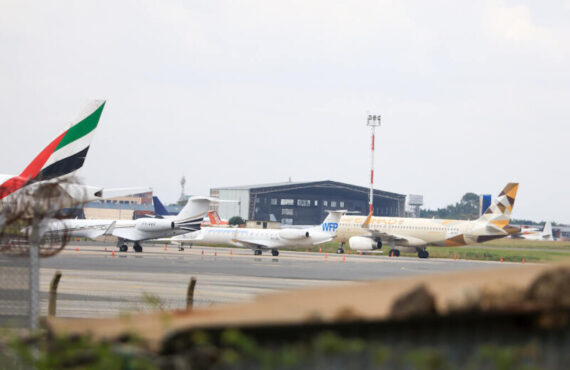
The closures have grounded thousands of flights, delivering the most acute shock to global aviation since the COVID-19 pandemic.
Aviation analytics firm Cirium said more than 2,000 flights to the Middle East were canceled on March 1 alone — roughly half of scheduled operations for that day. Data from FlightAware showed nearly 2,800 cancellations on Saturday and more than 3,400 flights scrapped across the region’s seven main airports on Sunday.
Dubai International Airport — the world’s busiest airport for international passenger traffic — handled 92.3 million passengers in 2024. Emirates carried 43.6 million passengers in the 12 months prior to the war. Together with Qatar Airways and Etihad Airways, the three Gulf carriers typically manage around 90,000 daily transit passengers through their hubs.
All three airlines initially suspended operations as airspace closures took effect. Emirates and Etihad paused most scheduled services, operating only limited special flights such as repatriations while awaiting safe airspace clearance. Qatar Airways suspended flights to and from Doha pending confirmation from Qatar’s Civil Aviation Authority that airspace is safe to reopen, with an update expected on March 4.
Israel’s national carrier, El Al, also canceled scheduled flights amid the closure of Israel’s airspace.
Recommended
The disruption has spread far beyond the Gulf.
Airlines across Asia and Europe have rerouted or suspended services to avoid closed corridors. Air India halted flights from Delhi, Mumbai and Amritsar to major European and North American destinations and suspended services between India and several Middle Eastern cities.
Singapore Airlines and its low-cost unit Scoot canceled Middle East services through March 7, while Lufthansa Group suspended operations to multiple regional cities until March 8.
Air France and KLM also paused services to several Gulf destinations.
The Guardian reported that 115,000 Australian travelers were affected by the disruptions, while FreightWaves said Qatar Airways was unable to move roughly 13 tons of daily cargo capacity due to the suspension of operations.
According to Insurance Business, rerouted services are adding 30 to 90 minutes to certain long-haul routes. The extended flight times are driving up fuel consumption and maintenance expenses at a time when operational costs have already climbed sharply in recent years.
With Gulf hubs such as Dubai, Doha and Abu Dhabi serving as vital bridges between Europe, Asia, Africa and Oceania, prolonged closures risk compounding economic losses and further straining global supply chains as the regional conflict shows no immediate signs of de-escalation.
(Source: Anadolu Agency)

Politics Today is dedicated to publishing insightful analyses in order to understand the changing nature of contemporary politics. It aims to contribute to the sound and constructive discussion of international affairs.
You can see how this popup was set up in our step-by-step guide: https://wppopupmaker.com/guides/auto-opening-announcement-popups/

Stay informed by subscribing to
our weekly newsletter.
You can see how this popup was set up in our step-by-step guide: https://wppopupmaker.com/guides/auto-opening-announcement-popups/
You can see how this popup was set up in our step-by-step guide: https://wppopupmaker.com/guides/auto-opening-announcement-popups/
You can see how this popup was set up in our step-by-step guide: https://wppopupmaker.com/guides/auto-opening-announcement-popups/
You can see how this popup was set up in our step-by-step guide: https://wppopupmaker.com/guides/auto-opening-announcement-popups/