
Kast’s Praise for Pinochet Sparks Debate in Chile
A 2023 survey by the polling firm Mori Chile found that more than one-third of Chileans believe the 1973 coup that brought Pinochet to power was justified.
March 12, 2026
C
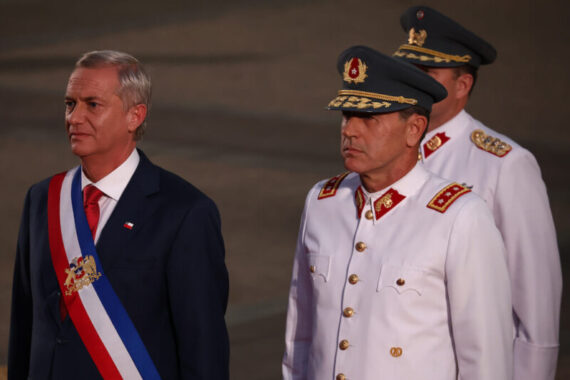
hile’s newly inaugurated president, José Antonio Kast, has reignited debate about the country’s authoritarian past after expressing admiration for former military ruler Augusto Pinochet.
Kast was sworn in on March 11 in Valparaíso after winning December’s presidential runoff with more than 58 percent of the vote — the largest vote total in Chilean electoral history.
The symbolism of his inauguration drew attention even before the ceremony. In an official portrait released weeks earlier, Kast wore a presidential sash bearing a coat of arms not used by Chilean presidents since Pinochet’s rule.
Pinochet governed Chile from 1973 to 1990 after leading the 1973 Chilean coup d’état that overthrew democratically elected president Salvador Allende. His regime was responsible for widespread repression, with more than 3,000 people killed or disappeared and thousands more imprisoned, tortured, or forced into exile.
Kast has long been associated with a sympathetic view of the former dictator. In past campaigns he suggested that Pinochet, if alive, would likely have supported his candidacy. Critics say that admiration is also reflected in his political alliances and cabinet appointments.
Among those named to his government are lawyers who previously defended Pinochet, including Fernando Barros as defense minister and Fernando Rabat as minister of justice and human rights.
Felipe González Mac-Conell, author of Kast: The Chilean Far-Right, says the new president’s political agenda echoes elements of the Pinochet era, including neoliberal economic policies and a strong emphasis on law-and-order measures.
“What has permeated his political project is a vindication of the cultural values and economic model associated with the dictatorship,” he said.
Despite the controversy surrounding Kast’s views, analysts say his electoral success cannot be explained simply by nostalgia for authoritarian rule.
Instead, many voters appear to have supported him out of frustration with Chile’s political system and economic conditions in recent years. The country has experienced rising crime concerns, social unrest and political polarization.
Discontent grew during the presidency of Kast’s predecessor, Gabriel Boric, whose ambitious reform agenda faced political resistance and economic challenges.
Kast capitalized on those frustrations by campaigning on promises of stronger security policies, tighter immigration controls and economic stability. His Republican Party positioned itself as a harder-line alternative to both the left and the traditional conservative establishment.
Jose Alejandro Godoy, a Peruvian political scientist studying democratic backsliding in Latin America, says Kast’s rise reflects a broader regional trend in which voters turn toward strong leadership when they lose faith in traditional politics.
“People feel politics is not improving their lives,” Godoy said. “In that environment, leaders who promise order and decisive action become attractive.”
Similar dynamics have appeared elsewhere in Latin America. In Brazil, former president Jair Bolsonaro openly praised the country’s past military dictatorship, while in Argentina, President Javier Milei has minimized some of the abuses committed during that country’s military rule.
Recommended
Chile remains deeply divided over the legacy of Pinochet. A 2023 survey by the polling firm Mori Chile found that more than one-third of Chileans believe the 1973 coup that brought the general to power was justified.
Supporters of Kast argue that references to Pinochet reflect admiration for the economic reforms introduced during his rule, which helped transform Chile into one of Latin America’s most market-oriented economies.
Critics, however, warn that glorifying authoritarian figures risks weakening democratic norms and respect for human rights.
“The concern,” Godoy said, “is that societies may begin to trade civil liberties for promises of security and order.”
As Kast begins his presidency, Chile now faces the challenge of addressing public demands for stability while safeguarding the democratic principles that have guided the country since the end of Pinochet’s rule in 1990.
(Source: Aljazeera English)

Politics Today is dedicated to publishing insightful analyses in order to understand the changing nature of contemporary politics. It aims to contribute to the sound and constructive discussion of international affairs.
You can see how this popup was set up in our step-by-step guide: https://wppopupmaker.com/guides/auto-opening-announcement-popups/

Stay informed by subscribing to
our weekly newsletter.
You can see how this popup was set up in our step-by-step guide: https://wppopupmaker.com/guides/auto-opening-announcement-popups/
You can see how this popup was set up in our step-by-step guide: https://wppopupmaker.com/guides/auto-opening-announcement-popups/
You can see how this popup was set up in our step-by-step guide: https://wppopupmaker.com/guides/auto-opening-announcement-popups/
You can see how this popup was set up in our step-by-step guide: https://wppopupmaker.com/guides/auto-opening-announcement-popups/